
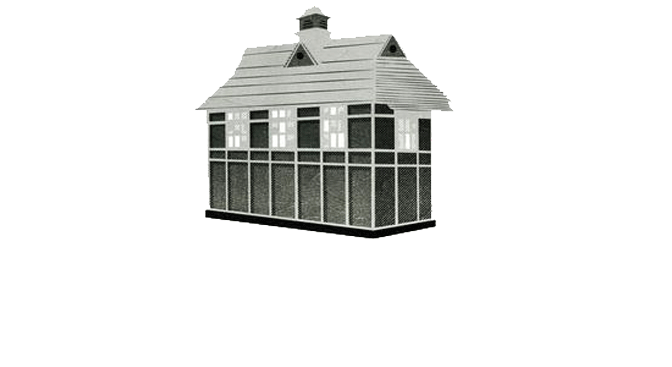
Kensington Park Road
The Kensington Park Road shelter which started life here in 1877 is an anomaly. Today this is upwardly mobile Notting Hill Gate frequented by film-makers.
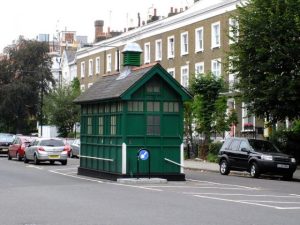
Three decades before the arrival of the shelter, an 1849 report described most houses as ‘merely hovels in a ruinous condition’ and ‘filthy in the extreme’. A medical officer reported that it was ‘one of the most deplorable spots, not only in Kensington but in the whole metropolis’. Life expectancy was just 11 years 7 months compared with the London average of 37.
Just after the last war, the area was still one of the most deprived in the capital as related by Alan Johnson in his memoir This Boy.
Another curiosity is the road’s name – Kensington Park Road – as far as I’m aware, the nearest Kensington Park is in Romford, so this thoroughfare doesn’t take you there or provide a means of leaving the park.
Notting Hill is the sort of place where an orange Fiat 500 is in a shop window displaying pizzas, or sewing machines are stacked floor to ceiling in a frock shop window.
I’m feeling comfortable in some parts around here, but travel north and it’s a different matter.
One of my first bilkers ran away without paying in Portland Road, which has a barrier half-way up the road, acting as a demarcation boundary marking the start of a no-go area.
Kensington Road
This shelter is located on a road that actually takes you to where it promises.
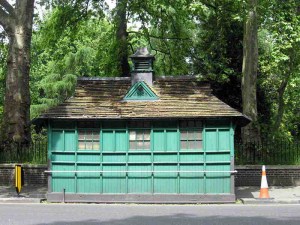
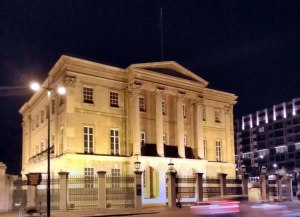
Conveniently situated by some conveniences, it is almost opposite the Albert Hall near to the site of the Great Exhibition of 1850, cabbies call it the ‘All Nations’ referring to the diversity of visitors attending the famous Victorian spectacle.
Striding off towards Scotch Corner I pass the now restored Albert Memorial. Next on my right is, or what was once the Iranian Embassy. On 5 May 1980, Britain realised it had an elite force when the SAS successfully stormed the terrorist-held embassy in Princes Gate after one of the hostages was killed and his body thrown out of the embassy. The soldiers later faced accusations of unnecessarily killing two of the five terrorists, but an inquest into the deaths eventually cleared the SAS of any blame. When I first started driving a cab around London, this building was still a burnt-out shell.
Further down the hill the road now changes its name – to Knightsbridge, thereby giving the lie that Harrods is in Knightsbridge, it’s actually in the more prosaically named Brompton Road, which does go to Brompton.



 On 11 October 1919 on a flight from London to Paris passengers enjoyed the first in-flight meals – lunch boxes a three shillings (15p) each
 HMP Pentonville built in 1842 at a cost £84,186 12s 2d was intended to be a holding prison for convicts awaiting transportation
 Cowcross Street is so named after the cows crossing on their journey to the slaughterhouses and butchers at Smithfield Market
 Idol Lane, off Great Tower Street was formerly Idle Lane denoting an area of the city where loiterers would congregate
 Christ Church Lambeth’s spire is decorated with stars and stripes commemorating the abolition of slavery, half the cost was borne by America
 The album cover for David Bowie’s The Rise and Fall of Ziggy Stardust and the Spiders from Mars was shot outside 23 Heddon Street
 Tossing the pie which apprentice boys tossed a coin to win a pie, if the pieman won he kept the 1d and the pie, losing he gave the pie away
 On 11 October 1940 Centre Court at Wimbledon was hit by five 500lb German bombs, 16 bombs hit the club during the war
 Transport for London Byelaw 10(2): No person shall enter through any train door until any person leaving by that door has passed through it!
 Friday Street (Fridei Strete in 12th Century) was named after the Friday market of fishmongers selling fish in memory of Good Friday
 Covering in total 620 sq miles London is the biggest city in Europe and with 4,699 people per sq kilometre has Britain’s highest density
 CabbieBlog