
Tag Archives: River Thames
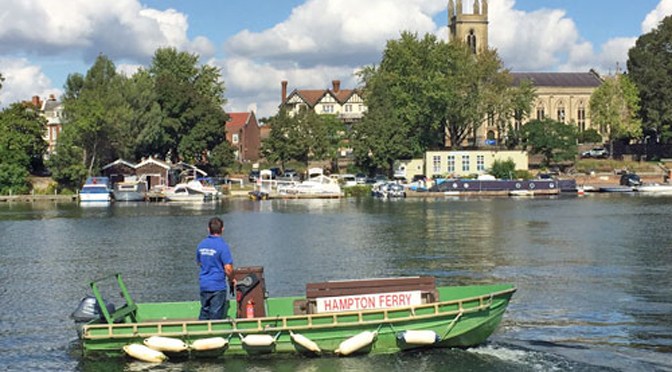
London’s oldest ferry
Lately, on CabbieBlog, we’ve had London’s oldest flyover and the oldest bridge still in use.
For many years the medieval London Bridge was the only means to cross the River without using a boat. The footprint of these past ferries remains, Horseferry Road, Westminster, numerous Ferry Lanes, Tottenham, Dagenham, Haringey and East and West Ferry Roads on the Isle of Dogs.
So where are London’s oldest working ferries? Well, there are only two contenders, the free ferry service at Woolwich and Hampton’s ferry.
Since at least the 14th century there has been a ferry service on the Thames running between Woolwich North to the south bank at Woolwich. In 1810 the army established its own ferry that ran from Woolwich Arsenal to Duvals Wharf. In 1811 an Act of Parliament was passed to establish a ferry across the Thames from Woolwich. In 1889 a free passenger and vehicle ferry service started operation. By the early 1960s, increasing demand saw the paddle steamers retire and the ferry service upgraded to a roll-on/roll-off model. It is currently run by Transport for London.
Another still operational ferry service is the Hampton Ferry, which can only transport pedestrians, operating on the Thames about a mile west of Hampton Court Bridge between Hampton on the north bank and Hurst Park, Molesey, on the south bank.
Dating from 1514 it provided a service for agricultural workers and fishermen. It was incorporated by statute, making it one of the oldest British companies. The ferry, which costs £2 for a single crossing, operates from April to October.
Featured image: The Hampton Ferry by DiamondGeezer (CC BY-NC-ND 2.0)
Protected: Did you know there are two River Thames?
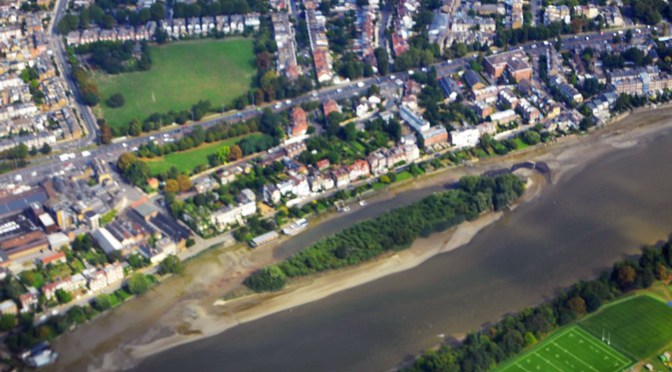
The Thames eyots
One of the conundrums when working as a London cabbie is, just where do you stop for lunch? The public’s perception that we all meet at a convenient diner is true for some, but where do you take your break if you’re on the other side of London?
One of my favourite watering holes, in more ways than one, was Chiswick Mall with its Georgian and Regency houses strung out along the River Thames.
Opposite these houses in the river is the Chiswick Eyot, the first major island you come to in the Thames if you’re travelling up from central London.
This island is an eyot, one of 120 islands in the Thames, each with its unique character and atmosphere, some have many people living on or around them in bungalows or houseboats, but like the Chiswick Eyot, some are completely uninhabited and are all the more mysterious for it.
The Chiswick Eyot is a protected nature reserve, and can completely flood on the fast-moving high tides – there are warning signs planted there telling you so. With permission at low tide, you could wade out to the eyot, but even then it would be at your own risk of the tide advancing.
At low tide, the island rears up before you, with a long raised bank around this four-acre lump of land covered at one end with clipped willow trees that once grew on many of the Thames islands. The willows were used to make baskets for the London markets and crayfish pots. This is the last place where basket makers still come across and cut them anywhere on the Thames, keeping alive an ancient craft.
The island is incredibly unstable, such is the force of the Thames’s tides that it is subject to continual erosion, and if it wasn’t for the work of volunteers who have helped to shore up its banks, it would have been washed away by now. This means that historically the island was much larger. Even today it’s constantly in danger of falling apart completely.
Unfortunately, the island is also being invaded by Chinese Mitten Crabs, a species of crab thought to have been introduced to the Thames estuary about 1935, arriving here as a by-product of intercontinental shipping by clinging onto the hulls of ships. The crabs burrow into muddy banks and create complex interconnected burrows. The consequences for Chiswick Eyot are potentially disastrous, as the crabs’ burrowing loosens the mud around the eyot, and when the tide flows in and out, the earth is washed away, steadily eroding the island over time.
Featured image: The Chiswick Eyot. The River Thames rises at Thames Head in Gloucestershire on the slopes of the Cotswolds and flows generally eastward to its mouth near Southend in Essex. At 215 miles long it is one of the longest rivers in Britain and the longest entirely in England. It is one of the most important rivers in Britain by N Chadwick (CC BY-SA 2.0)
 CabbieBlog