Tag Archives: London’s roads

Crossing roads

I‘ve written before about there being ‘no roads in The City’, and recently I’ve found that one examiner could ask Knowledge students: “Take me from Victoria Station to Chelsea Football Club, without going through any traffic lights”.

Well, cobbling together these two concepts, and including a project from Victor Keegan, a serious walker who has plotted a walk from Trafalgar Square to Greenwich, without crossing over a single road, I’ve come up with this project.

Is it possible to go from Charing Cross (the epicentre for The Knowledge) and get to Greenwich (home of the Meridian Line which started modern navigation), without crossing a single road?

Starting on Charing Cross, the road, not the station, which is at the western end of Northumberland Avenue turn right into Strand and head down for 100 yards. Turn right and go through Charing Cross Station (passing another Charing Cross in the station’s forecourt) and across Hungerford Bridge until you are on the South Bank. Turn left and continue the riverside walk until reaching Tower Bridge. Cross the bridge and hug the river around St Katharine Docks carry walking on further until you come to Island Gardens at the tip of the Isle of Dogs. This last stretch was the most tricky. Officially you’re on the Thames Path when you cross Wynan Road. The Thames Path leads you on to the Greenwich Foot Tunnel, then using the King William Walk, footpaths take you to the Meridian Line and your destination.

Featured image: Northumberland Avenue Looking west towards Trafalgar Square by Chris Downer (CC BY-SA 2.0 DEED)

ULEZ has arrived

After much hype by the Mayor’s office and objections by many, including low-paid shift workers, ULEZ has finally arrived with its Big Brother cameras now covering Greater London.

So let’s go through the arguments, first the scheme’s supporters:

• I don’t care because I don’t have a car.
• If I had a car it would probably be compliant anyway, most are.
• The new ULEZ zone will be the existing LEZ zone… which doesn’t quite cover the whole of London, so you’ll still be able to belch around Chingford or sputter along Farthing Downs to your heart’s content.
• Trying to gather accurate data on the existing ULEZ has been skewed by the pandemic, fuel shortages and the soaring cost of petrol, making conclusions harder to draw.
• Currently only 6 per cent of vehicles driving in the ULEZ are non-compliant, so only a small number of people are about to be shafted (but it’s 17 per cent of vans, so expect White Van Men to be angriest).
• The mayor’s office estimates that only an additional 135,000 vehicles a day will be affected by the extension of the ULEZ. For comparison, on an average day, London residents make 6 million journeys by car.
• If you drive daily then £12.50 a day is £4,500 a year. You could buy a replacement vehicle for that (which is probably the point).
• Londoners receiving certain means-tested benefits and disability benefits can apply for grants of up to £2,000 to scrap their non-compliant cars or motorcycles, so it’s not the cruel draconian scheme it could be.
• It’s not hard to get Londoners breathing ‘cleaner air’, even removing one car does that. What’s hard is making a significant difference.
• Brilliant, bring it on, the fewer polluting cars the better.

…and the arguments against:

• It’s ghastly that air pollution contributed to the death of that child the Mayor’s always going on about, but cars hitting things kill far more people.
• If ‘air pollution is making us sick from cradle to the grave’, then I have 76 years of breathing I ought to be able to sue someone for.
• If I genuinely wanted to reduce my exposure to toxic air the simplest solution would be to move out of London.
• The mitigation regarding ‘the biggest ever expansion of the bus network in outer London’ is mostly spin because hardly anyone’s going to live in the right place to make use of them. e.g. the first example on the list is ‘improved links between Harold Hill and Upminster’, a journey currently made by London’s least frequent bus, so nobody needs that.
• In Havering, where I live, no trains, no black cabs driving down our street, and all bus routes go in the same direction.
• The Mayor’s new scrappage scheme will include the option to get two annual bus passes, which at £464 a year isn’t exactly generous.
• Anyone who sends moaning letters to local newspapers saying “it’s just another Khan tax on the motorist, we need to remove all the bus lanes instead” should be forced to pay £12.50 anyway, as a cabbie that’s my opinion.
• If air pollution is as ghastly as the Mayor now claims, why has he taken seven years to implement this?
• If I had a non-compliant vehicle I’d be absolutely pissed off by the prospect of a £12.50 daily charge or forking out for a new vehicle during a cost-of-living crisis.
• Most households in the current ULEZ don’t have a car but most households in the extension do, so this is going to be a lot less popular.
• It’s not exactly surprising that ‘there are more deaths attributed to toxic air in the city’s outer boroughs’ because 1½ million more people live there.
• The M11 and M25 aren’t included but the M1 and the M4 are, plus you’ll be charged if you try to drive into Heathrow.
• I wonder how many one-off visitors to London are going to find themselves stung by an unexpected £180 fine.
• The first ULEZ expansion was announced with over a year’s notice, this one’s had only nine months.
• Just how are low-paid shift workers going to get home during the night?
• With most cars being replaced before they’re 10 years old, it wouldn’t have taken long before we were all-electric, without ULEZ’s additional costs.
• Surely more pollution will be created by scrapping millions of cars, but as this will occur away from London, I suppose that’s the point.
• If the Mayor want to display his green credentials, why hasn’t he allowed serviceable black cabs to be converted by Clipper Cabs to electric?

The road that didn’t exist

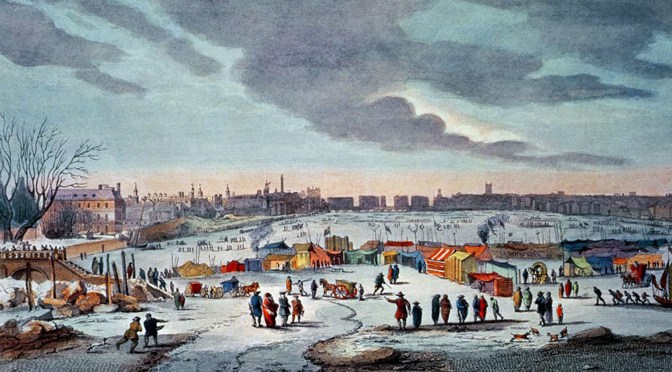
There is a real street in London that never actually existed, in the sense that one minute it wasn’t there, then it was, and then it was gone again.

It was called Broad Streete, and it appeared on 8th January 1683 in, what is, the most central part of the city. A great many shops opened on it, many thousands of people visited and traders arrived, a bullring was built and there were games and displays of strength and skill. Oxen were roasted and drink was sold, and a great time was had by all along its length.

Broad Streete could only be built because between the 14th and 19th centuries the Thames froze solid more than a dozen times. John Evelyn describes the street thus: “The ice was now become so incredibly thick, as the beare not onely whole streets of boothes in which they roasted meate, & had divers shops of wares…but coaches and horses passed over.”

In early January 1683, the Thames had frozen to a thickness of almost a foot and stayed that way for two months. At other times the ice grew to several feet thick, especially between Blackfriars and London Bridge. There are various reasons for the existence of Broad Streete. One was the ‘Little Ice Age’ that hit England, another was that the Thames had yet to be embanked, so it flowed more slowly and was prone to icing over. At that time London Bridge has several supports, called starlings, sunk into the river bed which also slowed the flow.

Rapid thaws sometimes caused the loss of life and property. In January 1789, melting ice dragged away a ship that was anchored to a riverside pub, pulling the building down and causing five people to be crushed to death.

In the pedestrian tunnel under the south bank of Southwark Bridge, there’s an engraving by sculptor Richard Kindersley made of slabs of grey slate, depicting a frost fair.

The global climate grew milder, the river was banked and flowed faster, and that was the end of Broad Streete.

That is until we get more climate change.

Five Curious Corners

London has many major junctions with folkloric names, I should know I had to learn them. Many recall past businesses, ancient coaching inns or an association with local characters. Here are five of those often heard on radio’s traffic reports.

Kosher Crossing

Henleys Corner, at the junction of the North Circular Road and the A1 gets its name from the Henleys Group garage which sat at the junction from 1935 to 1989. In October 2011, Britain’s first ‘hands-free’ pedestrian crossing here so that the local Jewish community did not have to use electricity or operate machinery. Traffic is held every 90 seconds over this duration (sunset Friday to sunset Saturday), with foot traffic principally to and from the Kinloss Synagogue.

Replacement windows

Francis Berrington Crittall started his eponymous company in 1849, but it wasn’t until 1884 they started making their famous metal windows which even found their way on to the Titanic. The company has always been based around Braintree in Essex, so it is a bit of a mystery why a roundabout on the A20 near Sidcup where one of their factories stood on its north-west corner should have been given the accolade of Crittalls Corner.

To kill a cow

Gallows Corner is named after a nearby execution spot, not far from a notorious spot frequented by highwaymen, which ably served the local community’s hanging needs from the 16th to 18th century. The ‘temporary’ flyover here was erected in just five nights in January 1970 it’s still in use. In 1932, a Metropolitan Police car collided with a cow at the junction. The animal was so badly injured it had to be destroyed. It was, in all probability, the last time the authorities had to sanction an execution at Gallows Corner.

Convoluted chaos

By any stretch of the imagination, you couldn’t call Staples Corner, a corner. It has two linked roundabouts and flyovers connecting the North Circular Road, Edgware Road and M1, between the two roundabouts are the Midland Main Line and Thameslink, with Dollis Brook running underneath towards the Brent Reservoir. In the past, a B&Q store here has been blown up by the IRA and once had two runaway trains crashing down onto the North Circular Road. The junction is named after a mattress factory, which lasted from 1926 until 1986, then improbably, it’s since been replaced by another Staples, this time a vendor of office supplies.

Missing moniker

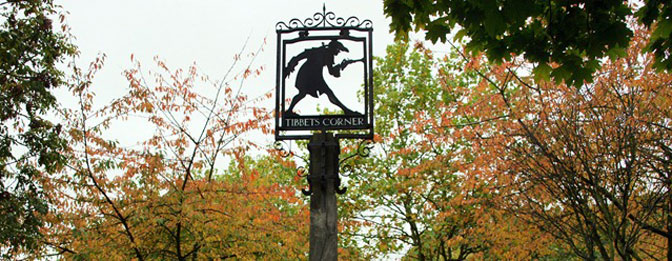
At the top of Putney Hill is a sign depicting a skulking highwayman wearing a long-brimmed hat and brandishing a pistol, obviously intent on surprising his next victim, celebrating the memory of a famous highwayman who used to frequent the then lonely wastes of Putney Heath. While Tibbets Corner was the haunt of criminal ne’er-do-wells and malcontents eager to relieve wealthy road users of their valuables there is no record of a highwayman by that name operating anywhere near the spot. Prosaically Tibbet was the name of the gate-keeper at the entrance to Lord Spencer’s estate.

London’s Corners

Apex Corner
Birchwood Corner
Canons Corner
Chalkers Corner
Crittalls Corner
Dovers Corner
Fiveways Corner
Frognall Corner
Gallows Corner
Gillette Corner
Gipsy Corner
Harlington Corner
Henlys Corner
Highbury Corner
Hobart Corner
Hyde Park Corner
Malden Corner
Ruxley Corner
Shannon Corner
Staples Corner
Stirling Corner
Tibbets Corner
Waterworks Corner

Featured image: Tibbet’s Corner Sign by Tristan Forward (CC BY-SA 2.0)