
Tag Archives: London cabs
Bills, badges and blights
Cabbies refer to their authorisation to ply for hire as their ‘Bill and Badge’. The badge is pretty self-evident as it hangs around their necks. Their bill or paper licence is thought to refer to the ‘bill of health’, which is very pertinent in today’s pandemic.
Another nod to the health of Londoners is that it was once supposedly illegal for people to hail a cab while suffering from the bubonic plague. This is still partly true, as the Public Health (Control of Disease) Act of 1984 requires a person suffering from a notifiable disease to inform the cab driver, who may then decide whether to ferry the passenger. If he does so, he is then required to notify the authorities and disinfect the cab before taking another fare.
More drivers than vehicles
Since Oliver Cromwell first licensed cabbies there has always been more drivers than available vehicles, in recent times some cabs were ‘doubled-up’ which allowed the cabbies to pay a reduced rent. In the past, all vehicles and the horses were owned by the proprietor who rented them out to many drivers. Today (much like the author) many badges have been retained but not used to ply for hire.
As the only restriction to becoming a London cabbie, irrespective of the licenses in issue at the time has been The Knowledge, therefore there has always been an excess of drivers. Last year, for example, there was 20,136 licensed cabs and 23,159 cabbies.
In the past, in London, the gulf between drivers and vehicles was even greater. For instance, in 1986 there were 14,000 licensed cabs and 19,000 licensed drivers while by 1996 there were 17,000 licensed cabs and 22,000 licensed drivers.
Recent records show the disparity has reduced and averages in the region of about 10 per cent more drivers than available cabs.
Available cabs plummet
But since the coronavirus pandemic, the number of taxis licensed in the capital has plummeted from 18,900 on 7 June to 15,000 on 8 November according to Transport for London.
The London Taxi Drivers Association believe that only 20 per cent of cabbies are plying for hire, which equates to about 4,500, while rental firm, Sherbet London, has hired a car park to help store 400 unoccupied cabs, representing two-thirds of its fleet, its chief executive Asher Moses has estimated 2,000 taxis are standing in fields at the moment, so they are exempt from insurance and road tax.
The last post
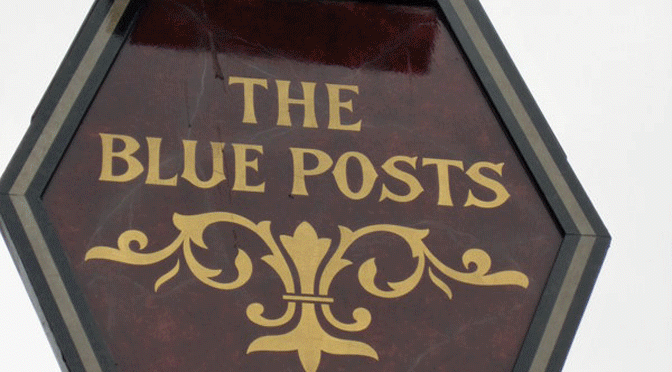
Have you noticed the preponderance of pubs named the Blue Posts? A simple tally shows at least five plus, as is inevitable in London nowadays, there are others which have closed to allow yet more ’executive apartments’ to be built.
For many years it was thought that while barber/surgeons sported a red and white striped pole outside their premises, a pair of blue posts denoted that this was a sedan rank.
So how many blue posts pubs are, or were, in London?
Cowcross Street (now called Jacomo’s); Berwick Street; Rupert Street; Kingly Street (now a gastropub); Hanway Street (closed); Old Bond Street (called Two Blue Posts, now closed); Cork Street (called Old Blue Posts, a famous dining room, closed in 1911); Newman Street and Shoe Lane. The Blue Posts in Bennet Street has the following sign hanging above this St James hostelry featuring a sedan chair and two brilliant-blue bollards:
Although the existing ’Blue Posts‘ replaces the one which was destroyed during World War II, a pub of this name, on this site, was mentioned by the Restoration dramatist George Etheredge as early as 1667. The poet Lord Byron lived next door in 1813. The ‘Blue Posts’ (two azure painted poles) once stood in the tavern’s forecourt and served as an advertisement for a fleet of sedan chairs which used to ply for hire in Bennet Street.
In 1634 the first rank for horse-drawn cabs was the brainchild of Captain John Baily, situated on the Strand near Somerset House. Unlike the old sedan ranks with their tiny blue posts this nascent rank was next to a 100ft maypole, no wonder they usurped the sedan chairs.
Horse-drawn vehicles for private hire had been around in one form or another since medieval times. But no one had attempted to operate from a designated waiting place, or rank, until the 17th century, pioneer Captain John Baily, was a veteran of one of Sir Walter Raleigh’s expeditions.
He managed a rank of four horse-drawn carriages, Baily’s cabmen wore a distinctive livery and charged customers a fixed tariff depending on the distance. The rank was positioned close to the Strand maypole, a prominent medieval landmark. This towered 100ft high, making it one of the tallest structures in London at the time. It must have made the cab rank very easy to find.
Baily’s cab rank scheme appears to have worked well, and others soon appeared. The cab profession was given official approval in 1654 when one of the first Acts of Parliament under Oliver Cromwell set up the Fellowship of Master Hackney Carriages, under the control of a court of aldermen in the City of London, and initially restricted to 200 cabbies.
Featured image: The Blue Posts on Eastcastle Street by Ian S (CC BY-SA 2.0)(CC BY-SA 2.0)

A (very) brave new world
In the 1970s or early 1980s car stickers started to appear on the rear of vehicles, with the wording:

Designed by computer
Built by robotDriven by an idiot

It was a parody of a successful advertising campaign for a car manufacturer whose model I cannot remember, but no doubt somebody might.
This mantra proved prescient and has stuck with me over the years, never more so, as the digital age has taken over our lives and seeing robots on an assembly line is regarded as the norm, and for the third line ‘Driven by an idiot’ could as easily be applied to many motorists driving in London today.
If you could take humans out of the equation, so the theory goes, the roads would be a safer place, and the subsequent reduction in overheads (the drivers) would be of huge interest to the likes of Uber.
That ambition of driverless cars has now become a reality thanks to the work, over many years, conducted at Warwick University. As soon as next year Jaguar is predicting their ‘Robocar’, a rectangular electric vehicle not dissimilar to the familiar electric cab could hit London’s streets.
With a top speed of 75mph and a range of 190 miles between charges, it can transport up to six people anywhere in London, and beyond.
The recent storms proved that this technology can save lives when two Tesler cars independently braked to avoid falling trees in the recent storm, thus saving the passengers from injury or death. These life-saving events help the argument that autonomous and computerised cars are far safer than human-driven vehicles as robots don’t drink drive, fall asleep, watch the passing landscape, or use their phone or i-pad whilst negotiating London’s complex streets.
Not until artificial intelligence has the ability, will these vehicles be likely to confront other artificial intelligence-led vehicles with road rage.
In the race to become a world-leader in autonomous technology, already the Department of Transport has been tasked with drawing up a digital Highway Code thus enabling self-driving cars on to the Capital’s roads by next year.
As the adage goes: ‘The most dangerous part of any car is the nut behind the wheel.’
 CabbieBlog