There are dozens of books devoted to London’s history, I should know I’ve dozens of them. But I doubt you’ll find a better-designed one, for if it was larger it could be described as a coffee table art book. Each entry is precisely the right length to create a harmonious balance with the headings and illustrations. For example and probably unnoticed by many readers, Jack and Katharine’s biographies occupy exactly the same number of lines. For this graphic design geek, it was perfect symmetry for me.
The square format fits perfectly with Jack’s bite-sized descriptions detailing discoveries he’s found in the capital. Many of the entries are illustrated with delightful watercolours by Katherine Fraser, each positioned perfectly within the text.
As a Licenced London cabbie much was known to me, but that didn’t temper the enjoyment of reading, the entries proving Jack’s superior knowledge as he’s found some, for me, previously unknown gems. Who knew 10 Downing Street had yellow bricks? The building was thought to be black, but London’s pollution had discoloured the bricks. When cleaned in the 1950s it was thought not to look prime-ministerial enough so was painted black. Or that Cavendish Square also has an empty plinth once occupied by Prince William, Duke of Cumberland’s statue, it was taken down after the public discovered he had mercilessly crushed the Highlanders. In 2012 the Duke’s effigy was reproduced in soap and allowed over time to dissolve.
At the end of each section is a short walk taking in much of the features described, the size of the book allows the map and itinerary to be photocopied to fit onto an A4 sheet to put in your pocket, rather than carrying the book around London.
As you would expect all entries have been indexed, but curiously an additional list of postcodes with their locations within the book is also included.
If you wish to own just one reference about London, you could do no better than purchasing this sumptuously produced book.
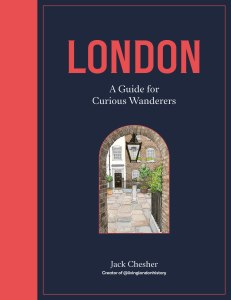
London: A Guide for Curious Wanderers by Jack Cheshire, with illustrations by Katherine Fraser
*Bimble (intransitive verb): Originating in the 1980s; to amble at a leisurely pace, to walk with no particular haste. Frequently associated with military slang, ‘bimble’ has become a part of the informal English language. It conjures up the notion of a relaxing stroll to fetch the Sunday papers, a ‘turn around the grounds’, or a pleasant summer stroll..
This is not a sponsored post. The publication reviewed has been kindly donated by the author or publisher. CabbieBlog has not received payment for writing this review and opinions are solely his own. All links here conform with guidelines set out in Write a Post.


 CabbieBlog