Previously Posted: A Cabbie’s View of London

For those new to CabbieBlog or readers who are slightly forgetful, on Saturdays I’m republishing posts, many going back over a decade. Some will still be very relevant while others have become dated over time. Just think of this post as your weekend paper supplement.

A Cabbie’s View of London (19.10.12)

As any artist, writer or photographer will tell you, professionally they will observe the world around them in ways that others can take for granted, it is that same attention to detail that’s needed when one undertakes “The Knowledge”, the qualification required to become a London cabbie; every street, club, bar, church, hotel and even blue plaque must be committed to memory.

In pursuit of all these facets of London the Knowledge student discovers that there is more to London than is apparent at first sight. Just like a writer they stop looking at the features of London in isolation and try to put them into some context linking them together and discovering their relation to London’s history and its people.

The Knowledge was introduced in 1851 after complaints by visitors to the Great Exhibition that cabbies didn’t know where they were going, now after 160 years we are regarded as the world’s finest taxi service. But our pedigree goes back even further; London was the first city in the world to have a licensed taxi trade and the licensing can be blamed on a little-known English playwright called William Shakespeare, his productions were so popular that all the carriages that arrived to pick up and drop off the theatre-going public would cause a “stop” – in modern day parlance a traffic jam; and just to show that red tape is not a modern phenomenon, it took the authorities about 40 years after Shakespeare’s death to introduce licensing – on 24th June 1654 the City of London authorised the use of 200 licenses for Hackney coachmen. With such a long history it is hardly surprising that anachronisms abound in the cab trade: the modern cab has a high roof so that gentlemen wearing a top hat may leave them on when travelling to Ascot; while a cabbie is required to carry sufficient hard food for his horse’s midday meal this is now interpreted as having a boot large enough to take a bale of hay; and to show some consideration to the poor old cabbie in a time of need, he may urinate over the rear nearside wheel if a police constable is in attendance to protect his modesty by shielding him with a police cape; but should he wish to stop at a Cabbies’ Green Shelter he may eat and drink tea but political discussion is forbidden by the philanthropists who originally donated the shelters.

While studying the Knowledge a student discovers that some streets in the City: Milk Street, Poultry, Goldsmith Street, and Ironmonger Lane are named after the goods once sold there; or Old Jewry was an area set aside for Jewish money lenders. On the Knowledge when given London Stone to locate in Cannon Street a little research suggests that London’s prosperity for many years was thought to depend on the Stone’s safekeeping and that the Romans could have used this limestone block as the point in which to measure all distances from Londinium.

Above all else the words of Dr. Samuel Johnson should be the mantra for any prospective Knowledge student: “Sir, if you wish to have a just notion of the magnitude of this city, you must not be satisfied with seeing its great streets and squares but must survey the innumerable little lanes and courts. It is not in the showy evolutions of buildings but in the multiplicity of human habitations which are crowded together, that the wonderful immensity of London consists.”

Johnson was right, the city isn’t just a collection of buildings, roads, lanes and courts; its magic is in Londoner’s belief that this complicated friend can fulfil the dreams and aspirations of those residing within its boundaries.

It is this belief that has given London its longevity as the world’s premier city, the result of generations of these resourceful, hard-working individuals coming together to improve their lives and in so doing adding another strata of history, business and culture to this incredible city for future Knowledge students to go out and discover.

London in Quotations: Charles Dickens

If the parks be “the lungs of London” we wonder what Greenwich Fair is – a periodical breaking out, we suppose — a sort of spring rash.

Charles Dickens (1812-1870), Greenwich Fair

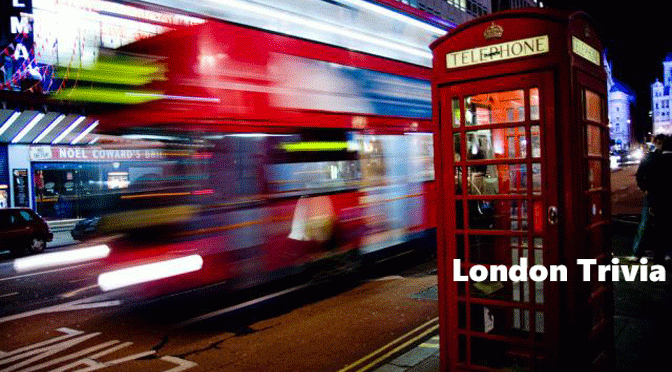
London Trivia: Economy of scale

On 9 November 1783 the first public hanging outside Newgate Prison took place when 10 criminals were hanged with the ‘new drop’ system, devised by Edward Dennis, the hangman, he was no saint either. He had been imprisoned in Newgate in 1780 and sentenced to death for taking part in the Holborn riots. He was later reprieved so he could hang his fellow rioters.

On 9 November 1947 a telerecording was used for the first time when the Remembrance Service from the Cenotaph was filmed by the BBC and recorded for transmission that evening

In 1415 following the Battle of Agincourt the Duke of Orleans, prisoner in the Tower of London, sent his wife the first ever valentine card

Blackfriars Bridge has several pulpits along its flank homage to Blackfriars Monastery which stood here until it was dissolved by Henry VIII

Domestic servants with visible smallpox scars were preferred to those unmarked, proof that they would not bring smallpox into the household

Theobalds Road was once a track that led to the Stuart kings’ hunting grounds at Theobalds Park in Hertfordshire

The dinner party attended by Julia Roberts and Hugh Grant in the film Notting Hill was held at 91 Lansdowne Road, Notting Hill

Tradition has it that Pimlico is named after Ben Pimlico, a 17th Century Hoxton brewer who supplied London with a popular Nut Brown ale

The world’s oldest cricket ball dates from 1820, was swatted over a 3 day period during William Ward’s record innings of 278 at Lord’s its present home

On Tower Hill is an entrance to the 1870 Tower Subway. You could ride under the river in a carriage pulled by cable

Arsenal were founded as Dial Square in 1886 by workers at the Royal Arsenal in Woolwich, but were renamed Royal Arsenal shortly afterwards

The world’s first weather forecast was issued from Greenwich Royal Observatory in 1848 by James Glaisher

CabbieBlog-cab.gifTrivial Matter: London in 140 characters is taken from the daily Twitter feed @cabbieblog.
A guide to the symbols used here and source material can be found on the Trivial Matter page.


Previously Posted: The King’s Cross Lighthouse

For those new to CabbieBlog or readers who are slightly forgetful, on Saturdays I’m republishing posts, many going back over a decade. Some will still be very relevant while others have become dated over time. Just think of this post as your weekend paper supplement.

The King’s Cross Lighthouse (16.10.12)

It has been degenerating since Edison Lighthouse appeared in the charts during the 70s and has lay empty for years, but recently scaffolding has appeared surrounding the building. Could this be the start of the regeneration that this forlorn building has needed for the best part of a quarter of a century?

Sandwiched between two converging roads – Pentonville Road and Gray’s Inn Road – opposite King’s Cross railway station perched on top of a narrow building, sometimes referred to as the flatiron building (it shares a similar footprint to the iconic Manhattan block), stands an architectural folly some people think of as a windmill or lighthouse.

It has looked much as it does today since 1884 but its date of building and original purpose are unknown.

Now apparently owned by the splendidly named – The Peninsular and Oriental Steam Navigation Company (or just P&O) it has been left to rot in this area of huge regeneration.

There are many explanations for this strange Grade II listed building, which was erected in 1875, but no one seems to be absolutely sure. It has been semi-derelict for many years and always seems to be on the point of being regenerated, or falling down, but never quite getting there.

Used as the location for Harry Palmer’s office in the 1967 film Billion Dollar Brain, some say it was a clock tower, Victorian helter-skelter, or even a camera obscura.

Another explanation, although it has to be said that no other examples have been found, is that when oysters were the cheap and popular fast food of the day, Netten’s Oyster House was marked with a lighthouse – a kind of the Mcdonald’s golden arches’ of their day.

An architectural practice called Richard Griffiths has been charged with redeveloping the area, so it’s already spawned a suitably gentrification-friendly, nom-de-plume, ‘The Regent’s Quarter.’

Let us hope this eccentric and loved building gets the refurbishment that it deserves.

Monthly Musings

October 2025

📣 Podcast

The wait is over! London author Christopher Winn has finished editing my rambling talk about being a cabbie when we met in Romford’s Golden Lion pub. TimeTable London uploads a new podcast fortnightly featuring guests a lot more interesting and knowledgeable than this humble scribe. Here’s my contribution.

🔪 Taking it easy

I’ve been banging on for months about my procedure to correct an inguinal hernia. October was spent convalescing, so this month’s Musings are rather truncated.

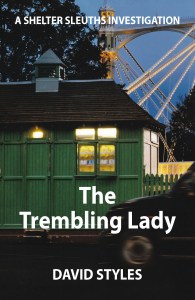
📖 The Trembling Lady

At least these past few weeks have not been wasted. Finally, I’ve finished the next Shelter Sleuths Investigation and am now on the line editing.

👀 1984

As they had it out on display, last month I picked up George Orwell’s dystopian masterpiece in Waterstones. They clearly thought it was prescient. Since then, the Government has announced the imposition of ID cards. It seems the bookseller was right.

📺 Riot Women

It comes to most of us, but midlife invisibility is much worse for women, along with family responsibilities, being taken for granted, at the same time as undergoing hormonal changes. Sally Wainwright’s brilliant depiction of a group forming a ‘girl’ rock band, endeavouring to get noticed, is brilliant. Even this uncomprehending man could understand the problems and the humour.

📅 October’s posts and pages

Most read post – Buying a black cab as a private car
Most read page – The Knowledge

📈 Last month’s statistics

3,415 views (+131.5%)
1,214 visitors (+66.8%)
42 likes (+27.3%)
52 comments (+108.0%)
15 posts (-16.7%)

Taxi Talk Without Tipping