

North Street, a road running, well North, from Romford crosses Eastern Avenue at its northernmost end necessitating a set of traffic lights at this busy junction. So reviled is Sadiq Khan and his Ulez around here, an area which borders farm fields, the Bladerunners (vandals who destroy Khan’s cameras) removed the cameras only to break the traffic lights which has taken days to mend, with the consequence of gridlock around these parts.

Johnson’s London Dictionary: London Gin
LONDON GIN (n.) Inexpensive alcohol-based tipples used to quell dissent much favoured William Hogarth’s satire.
Dr. Johnson’s London Dictionary for publick consumption in the twenty-first century avail yourself on Twitter @JohnsonsLondon

Obsolete technology
I was out walking the other day and looking up, usually, I’m looking down to see what my dog is up to, I came across this piece of GPO ceramic history.
 When I was young, the sight of this technology attached to a property’s fascia was an indication that the family was pretty comfortably off, for they could afford a telephone.
In those days after waiting months to have a phone line, you’d share it with a neighbour. Regularly when lifting the receiver you could hear a conversation by your ‘shared’ line user. Etiquette required you to immediately replace the handset on the receiver and not listen in.
Now wherever I go around this little outpost of north-east London men are up telegraph poles (why on earth do we call a tree trunk supporting telephone lines – a telegraph pole?) attaching wires and black boxes. It all looks very efficient, and BT has even subcontracted all this climbing malarkey.
Now to press this brave new world of telephony upon us we’re getting emails warning us oldies much of our 1960s technology won’t work, while ambitious young men knock on our doors in an attempt to lure us away from our current provider with deals ‘we can’t ignore’, and our daily paper forecasts calamity awaits our future ability to call for help should we need help.
But hang on a moment, haven’t we been here before? If memory serves, around the turn of the century all our pavements were dug up to lay conduit in anticipation for cable TV and the Internet. But here it is, the telegraph method of communicating is still being used for 21st-century communications, and the wooden pole is even named after a Victorian invention.
Couldn’t the owners of the plastic pipes under our pavements just lease the tube to whoever has a contract to supply a property, just as our electricity and gas are delivered by the company of our choice, and just remove those overhead cables? With climate change and the increased winds predicted BT might be forced to take the subterranean path.

London in Quotations: Craig Taylor

London is actually a beautiful place when the weather’s good; the mood is lighter and everybody’s smiling. But for the other 350 days a year, it’s miserable. You’re standing there waiting for the bus in the rain or you’re waiting for a train on a platform and it’s freezing. Always a persistent drizzle – or if it’s not drizzling, it’s overcast and cold.
Craig Taylor (b.1976), Londoners: The Days and Nights of London Now – As Told by Those Who Love It, Hate It, Live It, Left It, and Long for It
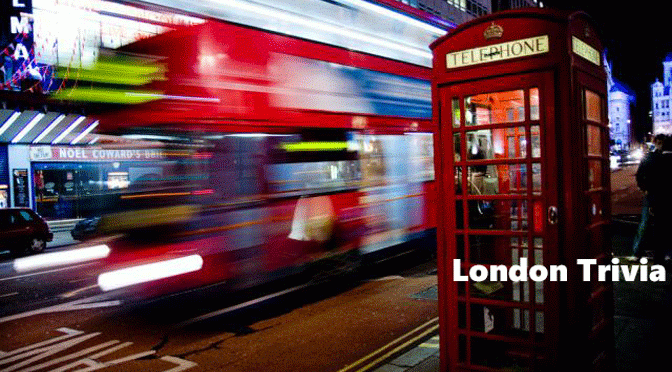
London Trivia: A perfect storm
On 7 January 1928 a perfect storm hit London. Heavy snow, followed by a sudden thaw with heavy rain combined with a high spring tide and a storm surge raised the water levels on the Thames. A massive flood ensued, water overflowed from the City to Putney and Hammersmith, fourteen people drowned and 4,000 were made homeless. The disaster contributed to the eventual building of the Thames Barrier.
 On 7 January 1618 Sir Francis Bacon, one of the cleverest of his generation, was made Lord Chancellor of England by his patron King James I.
 A punishment in London’s Victorian prisons was oakum picking. Prisoners were given old ships’ rope with the task of unpicking the strands
 On Admiralty Arch is a small nose said to be Lord Nelson’s second nose – it’s not. Placed there in 1997 by an artist as a form of protest
 In 1924, the first baby was born on the Underground, on a train at Elephant and Castle on the Bakerloo Line
 Harold Wilson always drank Lucozade during speeches – but from a blue glass, as he worried that in a clear one it would look like Scotch
 Victorian poet Swinburne and artist Rosetti shared 16 Cheyne Walk Chelsea with Rosetti’s menagerie including a pet wombat
 London’s oldest hotel Claridge’s opened as Mivart’s Hotel in 1812 by French chef Jacques Mivart. He sold out to William Claridge in 1838
 Charlton means ‘homestead belonging to the churls’. Churls were the lowest rank of freeman during medieval times
 On the Metropolitan line, trains can reach over 60mph but the average is a mere 20.5 miles per hour including stops
 Inventor Richard Arkwright who with John Kay invented the spinning-frame that produced a strong cotton thread lived at 8 Adam Street, Strand
 There is evidence to show that in medieval London, off Cheapside, there was a road, probably frequented by prostitutes, named Gropecunt Lane
 Trivial Matter: London in 140 characters is taken from the daily Twitter feed @cabbieblog.
A guide to the symbols used here and source material can be found on the Trivial Matter page.
 CabbieBlog