
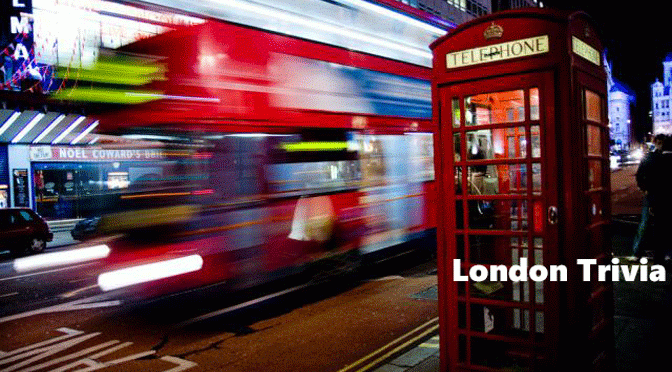
London Trivia: We shall never surrender
On 4 June 1940 Winston Churchill made his most famous speech. Not original, it was based on President Georges Clemenceau’s speech a half century earlier. But was nevertheless a defining moment . . . we shall never surrender. This was the second of three major speeches given around the period of the Battle of France, with the others designated as the Blood, toil, tears, and sweat speech of 13 May, and the This was their finest hour speech of 18 June.
 Quite probably on 4 June 1456 a comet appeared in the sky, just after the anti-alien riots. It was subsequently identified as Halley’s Comet
 Between 1196 and 1783 more than 50,000 people were hanged at Tyburn, the original was expanded in 1511 into the Tyburn Tree capable of hanging 24 at a time
 The 2nd Duke of Westminster fell in love with Coco Chanel and allegedly put the linked Cs of Chanel on the lampposts of his Grosvenor Estates
 John Thompson was Royal Foodtaster to four Monarchs: Charles II, James II, William III and Anne. He is buried at Morden College, Blackheath
 The last private resident of 10 Downing Street was a Mr Chicken, nobody knows anything about him other than his name, he moved out in 1732
 Between 1891-1894 Sir Arthur Conan Doyle lived at 12 Tennison Road, South Norwood his first work featuring Sherlock Holmes A Study in Scarlet was taken by Ward Lock & Co on 20 November 1886
 In 1841 the Metropolitan Police reported there were 9,409 prostitutes and 3,325 brothels known to the police across the 17 police districts
 Fulham’s first football ground, in 1879, was located on a patch of land known locally as Mud Pond, its location is not known, but the place was described as being in Lillie Road
 Aldgate tube station is built on the site of a plague pit mentioned by Daniel Defoe in Journal of a Plague Year in which 1,000+ were buried
 The 19th century classic writer Anthony Trollope who also worked for the Post Office helped create the red letter box
 The City’s Square Mile is now an imperfect 1.16 square miles following 1990s boundary changes incorporating an area north of London Wall
 Trivial Matter: London in 140 characters is taken from the daily Twitter feed @cabbieblog.
A guide to the symbols used here and source material can be found on the Trivial Matter page.
Protected: Site Unseen: WH & H LeMay
Protected: Barbican’s wildflowers
London Trivia: Strong Man of Islington
On 28 May 1741, to celebrate the taking of Portobello by Admiral Vernon, Thomas Topham ‘the Strong Man of Islington’ performed at the Apple Tree Inn, formerly opposite Coldbath Fields prison, in the presence of the admiral and numerous spectators. Here, standing on a wooden stage, he raised several inches from the ground three hogsheads of water weighing 1,336 pounds, using for the purpose a strong rope and tackle passing over his shoulders.
On 28 May 1759 Britain’s youngest Prime Minister Pitt the Younger was born. He grew up to be so thin that he was known as the Bottomless Pitt
Serial billiard ball thief Harry Jackson received seven years jail for two convictions – how times have changed
The house numbering in Downing Street used to be different. Number 10 was originally No 5 and did not acquire its present number until 1779
Henry Campbell-Bannerman has been the only British Prime Minister to die at 10 Downing Street. He died there in April 1908
While Cromwell never readmitted Jews a London colony of Sephardic Jews was identified in 1656 and allowed to remain – first time since 1290
In Elizabethan theatre different coloured flags were used to advertise the play’s theme – black flag tragedy, white comedy and red history
Until 1983 women could not be served at the bar in Fleet Street’s El Vino – only when seated at a table served, presumably by a subservient waiter
On 28 May 1742 the Bagnio the first indoor swimming pool opened Lemon Street, Goodman’s Fields, for a guinea gentlemen only could use the 43ft pool
The tallest escalator on the Underground is at the Angel with a length of 197ft (making it the world’s longest) and a vertical rise of 90ft
London Scientist Christopher Merret invented sparkling wine in 1662, Champagne didn’t come on the scene until 1697
17th century diarist John Evelyn proposed moving smoky industries out of London and then encircling with ‘sweet-smelling plants and hedges’
Trivial Matter: London in 140 characters is taken from the daily Twitter feed @cabbieblog.
A guide to the symbols used here and source material can be found on the Trivial Matter page.
 CabbieBlog