
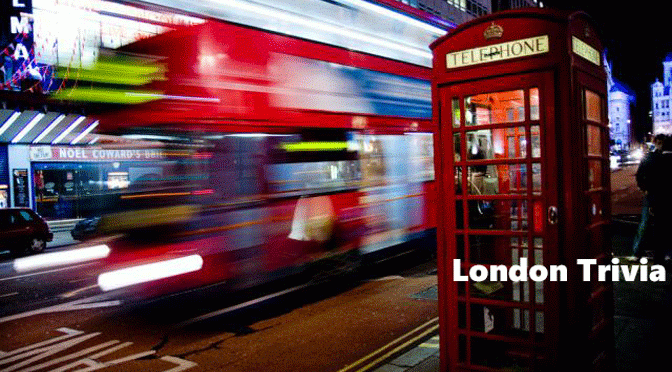
London Trivia: Hitting the jackpot
On 19 November 1994 defying the odds of 1-in-14-million seven lucky lottery winners won Britain’s first national lottery aired live from a London studio. 35 million tickets were purchased and the winning numbers as drawn were 30, 3, 5, 44, 14 and 22. The bonus ball was 10. A lottery took place in 1566 for a jackpot of £5,000 according to a letter from Queen Elizabeth I, giving instructions for collecting money, commanding that persons of ‘good trust’ be entrusted with the prizes.
 At the Royal Albert Hall on 19 November 1987 a rare 1931 Bugatti Royal was sold for £5.5 million at the time a semi-detached house cost £50,000
 For some crimes the guilty were locked in the pillory then had their ears nailed to the frame, upon release were forced to leave them behind
 King Street, St James’s is named after Charles II, King Street, Covent Garden is named after Charles I and Kingsway after Edward VII
 The American talk show host Jerry Springer was born at Highgate during the Second World War: his mother had taken shelter in the station from an air raid
 Trafalgar Square was to have been called ‘King William the Fourth’s Square’; however, George Ledwell Taylor suggested Trafalgar Square
 It was at 9A Denmark Street (Tin Pan Alley), then La Gioconda, where David Jones (Bowie) and his first backing band – Lower Third – met
 The Sanderson Hotel, Berners Street was a showroom for Sandersons wallpaper, the listed sign meant the hotel could have no other name
 The oldest (and possibly most bizarre) medal winner was John Copley who won Silver in the London 1948 Olympics for an etching he was 73 at the time, drawing was in the Olympics until 1948
 Charles Pearson, MP and Solicitor to the City of London, is credited with successfully campaigning for the introduction of the Underground. He died in 1862 shortly before the first train ran
 During the war, some stations (now mostly disused) were converted into government offices: a station called Down Street was used for meetings of the Railway Executive Committee
 Brydges Place named after Catherine Brydges daughter of 3rd Baron Chandos at 15 inches at its narrowest point is London’s tightest alley
 Trivial Matter: London in 140 characters is taken from the daily Twitter feed @cabbieblog.
A guide to the symbols used here and source material can be found on the Trivial Matter page.
Protected: The London Grill: Alan Gilbey
Protected: Going Dark
London Trivia: Quids In
On 12 November 1984 Chancellor Nigel Lawson in his autumn statement to Parliament declared the £1 note – popularly known as a ‘quid’ – would be phased out and replaced by coins which were introduced the previous April and which have weighed down trousers ever since. Ironically, £1 notes were greeted with public outrage when they were first put into widespread use as an emergency measure to replace gold sovereigns during World War I.
The 12 November 1974 was a red letter day for anglers for in the River Thames a salmon was caught the first since the 1840s
In his novel Moll Flanders Daniel Defoe described Newgate Prison as “that horrible place”, he should know he was imprisoned there in 1703
The circumference at the Gherkin’s widest point is 178 metres, which is only two metres less than its height of 180 metres
In 1926 suicide pits installed due to passengers throwing themselves in front of trains only Jubilee line has glass screens to deter jumpers
In Parliament in 1981 a private member’s bill (Control of Space Invaders (& other Electronic Games) Bill) tried to ban Space Invaders
The wedding in the movie Four Weddings and a Funeral was filmed at the Augustinian priory church of St. Bartholomew the Great
The first HMV store at 363 Oxford Street was opened by composer Edward Elgar in 1921. HMV stands for ‘His Master’s Voice’
Boxing legend Sir Henry Cooper trained in the gym above the Thomas a Becket pub previously at 320 Old Kent Road, Walworth
The Underground’s longest journey without change is on the Central line from West Ruislip to Epping – a total of 34.1 miles
Prostitutes around Southwark worked in the many brothels or ‘stews’ licensed by the Bishop of Winchester and were known as the Bishop’s Geese
Wildlife observed on the Tube network includes woodpeckers, deer, sparrowhawk, bats, grass snakes, great crested newts, slow worms
Trivial Matter: London in 140 characters is taken from the daily Twitter feed @cabbieblog.
A guide to the symbols used here and source material can be found on the Trivial Matter page.
 CabbieBlog