
On 8 February 1952 Princess Elizabeth proclaimed herself Queen, watched by 150 dignitaries at St. James’s Palace. She said: “My heart is too full for me to say more to you today than I shall always work, as my father did throughout his reign, to advance the happiness and prosperity of my peoples, spread as they are all the world over.” After the Accession Declaration, the new Queen held her first Privy Council meeting and her Proclamation was signed, by among others, the Lord Chancellor.
 On 8 February 1983 champion thoroughbred Shergar was kidnapped in Ireland, never found Lloyds of London paid $10.6 million insurance
 Little Ease dungeon at the Tower is too small to stand, lie or walk forcing its occupant to squat painfully in the dark for days on end
 The Millennium Dome (O2) the largest structure of its kind in the world big enough to house the Great Pyramid of Giza or Statue of Liberty
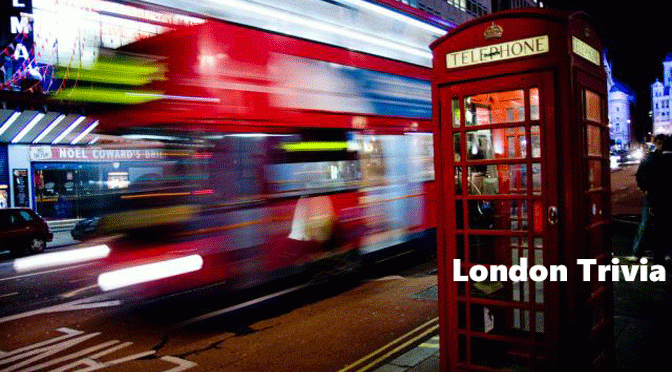
 On 8 February 1960 Sir Giles Gilbert Scott, architect of Waterloo Bridge, Battersea & Bankside Power Stations and the red telephone box died
 The ashes of former Prime Minister James Callaghan are scattered next to the Peter Pan statue at Great Ormond Street hospital
 On 8 February 1819 writer and art critic John Ruskin was born at 54 Hunter Street, Brunswick Square, Holborn
 Stone blocks outside the Athenaeum Club, Pall Mall were installed to assist the rather short Duke of Wellington mount his horse
 Greater London is 607 square miles, if grassed over it would total 220,000 football pitches – but without room for spectators
 When the first escalators were installed at Earls Court Station a one-legged man was employed to demonstrate their safety and ease of use
 According to Guinness World Records Whitechapel Bell Foundry in London’s East End established in 1570 is Britain’s oldest manufacturing firm
 On the London Eye, despite there only being 32 capsules, for superstitious reasons they are numbered 1-33, for good luck number 13 is left out
 Trivial Matter: London in 140 characters is taken from the daily Twitter feed @cabbieblog.
A guide to the symbols used here and source material can be found on the Trivial Matter page.


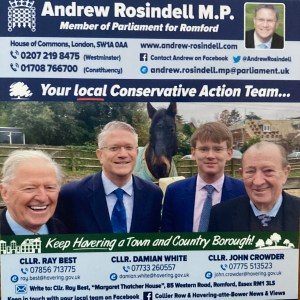
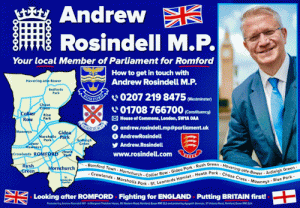 Andrew is convinced that Romford shouldn’t be in Europe, be a part of London, or within the embrace of the political party he’s been a member of since he was 14. He has proposed that “Havering Belongs in Essex – Not Greater London”. Andrew loves to use the coat of arms of the long-defunct Municipal Borough of Romford, so it appears on his flyer. I suspect soon we’ll have Romford passports.


 CabbieBlog