
BOAT RACE (n.) Aquatic competition between university students who rather than studying spend their days paddling water.
Dr. Johnson’s London Dictionary for publick consumption in the twenty-first century avail yourself on Twitter @JohnsonsLondon

BOAT RACE (n.) Aquatic competition between university students who rather than studying spend their days paddling water.
Dr. Johnson’s London Dictionary for publick consumption in the twenty-first century avail yourself on Twitter @JohnsonsLondon
We challenge our contributors to reply to ten devilishly probing questions about their London and we don’t take “Sorry Gov” for an answer. Everyone sitting in the hot seat they will face the same questions ranging from their favourite way to spend a day out in the capital to their most hated building on London’s skyline to find out what Londoners think about their city. The questions are the same but the answers vary wildly.

I am Jack Hines, an aspiring artist from Kent who has embarked on a highly ambitious project to draw every single building in Greater London – www.drawingalloflondon.co.uk. London has such a rich and diverse architectural history, I hope to take a snapshot of London by drawing the city in the span of my own lifetime. I am not only doing this for the creative challenge but to also create an archive of London in the 21st Century for future generations to look back on.
When you’re in the centre of London, never get the Tube. You’ll discover many new places and buildings that you would normally miss if you weren’t travelling on foot.
St Swithin’s Church Garden. When I used to commute to and from London, if I had to wait for my return train from Cannon Street station, I’d regularly visit this tiny garden opposite the station. It’s right outside the station, tucked away down a small alleyway, so not many people know about it. Which makes it a great place to wait out the usually delayed train.
The trains. I live in Kent so whenever I need to visit the city for photography purposes, it can be quite pricey to visit all the locations I need to. It builds up over time and is very expensive. On top of the expensive tickets, you’re not guaranteed a seat, which can be fairly tiresome on longer all-day journeys.
A classic, it has to be Big Ben. It’s an icon of the city and also the nation. Drawing Big Ben brings back great memories from the start of my project where I would stream the drawing process, it was great to interact with people who also had a shared interest in architecture and artwork.
I wouldn’t say I outright hate any building in London, as they all have some kind of redeeming quality or a story to tell. But if I had to choose, it would be 22 Bishopsgate. Most skyscrapers in London have a quirky twist that makes them unique, however, 22 Bishopsgate is just a bland glass tower that could be copied and pasted from any financial district from around the world.
The view from The Monument (but only if you’re in the mood to climb the 311 stairs). This location brings back cherished memories of my artwork in the sixth form where I would create sweeping panoramic drawings of the London skyline
It was the iconic brutalist Welbeck Street car park until it was demolished a few years ago. Its spectacular facade has been my desktop wallpaper for about 5 years now, I never get tired of seeing it.
Perhaps slightly biased as I’ve recently watched it, but I’d say The Favourite. Filmed at Hampton Court Palace, it brings to life the extravagance of the 18th Century and showcases the beautiful architecture of the time. Also, Olivia Coleman’s performance is fantastic, a well-deserved Oscar winner for this film. The Favourite has become one of my personal favourite films.
Lowlander Grand Cafe, it has the best selection of Belgian beers in London, great staff and excellent food, and all-round brilliance.
I’m lucky in what I do as I get to experience my ideal day fairly often. That is to explore the city, mostly on foot, discovering parts of the city I haven’t visited before. As I travel around I like to photograph buildings for future drawings in my project to draw all of London.

The City is the Centre of its Commerce and Wealth. The Court of its Gallantry and Splendor. The Out-parts of its Numbers and Mechanicks; and in all these, no City in the World can equal it.

Daniel Defoe (1660-1731), Vision of Britain Letter 5 (London), Part 2: The City
On 4 June 1940 Winston Churchill made his most famous speech. Not original, it was based on President Georges Clemenceau’s speech a half century earlier. But was nevertheless a defining moment . . . we shall never surrender. This was the second of three major speeches given around the period of the Battle of France, with the others designated as the Blood, toil, tears, and sweat speech of 13 May, and the This was their finest hour speech of 18 June.
 Quite probably on 4 June 1456 a comet appeared in the sky, just after the anti-alien riots. It was subsequently identified as Halley’s Comet
 Between 1196 and 1783 more than 50,000 people were hanged at Tyburn, the original was expanded in 1511 into the Tyburn Tree capable of hanging 24 at a time
 The 2nd Duke of Westminster fell in love with Coco Chanel and allegedly put the linked Cs of Chanel on the lampposts of his Grosvenor Estates
 John Thompson was Royal Foodtaster to four Monarchs: Charles II, James II, William III and Anne. He is buried at Morden College, Blackheath
 The last private resident of 10 Downing Street was a Mr Chicken, nobody knows anything about him other than his name, he moved out in 1732
 Between 1891-1894 Sir Arthur Conan Doyle lived at 12 Tennison Road, South Norwood his first work featuring Sherlock Holmes A Study in Scarlet was taken by Ward Lock & Co on 20 November 1886
 In 1841 the Metropolitan Police reported there were 9,409 prostitutes and 3,325 brothels known to the police across the 17 police districts
 Fulham’s first football ground, in 1879, was located on a patch of land known locally as Mud Pond, its location is not known, but the place was described as being in Lillie Road
 Aldgate tube station is built on the site of a plague pit mentioned by Daniel Defoe in Journal of a Plague Year in which 1,000+ were buried
 The 19th century classic writer Anthony Trollope who also worked for the Post Office helped create the red letter box
 The City’s Square Mile is now an imperfect 1.16 square miles following 1990s boundary changes incorporating an area north of London Wall
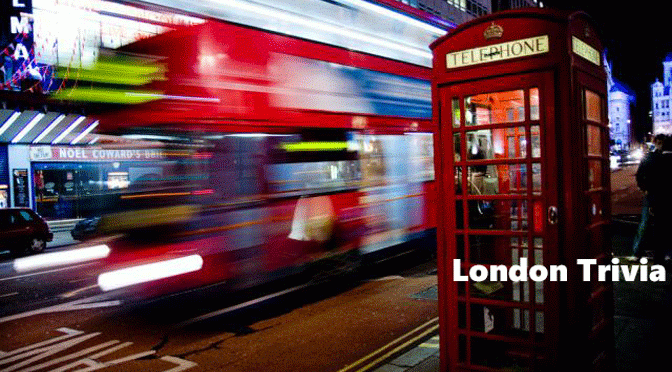
 Trivial Matter: London in 140 characters is taken from the daily Twitter feed @cabbieblog.
A guide to the symbols used here and source material can be found on the Trivial Matter page.
For those new to CabbieBlog or readers who are slightly forgetful, on Saturdays I’m republishing posts, many going back over a decade. Some will still be very relevant while others have become dated over time. Just think of this post as your weekend paper supplement.
It started as a promising day, the sun was shining, we had a new Government and yes, I had earned enough to warrant a trip to the bank. I proffered my deposit, the cashier smiled and said good morning, and then her eyes alighted upon a £50 note of mine. In a nanosecond a money checker detection pen appeared and like a censor from the Lord Chamberlain’s Office she had drawn a line across the note.
“It’s a forgery, I’m afraid, and I can’t give it back, but I can if you wish, give you a receipt”. Great, £50 down.
Rapidly striding off to WH Smiths, and taking the cashier’s advice to purchase for myself said detector pen, my mood darkened.
In an effort to cheer myself up and repair my dented ego, I did a bit of research on counterfeiting and also to confirm that I wasn’t the only London cabbie to get caught.
As a large city London has vast sums of cash changing hands each day, and this makes the Capital a perfect place to distribute this worthless junk. This was recognised in the Middle Ages and they used some rather novel methods to deter offenders.
Clipping was a popular past time in this period, where small clips were taken from the edge of a coin and using them to mint a counterfeit. Coin clipping is why many coins have the rim of the coin marked with stripes, text or some other pattern that would be destroyed if the coin were clipped, a safeguard attributed to Isaac Newton, after being appointed Master of the Mint.
Unlike today the threat to England’s economy from counterfeiting and ultimately the country’s security was appreciated by Parliament and offenders had a multiple choice of punishments, ranging to having one’s ears removed to hanging.
The Treason Act 1415 was an Act of the Parliament of England which made clipping coins high treason and punishable by death. (It was already treason to counterfeit coins.) The Act was repealed by the Treason Act 1553, and then revived again in 1562. The Act originally only protected English coins, but was later extended in 1575 to cover foreign coins “current” within England. The Coin Act 1575 also abolished (for coin clipping only) the penalties of corruption of blood and forfeiture of goods and lands (see what I mean by multiply punishments).
In modern times fraudsters have now a range of aids to perfect their craft making detection harder, so there is far more counterfeit currency in circulation. Remarkably last year the total amount of fake £1 coins hit 37.5 million, the highest sum since the coin was introduced in 1983, and a rise of 26 per cent since 2007, when 30 million were found to be fakes. Even more remarkable is that convicted forgers these days retain their ears, and only serve the shortest of sentences.



 CabbieBlog