Category Archives: Puppydog tails

He has been here and fired a gun

For years we had a very large print on our living room wall by London’s greatest artist, and arguably Britain’s too.

But let’s go back nearly 200 years to 1832 and Somerset House, the former home of the Royal Academy. There John Constable who a decade ago had painted an image, later to adorn every biscuit tin at Christmas, with an idiot getting his waggon stuck in a pond as a boy and dog look on incredulously.

The previous year Constable had had a row with a fellow Academician over him replacing Caligula’s Palace and Bridge with his own chocolate boxy view of a large grey church.

Now, in the gallery of the Royal Academy, before the exhibition commencement, Constable was putting the finishing touches to Opening of Waterloo Bridge, a painting he had worked on for a decade.

I know little about painting, but a few rules I understand. There comes a time when a piece of work becomes overworked, the secret is knowing when to stop. Also, every painting needs a ‘hero’, a point of light, colour or interest to which the eye is drawn before examining the rest of the canvas. This hero should be positioned along the ‘golden ratio’ a point where the eye naturally alights. Numerous mathematical formulae calculate where this falls, but unless you are a master draftsman like Tracy Emin, it’s two-thirds down and one-third across to you and me.
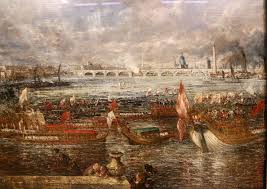
Opening of Waterloo Bridge by John Constable

So here at the Royal Academy is Constable fiddling around with his masterpiece in the last days before public viewing when in shambles the very painter he had argued with this time last year, and whose painting now hung next to his own.

Joseph Mallord William Turner was the antithesis of John Constable. At 56 and only a year older, not that you’d know it, his personal hygiene needed attention, wearing a battered stovepipe hat, an old shiny black coat, and holding a umbrella-cum-swordstick. A large nose, protruding chin and remarkably short, this irascible old man, born in Covent Garden had lost none of his Cockney accent, but he was so confident of his genius he had proclaimed: “I am the great lion of the day”, modesty certainly wasn’t his forte.

Turner stood behind Constable for a time, walked away and returned with his palette and brushes. Walking up to his simple grey seascape, without hesitation added a daub of red, slightly bigger than a coin in the middle of the grey sea, and then left.
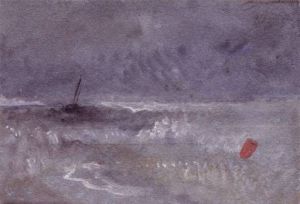

Helvoetsluys by JMW Turner

Fellow Academician, C. R. Leslie entered the room and observed how ‘the intensity of the red lead, was made more vivid by the coolness of Turner’s picture…causing Constable’s to look weak’.

Constable exclaimed, “He has been here, and fired a gun”.

Turner didn’t bother to come back for nearly two days, and then, in the last moments that were allowed for painting, shaped the red blob into a buoy.

That simple blob of paint was a bullet across his rival’s bows, showing that less is more. It also goes to explain why every year we have the Turner Prize awarded to the most innovative artists of the day, and not the Constable Prize.

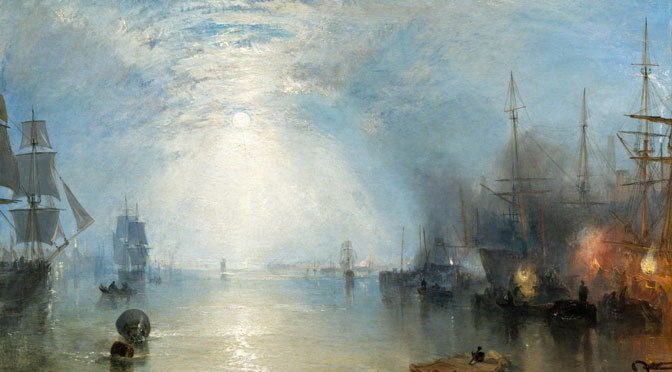
Featured image: Keelmen Heaving in Coals by Moonlight, 1835 by Joseph Mallord William Turner


Test Your Knowledge: May

This month’s quiz is rather eclectic. I’ve posed these questions before so that should give you a fighting chance. As before the correct answer will turn green when it’s clicked upon and expanded to give more information. The incorrect answers will turn red giving the correct explanation.

1. A performance of La Traviata at Sadler’s Wells theatre in 1952 had to be abandoned, but what was the reason?
Smog drifting into the theatre obscured the stage from the audience
CORRECT It was The Great Smog of 1952, coal fires and industrial emissions had reduced visibility in London to inches, lasting from Friday 5th December to Tuesday, 9th December in those few days over 4,000 would die.
The tenor in mid-aria collapsed with a heart attack
WRONG It was The Great Smog of 1952, coal fires and industrial emissions had reduced visibility in London to inches, lasting from Friday 5th December to Tuesday, 9th December in those few days over 4,000 would die.
The Sadler’s Well overflowed flooding the auditorium
WRONG It was The Great Smog of 1952, coal fires and industrial emissions had reduced visibility in London to inches, lasting from Friday 5th December to Tuesday, 9th December in those few days over 4,000 would die.
2. At the junction of Kensington Gore and Exhibition Road is known by cabbies as ‘Hot and Cold Corner’. Why?
Either you are inundated with work or there’s nothing
WRONG The Royal Geographical Society building has a statute of Shackleton looking towards Exhibition Road by Charles Jagger, a sculptor best known for war memorials and Livingstone setting his sights on Kensington Gore by Thomas Bayliss Huxley-Jones.
The statutes of David Livingstone, explorer of Africa and Ernest Shackleton hero of the Antarctic is to be found there
CORRECT The Royal Geographical Society building has a statute of Shackleton looking towards Exhibition Road by Charles Jagger, a sculptor best known for war memorials and Livingstone setting his sights on Kensington Gore by Thomas Bayliss Huxley-Jones.
Cold air rolls off Hyde Park, while the Albert Hall shelters you from the icy blast
WRONG The Royal Geographical Society building has a statute of Shackleton looking towards Exhibition Road by Charles Jagger, a sculptor best known for war memorials and Livingstone setting his sights on Kensington Gore by Thomas Bayliss Huxley-Jones.
3. You probably see it every day, but what is Johnston Sans?
The typeface used on London Underground
CORRECT Edward Johnston took the popular Gill Sans and re-designed it for all signage on the Underground, apart from slight changes it has remained the same since it was first used in 1916.
The design of a street waste paper bin
WRONG Edward Johnston took the popular Gill Sans and re-designed it for all signage on the Underground, apart from slight changes it has remained the same since it was first used in 1916.
French for an Oyster card
WRONG Edward Johnston took the popular Gill Sans and re-designed it for all signage on the Underground, apart from slight changes it has remained the same since it was first used in 1916.
4. In a little courtyard off St. James’s Street lays Pickering Place, it once housed an embassy, but which short-lived nation-state was represented?
The Republic of Crimea
WRONG Britain was one of the first nations to recognise the Republic of Texas when it broke away from Mexico in the 1830s, it would later become the twenty-eighth state of the United States.
The State of Somaliland
WRONG Britain was one of the first nations to recognise the Republic of Texas when it broke away from Mexico in the 1830s, it would later become the twenty-eighth state of the United States.
Texas
CORRECT Britain was one of the first nations to recognise the Republic of Texas when it broke away from Mexico in the 1830s, it would later become the twenty-eighth state of the United States.
5. The Russian word for a railway station is also the mainline terminal in London, which one?
Vauxhall
CORRECT One theory is that a Russian parliamentary delegation visited London to view a fabulous new invention, the railway. Their hosts from the House of Commons took them over the river to the nearest station, Vauxhall in South London. When the Russians asked what it was called, meaning the type of building, they got the reply ‘Vauxhall’. So vokzal to this day means railway station in Russian.
Waterloo
WRONG One theory is that a Russian parliamentary delegation visited London to view a fabulous new invention, the railway. Their hosts from the House of Commons took them over the river to the nearest station, Vauxhall in South London. When the Russians asked what it was called, meaning the type of building, they got the reply ‘Vauxhall’. So vokzal to this day means railway station in Russian.
Marylebone
WRONG One theory is that a Russian parliamentary delegation visited London to view a fabulous new invention, the railway. Their hosts from the House of Commons took them over the river to the nearest station, Vauxhall in South London. When the Russians asked what it was called, meaning the type of building, they got the reply ‘Vauxhall’. So vokzal to this day means railway station in Russian.
6. London has experienced many ‘Great Storms’, but one in 1703 dislodged a well-known icon, what was it?
The lantern on the roof of St. Paul’s just recently completed
WRONG Upon the restoration of the Monarchy Cromwell’s body was disinterred from its tomb in Westminster Abbey, given a posthumous trial and subsequent execution. His head was then placed on a long spike upon the roof of Westminster Hall. It remained there for over 40 years before the storm dislodged the gruesome remains.
Oliver Cromwell’s head
CORRECT Upon the restoration of the Monarchy Cromwell’s body was disinterred from its tomb in Westminster Abbey, given a posthumous trial and subsequent execution. His head was then placed on a long spike upon the roof of Westminster Hall. It remained there for over 40 years before the storm dislodged the gruesome remains.
The plaque commemorating the beheading of King Charles on Whitehall Palace
WRONG Upon the restoration of the Monarchy Cromwell’s body was disinterred from its tomb in Westminster Abbey, given a posthumous trial and subsequent execution. His head was then placed on a long spike upon the roof of Westminster Hall. It remained there for over 40 years before the storm dislodged the gruesome remains.
7. What is the connection between Dirty Dick’s pub opposite Liverpool Street Station and Charles Dickens?
The famous novelist’s father drank himself to death there
WRONG The original Dirty Dick was a young dandy called Nathaniel Bentley who owned a warehouse on Leadenhall Street. On the eve of his wedding his bride-to-be died, grief-stricken, he gave up washing, neglected his appearance, and rarely would be seen in public for the rest of his days. Charles Dickens edited Household Words, a magazine in which a poem based on Bentley’s squalid life appeared.
The pub’s collection of stuffed cats inspired the novelist to write The Old Curiosity Shop
WRONG The original Dirty Dick was a young dandy called Nathaniel Bentley who owned a warehouse on Leadenhall Street. On the eve of his wedding his bride-to-be died, grief-stricken, he gave up washing, neglected his appearance, and rarely would be seen in public for the rest of his days. Charles Dickens edited Household Words, a magazine in which a poem based on Bentley’s squalid life appeared.
Its namesake provided the basis for Miss Havisham in Great Expectations
CORRECT The original Dirty Dick was a young dandy called Nathaniel Bentley who owned a warehouse on Leadenhall Street. On the eve of his wedding his bride-to-be died, grief-stricken, he gave up washing, neglected his appearance, and rarely would be seen in public for the rest of his days. Charles Dickens edited Household Words, a magazine in which a poem based on Bentley’s squalid life appeared.
8. Norman Balon, the proprietor of Soho’s Coach and Horses for over 60 years, was celebrated as ‘the rudest landlord in London’. Under what name did he often appear in the satirical magazine Private Eye?
Bally Balon, the benign friend of the boozer
WRONG Private Eye’s journalists would lunch regularly in the upstairs room of the pub. At Balon’s retirement, Private Eye’s editor paid tribute to the landlord as: “The only man grumpier than me.” Balon’s autobiography, fittingly, was entitled You’re Barred, You Bastards!
Norman Nice, the kindly landlord
WRONG Private Eye’s journalists would lunch regularly in the upstairs room of the pub. At Balon’s retirement, Private Eye’s editor paid tribute to the landlord as: “The only man grumpier than me.” Balon’s autobiography, fittingly, was entitled You’re Barred, You Bastards!
Monty Balon, the genial mine host
CORRECT Private Eye’s journalists would lunch regularly in the upstairs room of the pub. At Balon’s retirement, Private Eye’s editor paid tribute to the landlord as: “The only man grumpier than me.” Balon’s autobiography, fittingly, was entitled You’re Barred, You Bastards!
9. Since 1820, what has a sailor done each Good Friday at the Widow’s Son pub in Bow?
Placed a hot cross bun in a basket hanging from the ceiling
CORRECT A widow lived in a cottage which once stood on the site. Her sailor son was due to arrive home on Good Friday. She put a hot cross bun aside for him on his return. Each year she kept a bun, but he never returned. The ritual was subsequently taken up by the pub after her death.
Rung the Bow Bell kept behind the bar
WRONG A widow lived in a cottage which once stood on the site. Her sailor son was due to arrive home on Good Friday. She put a hot cross bun aside for him on his return. Each year she kept a bun, but he never returned. The ritual was subsequently taken up by the pub after her death.
Poured a pint to celebrate Christ’s resurrection
WRONG A widow lived in a cottage which once stood on the site. Her sailor son was due to arrive home on Good Friday. She put a hot cross bun aside for him on his return. Each year she kept a bun, but he never returned. The ritual was subsequently taken up by the pub after her death.
10. The Prospect of Whitby in Wapping is London’s oldest remaining riverside inn. What was it originally named?
The Smuggler’s Rest
WRONG Built-in 1520, the Devil’s Tavern was a popular haunt of smugglers. Its current name derives from a ship that traded between London and the North Yorkshire fishing town of Whitby.
The Devil’s Tavern
CORRECT Built-in 1520, the Devil’s Tavern was a popular haunt of smugglers. Its current name derives from a ship that traded between London and the North Yorkshire fishing town of Whitby.
The Damn Your Eyes
WRONG Built-in 1520, the Devil’s Tavern was a popular haunt of smugglers. Its current name derives from a ship that traded between London and the North Yorkshire fishing town of Whitby.