Category Archives: Puppydog tails

Curious Bimbling*

There are dozens of books devoted to London’s history, I should know I’ve dozens of them. But I doubt you’ll find a better-designed one, for if it was larger it could be described as a coffee table art book. Each entry is precisely the right length to create a harmonious balance with the headings and illustrations. For example and probably unnoticed by many readers, Jack and Katharine’s biographies occupy exactly the same number of lines. For this graphic design geek, it was perfect symmetry for me.

The square format fits perfectly with Jack’s bite-sized descriptions detailing discoveries he’s found in the capital. Many of the entries are illustrated with delightful watercolours by Katherine Fraser, each positioned perfectly within the text.

As a Licenced London cabbie much was known to me, but that didn’t temper the enjoyment of reading, the entries proving Jack’s superior knowledge as he’s found some, for me, previously unknown gems. Who knew 10 Downing Street had yellow bricks? The building was thought to be black, but London’s pollution had discoloured the bricks. When cleaned in the 1950s it was thought not to look prime-ministerial enough so was painted black. Or that Cavendish Square also has an empty plinth once occupied by Prince William, Duke of Cumberland’s statue, it was taken down after the public discovered he had mercilessly crushed the Highlanders. In 2012 the Duke’s effigy was reproduced in soap and allowed over time to dissolve.

At the end of each section is a short walk taking in much of the features described, the size of the book allows the map and itinerary to be photocopied to fit onto an A4 sheet to put in your pocket, rather than carrying the book around London.

As you would expect all entries have been indexed, but curiously an additional list of postcodes with their locations within the book is also included.

If you wish to own just one reference about London, you could do no better than purchasing this sumptuously produced book.
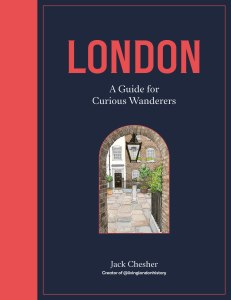
London: A Guide for Curious Wanderers by Jack Cheshire, with illustrations by Katherine Fraser

*Bimble (intransitive verb): Originating in the 1980s; to amble at a leisurely pace, to walk with no particular haste. Frequently associated with military slang, ‘bimble’ has become a part of the informal English language. It conjures up the notion of a relaxing stroll to fetch the Sunday papers, a ‘turn around the grounds’, or a pleasant summer stroll..

This is not a sponsored post. The publication reviewed has been kindly donated by the author or publisher. CabbieBlog has not received payment for writing this review and opinions are solely his own. All links here conform with guidelines set out in Write a Post.
 

Now! Here’s the thing

One of the most prestigious shopping thoroughfares runs in a circulatory route between Oxford Street and Piccadilly and is the only street running between the two. Most shoppers erroneously would call it Bond Street. Running through the centre of Mayfair it’s prosaically named after Sir Thomas Bond, the landowner who had it developed in the 1720s.

But hold on, there is no Bond Street featured on the Geographers’ A-Z. Did you ever notice that Bond Street doesn’t actually exist as a road? You’ll find a Bond Street tube station and numerous brands advertising that their shop fronts the street, but the road itself is strictly termed New Bond Street, or Old Bond Street.

Sir Thomas Bond’s family motto was Orbis non sufficit, which translates as The World is not Enough. Where have we heard that recently?

The phrase originated from Sir Thomas Bond, 1st Baronet, a 15th-century landowner, who was used by Fleming as an ancient ancestor of the modern-day Bond. The coat of arms was first revealed in the novel On Her Majesty’s Secret Service, and it was subsequently used in the film adaptation of the novel as well. It’s implied elsewhere in Ian Fleming’s novels that Thomas was an ancestor of the illustrious spy.

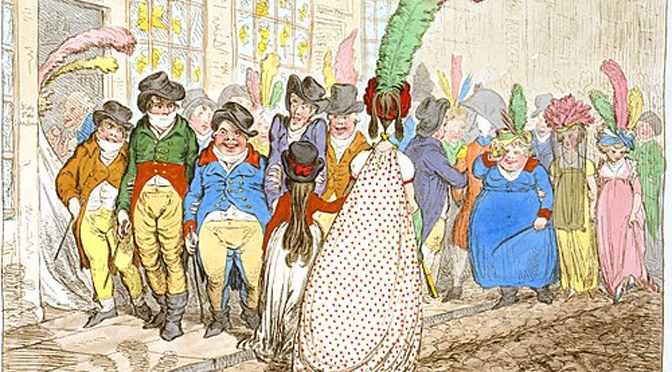
Featured image: In High-Change in Bond Street (1796), James Gillray caricatured the lack of courtesy on Bond Street (young men taking up the whole footpath), which was a grand fashionable milieu at the time.

Johnson’s London Dictionary: Albert Memorial

ALBERT MEMORIAL (n.) Doth dedicated to Her Majesty’s late consort, once constructed the monument was allowed to decline for 150 years, the restoration took as long as the original construction, and much monies.

Dr. Johnson’s London Dictionary for publick consumption in the twenty-first century avail yourself on Twitter @JohnsonsLondon

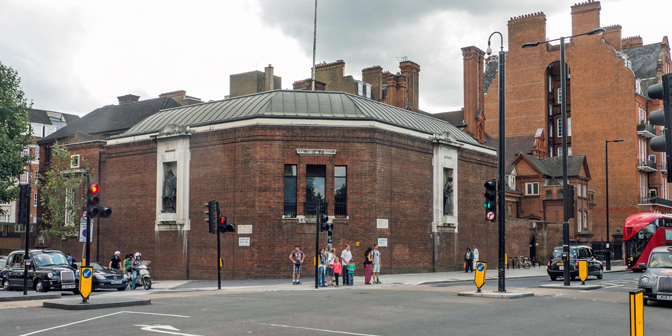
Hot and Cold Corner

London’s cabbies love to give a moniker to places around the capital. The Resistance was a derogatory nickname given to Harley Street as it was populated by doctors opposed the formation of the NHS, the Dead Zoo for the Natural History Museum. But surely the most inspired must be ‘Hot and Cold Corner.

Royal Geographical Society was formed in 1830 as a professional body to advance, as you might have guessed, geographical studies.

The Royal Geographical Society purchased this [featured] 1874-built property at 1 Kensington Gore, known as Lowther Lodge in 1913 for £100,000. It stands on the intersection of two busy roads, Kensington Road/Kensington Gore going east-west and Exhibition Road/West Carriage Drive north-south.

Ernest Shackleton

In 1932 a statue by Charles Sargeant Jagger of Ernest Shackleton, the polar explorer who led three British expeditions to the Antarctic, was unveiled on the eastern side of the building facing Exhibition Road.

David Livingstone

Some twenty years later in 1953 a statue by Thomas Bayliss Huxley-Jones, of David Livingstone, pioneer medical missionary with the London Missionary Society and Africa explorer was unveiled looking north on the Kensington Gore side of the building.

I suppose both statues should have faced south towards their achievements, but nobody would be able to see them.

So next time you’re in the vicinity of the Royal Albert Hall check out Hot and Cold Corner.

All images courtesy of Statues – Hither & Thither by René and Peter van der Krogt

Johnson’s London Dictionary: Albert Bridge

ALBERT BRIDGE (n.) Nicknamed ‘The Trembling Lady’ due to its tendency to vibrate as people walk over it, after having proffered monies for the toll fee.

Dr. Johnson’s London Dictionary for publick consumption in the twenty-first century avail yourself on Twitter @JohnsonsLondon