For those new to CabbieBlog or readers who are slightly forgetful, on Saturdays I’m republishing posts, many going back over a decade. Some will still be very relevant while others have become dated over time. Just think of this post as your weekend paper supplement.
A Black Day for Black Cabs (16.11.2010)
I’m sorry to come over all cabbie centric here, but if you want the answer to why there aren’t any cabs are to be found soon on a wet Friday night, stick with me so you’ll know who to blame, now here is a clue: Our London Mayor Boris Johnson is proposing to put a 10 year limit to the age of London Black taxi fleet.
A leading trade journalist has estimated that at a stroke 7,500 cabs will be taken off the road equating to one third of the fleet. Followed by another 1,500 every year after that, so in just over two years nearly half of London cabs would be scrapped. These scrapped cabs are the vehicles approved by TfL and in fact until recent they were virtually the ONLY vehicles cabbies could use with TfL approval.
Not long ago to gain our green credentials every older cab had to undergo an expensive modification to bring it up to Euro 3 compliant. Apparently Boris doesn’t think the £2,000 conversion goes far enough and wants to run fleets of Euro 4 or higher compliant vehicles.
His proposition to cap the age of cabs at 10 years means that their residual value would reduce by approximately £4,000 a year and that dear reader would mean increased fares just at the time of austerity measures for many London business and residents.
Setting aside the environmental impact of dismantling perfectly serviceable vehicles only to replace them with imports from China, yes China, many components from London’s cabs are produced in Asia and the vehicles are only assembled in Birmingham, how can that be a realistic option for the environment when many much older cars are allowed into London?
What our passengers don’t realised (and why should they), is that many vehicles are rented. Again the London Taxi Drivers Association (“LTDA”) estimated this older fleet of rented vehicles will diminish by up to 50 per cent and the operators would be unable to survive this catastrophic blow to their equity. These garages owned by fleet owners would just shut up shop with their staff being made redundant.
Many older drivers, including this writer, would simply retire having decided that to replace their cab or the increase in rent was too a higher price to pay, for what a part-time job is for many. Some younger drivers, particularly firemen supplement their income as cabbies, and would have to consider the viability of replacing their vehicle or seeking alternative employment.
The LTDA have commissioned a report to counter some of the dubious claims made about London cabs green credentials by TfL, and hope to persuade Boris of his folly. But if reasoned persuasion doesn’t work (and Boris is not renowned for about-turns) expect to find an awful lot of empty cabs blocking traffic flow while demonstrating in central London.





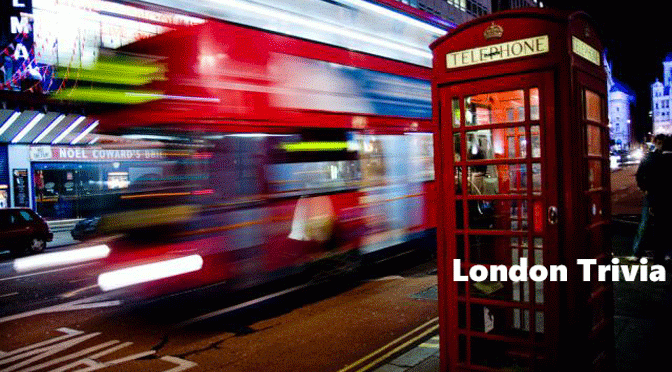
 On 17 December 1983 an IRA bomb exploded outside Harrod’s, killing six and injuring 90, the car containing the bomb was projected onto the 5th floor of an adjoining building
 In 1952 a Nigerian visitor was fined £50 for committing an indecent act with a pigeon in Trafalgar Square and £10 for having it for tea
 Caxton Hall has been the venue for celebrity weddings including Peter Sellers and Britt Ekland. Diana Dors liked it so much she used it twice!
 Suicide victims were once buried at crossroads to bring absolution, last person was Abel Griffiths interred at Grosvenor Place/Lower Grosvenor Place 1823
 In December 2005 the London Eye was lit pink in celebration of the first Civil Partnership performed on the wheel
 The Proms came to the Royal Albert Hall in 1941 from the Queen’s Hall in Marylebone which was bombed in the Blitz
 Before the statue of Nelson was placed on top of the 170-foot-tall column in Trafalgar Square in 1842, 14 stonemasons had dinner at the top
 The place name Millwall originates from the windmills that previously lined the western embankment of the Isle of Dogs
 There was great opposition to the building the London underground from Victorian Churchmen because they thought it would ‘disturb the devil’
 Kenneth Williams was once employed as an apprentice draughtsman at Stanford’s Map Shop at 12-14 Long Acre, Covent Garden
 Before he got the part of James Bond, Roger Moore moved into a new house where he inherited a telephone number ending ‘007’

 CabbieBlog