Previously Posted: Lost in translation

For those new to CabbieBlog or readers who are slightly forgetful, on Saturdays I’m republishing posts, many going back over a decade. Some will still be very relevant while others have become dated over time. Just think of this post as your weekend paper supplement.

Lost in translation (31.01.12)

London cabbies have the reputation that they have an opinion on everything; they will not go south of the River; and know just about anything to do with London, all of which we do little to dispel, but which are patently untrue.

This third urban myth that we are in fact just a mobile information desk to catch “The Lost” and reliably point them in the right direction must consume hours of our time every day.

Contemplating the meaning of life whilst waiting at traffic lights, the loss break into one’s hypnotic state, surprise and momentarily disorientated you. They ask with trepidation sometimes in a northern accent “Do you know the way to the Lyceum for the Lion King”?

You see it’s 7.21 in the evening, they are hopelessly lost and the show commences in nine minutes. Sure you can drive them, but it’s Covent Garden, gridlocked as usual, and you know with the one-way systems it’s far quicker to walk.

You are flummoxed, but you must never reveal this, you’re the world authority on everything London, right? But as you spend an entire lifetime driving, walking in the opposite direction to the road’s one-way system is – well just weird.

Don’t show your indecision, not a frown must pass your countenance, not even for a nanosecond. “Certainly Sir, it isn’t far from here, just a few minutes’ walk away”.

That has bought a few more seconds thought. Do you now send them across the Piazza, but what does the back of the Opera House look like? Would they know when to turn right? And are they going to even know when to turn into that famous square?

Your momentarily pause in answering has brought on near hysteria from the girlfriend, who has spent hours getting ready little realising that Londoners dress down nowadays to go to the theatre. They have spent nearly an hour walking around the area’s labyrinthine streets and to cap it all can hardly understand the cabbie with his cockney accent.

By now, and I swear TfL do this deliberately – the lights have changed and that nice private hire driver in his Mercedes is suggesting, by the use of his horn, that conversing with pedestrians just isn’t to his liking.

The best pedestrian route that was forming in your brain has disappeared from your consciousness, and to make matters worse at the end of the road, now empty of traffic due to your inability to move forward, is a fare.

“Look walk just down to the end of the street, turn left and you can’t miss it”. Yes very professional, but at least they start to move in the right direction. And come to think of it you haven’t told them that the start of the show is not to be missed with a sun rising over Africa’s savannah.

Now, where was that fare I saw?

London in Quotations: Desirée Rogers

In London, a lot of the time you don’t see the sun shine.

Desirée Rogers (b.1959)

London Trivia: A sparkling idea

On 9 February 1792 German-Swiss entrepreneur Johann Jakob Schweppe arrived in London to set up his first Seltzer water factory at 141 Drury Lane. Despite an unpromising start with his Swiss partners pulling out, Johann Schweppe persevered, his Soda Water became the colloquial term for sparkling water within a decade cementing his business name in the popular lexicon and creating the worldwide brand.

On 9 February 1915 an IRA 500kg bomb in a truck explodd at South Quay, Canary Wharf at 7pm, killing two and injuring 39, causing over £100 million damage

In 1992 driving a Porsche 911 a driver clocked up 147 mph, the highest speed recorded by the police on the M25 needless to say he got banned

The oldest surviving Blue Plaque is Napoleon III staying at 1c King Street in 1848 it’s the only one installed during a candidate’s lifetime

On 9 February 1915 Only Fools and Horses actor Lennard Pearce, who played Grandad in the TV show, was born in Paddington

The Connaught Hotel was called The Coburg, but like the Royal Family changed its name during World War I to avoid anti-German sentiment

In 1851 Britain’s greatest painter J. M. W. Turner bequeathed the contents of his studio to the nation the Tate holds 39,389 pieces

In 1912 the first Royal Variety Show took place at the Palace Theatre. Queen Mary was shocked by male impersonator Vesta Tilley

Only 14 men have run each and every one of the 34 London Marathons, one is former head teacher Mike Peace his best time is 2:37.12 in 1991

Over 47 million litres water are pumped from the Underground each day, enough to fill a 25m swimming pool every quarter of an hour

The man appointed by Charles II to put out the Great Fire of London was his brother the Duke of York – after whom New York was named

The statues of Livingstone and Shackleton outside the Royal Geographical Society have given rise to cabbies calling it “Hot and Cold Corner”
CabbieBlog-cab.gifTrivial Matter: London in 140 characters is taken from the daily Twitter feed @cabbieblog.
A guide to the symbols used here and source material can be found on the Trivial Matter page.

Previously Posted: A different view

For those new to CabbieBlog or readers who are slightly forgetful, on Saturdays I’m republishing posts, many going back over a decade. Some will still be very relevant while others have become dated over time. Just think of this post as your weekend paper supplement.

A different view (27.01.12)

It was in 1962 with the construction of the Post Office Tower that St. Paul’s Cathedral lost its claim to be London’s tallest building after dominating the City’s skyline for centuries. It then took nearly 20 years before the NatWest Tower laid claim to that crown, but it now seems a race to the top.

Socio-economists are those people who, if you didn’t know – or care, study the social mood of society and they have argued that ladies’ hemlines reflect the price of shares (when they rise so do shares and vice versa). The opposite could be paid of building developers, for in times of hardship they build ever higher.

The Empire State building in New York was started in 1930 in competition with 40 Wall Street and the Chrysler Building to become the world’s tallest building. The Empire State building won and was opened on 1st May 1931 just in time to coincide with the great depression, in fact, the building wouldn’t become profitable until 1950 by which time it was dubbed “The Empty State Building”.

Centre Point suffered a similar fate, when completed in 1966 it remained empty for years as its developer sought to find a sole tenant to take the entire 34 floors. For a recent development, it is hard to get more central in the City of London financial district than the Walbrook. This gleaming glass box designed by Norman Foster’s firm sits less than 660 feet from the Bank of England and almost two years after its completion the office building remains empty.

Just why do developers choose to build during times of economic woes? The Georgian landowners would employ their estate workers at times of hardship to build obelisks and follies for their landscaped gardens in a philanthropic gesture to prevent their staff from starving to death.

Not so the developers of the City. By choosing to construct the largest/tallest/ugliest or maddest in a recession they hope to economise on labour and material costs.

Now after 350 years St. Paul’s is surrounded by building sites each intending to make its mark on London’s landscape. Bishopsgate – has there ever been a time since the Romans when this road wasn’t dug up? – has two, the Heron Tower completed last year and the 64-storey Pinnacle which coincidentally at the time of writing has had its construction halted with only 7 floors built due to lack of funding. If the Pinnacle, or Helter Skelter as it has been dubbed, is ever finished it will be the tallest tower in the City of London and the second tallest in the European Union. There is the Walkie Talkie in Fenchurch Street, Leadenhall Street’s Cheesegrater and the big daddy of them all the Shard at London Bridge, now the tallest building in the European Union.

Will they improve London’s vista? That is not likely for quaint beauty is not their purpose. London is a world-class city and as such cannot be preserved in aspic with only tourism to fill its coffers – Europe has plenty of other heritage cities.

London lost its charm when it had to be rebuilt after the Blitz. The question that should be asked is will these monoliths make a profit? Many skyscrapers have a poor track record, let us hope that more companies will relocate to London and not take the BBC’s lead and move up north. Hopefully, if there are enough jobs in London to fill their floors with office workers some might have the need for a cab.

Today: 150 years ago

Nighteen-seventy-five was a year when London-based Victorian entrepreneurs were at their zenith, onward march to success knew no bounds, and philanthropy was accepted as an obligation.

George Routledge’s publication of 1875 titled The Popular Guide to London and its Suburbs described London as “…the true centre of the world, come ships from every clime, bearing: the productions of nature, the results of labour, and the fruits of commerce. Railways converge to it, and science, art, discovery, and invention seek it as their true home.”

This year proved no exception to Routledge’s description.

In 1875 with a £2,000 loan from his future father-in-law, Arthur Lasenby Liberty opened his iconic store in a half shop at 218a Regent Street with three staff members, selling ornaments, fabric and objets d’art from Japan and the East. Within eighteen months, he had repaid the loan and acquired the second half of 218 Regent Street.

Joseph William Bazalgette was knighted for completing London’s sewage system.

The Public Health Act of 1875 made it compulsory for local authorities to purchase, repair or create sewers.

The Chimney Sweeps Act forbade employing young boys to climb up chimneys.

A group calling themselves The Society for Photographing Relics of Old London employed Alfred and John Bool to publicise their campaign to save the Oxford Arms a 17th-century old coaching inn in East London.

Captain Matthew Webb became the first recorded person to swim the English Channel for sport without the use of artificial aids, when on 24th August 1875, he swam from Dover to Calais in less than 22 hours.

The first newspaper weather map was published in The Times on 1st April 1875, the work of polymath Francis Galton explorer, anthropologist, statistician and meteorologist. The map was not a forecast, but a representation of the conditions of the previous day, readers could then make their predictions based on the information it provided.

In 1875 the impressively named Sir George Carlyon Hughes Armstrong, Bt took control of the loss-making London-based Globe Newspaper, without previous experience of journalism, he transformed it into a leading broadsheet, supporting Prime Minister Benjamin Disraeli, Britain’s first Jewish leader.

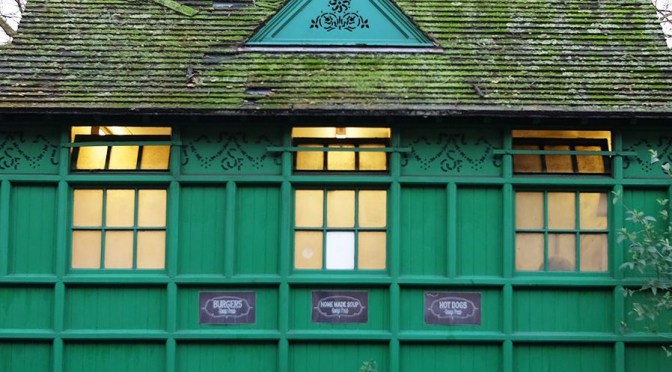
And on Saturday 6th February 1875, on a cold wintery morning, a group of Victorian worthies, including the aforementioned Sir George, accompanied by a few dozen cabbies stood on a misty St. John’s Wood road listening to speeches marking the inauguration of London’s first cabbies’ shelter.

Since that first shelter opened, exactly 150 years ago, these unnoticed cafés have been serving up meals, and providing shelter to London’s cabbies.

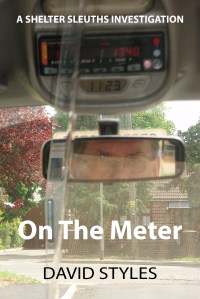
To mark this anniversary, today my new novel On The Meter is being published:

On a cold wet London night, Frank Belzoni finds a laptop in his cab, little did he realise where the journey would lead.

The nascent Shelter Sleuths uncover a plot to monitor Londoners, resulting in blackmail, espionage and murder.

Can the Sleuths convince the authorities of the dangers, and will they survive to find the spy within their ranks?

I’m holding a competition to win a signed copy of On the Meter to celebrate publication day in a shameless piece of self-promotion.

To enter, all you have to do is identify the road where the first shelter was located.

Entries should be sent via CabbieBlog’s Contact Page.

You may make as many entries as you like.

The competition is open until 23.59 GMT on Sunday 16th February 2025. The winner will be contacted by Saturday 22nd February 2025.

Good luck!

If you have a distaste for receiving free things or are too impatient to wait, here’s where you can buy it. On the Meter is now here available on Amazon.

Cabbieblog’s decision as to the winner is final. CabbieBlog reserves the right to decide the winner if there are two correct entries. Apart from notifying the winner, no correspondence relating to the competition will be entered. Up to the closing date, there is no limit on the number of entries a person can make. Cabbieblog reserves the right to cancel alter or amend the competition at any stage if deemed necessary in its opinion, or if circumstances arise outside of its control.