
Monthly Archives: May 2023

London in Quotations: Sir Nikolaus Pevsner

The essential qualities of the city are closeness variety, and intricacy, and the ever-recurring contrasts of tall and low, of large and small, of wide and narrow, of straight and crooked, the closes and retreats and odd leafy corners.

Sir Nikolaus Pevsner (1902-1983)
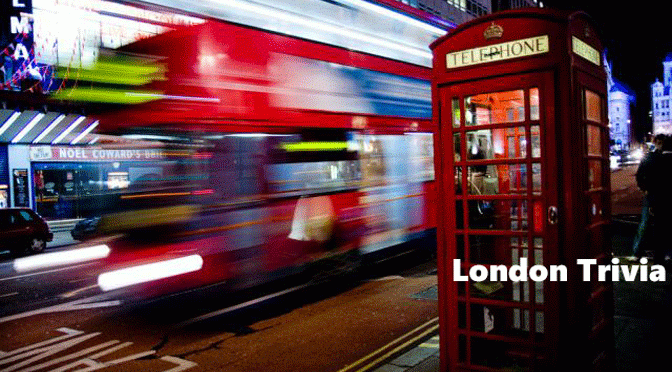
London Trivia: Are you sure it’s safe?
On 14 May 1856 the Old Bailey heard that Dr. William Palmer had poisoned with strychnine his friend John Cook. Heavily in debt to the tune of £4,000 due to his love of gambling on the horses he had taken out insurance policies one many of his victims. His mother-in-law, wife, four of his children, his creditor, brother and housekeeper had all met with premature deaths. Convicted he was hanged at Stafford prison on 14 June 1856. Stepping out on the gallows he asked “Are you sure it’s safe?”.
 On 14 May 1932 the BBC made their last transmission from their Savoy Hill headquarters transferring to the new Langham Place Broadcasting House
 Serial killer Dennis Nilsen once lived at 195 Melrose Avenue, Cricklewood the scene of 13 murders. Nilsen was sentenced to 6 life sentences
 The GDP of London is significantly larger than that of several European countries, including Belgium and Sweden
 Swedish mystic Emanuel Swedenborg who lived off Farringdon Road predicted there would be a special part in heaven reserved for the English
 A white spike at the south end of London Bridge commemorates a practice of displaying traitors heads dipped in pitch on the original bridge
 Kenneth Grahame author of The Wind in The Willows and Secretary of the Bank of England was shot at at the bank by a deranged George Robinson
 6ft 5in circus strongman Carl Dane in 1926 was the first to pull a London bus with 12 passengers inside using only his teeth
 When he was Prime Minister the Duke of Wellington held indoor races along Downing Street corridors with men pulling women seated on rugs
 In 2014, not a single 07.29am Brighton–London Victoria train reached its destination on time after failing to roll in at its scheduled time of 8.35am on a single occasion
 When Selfridges opened in 1909 their information bureau answered queries on subjects from crossword clues to government stats
 The City’s Square Mile is now an imperfect 1.16 square miles following 1990s boundary changes incorporating an area north of London Wall
 Trivial Matter: London in 140 characters is taken from the daily Twitter feed @cabbieblog.
A guide to the symbols used here and source material can be found on the Trivial Matter page.

Previously Posted: Smooth Operators
For those new to CabbieBlog or readers who are slightly forgetful, on Saturdays I’m republishing posts, many going back over a decade. Some will still be very relevant while others have become dated over time. Just think of this post as your weekend paper supplement.
Smooth Operators (11.05.2010)
In a recent consultation document it would appear that our Mayor “Bicycle Clips” Boris has all but given up on trying improving the average speed to transverse London, with an average of 10 mph it has hardly changed since the days of horse drawn transport in Victorian London.
His traffic boffins have come up with an idea called “Smoothing Traffic Flow” which it is claimed can make journey times more predictable but not any quicker. With London’s streets now gridlocked for most of the working day due to roadworks.
Your journey times are pretty predictable now albeit at walking pace.
The scheme has some good initiatives, such as Pedestrian Countdown which is a timer telling pedestrians crossing the road how much green time remains, it is a pity those same lights are ignored by pedestrians already.
Another is lane charging where it is hoped to charge utilities a fee every time they dig up the road, unfortunately legislation brought in when London was given its own mayor 10 years ago, the then (unelected) minister for London, John Gummer, capitulated to the privatised utility companies in their outrageous demand for unrestricted access to the ground beneath London’s streets. That dreadful decision, leading to Oxford Street being dug up 176 times in a single year and the Strand 154 times and has remained to this day. With this situation Boris almost thrown in the towel on his promise to charge utilities per hole in the road.
The Mayor has also ordered a review to identify which, if any, traffic lights may be unnecessary and could safely be removed, which sounds great until you realise that in the last 10 years over a 1,000 additional sets have been installed and that newly planned signals will be exempt from the review, so just to stand still they are going to have to get very busy removing some old ones.
With London’s population predicted by some to reach over 12 million in the next 15 years and with increasing wealth giving many the opportunity own a car, London is set to become as bad as Mumbai.
The majority of roads are not controlled by Transport for London and local boroughs are continually harassing motorists with the zeal of a religious convert. Not content with having a small army of traffic wardens, The People Republic of Camden (a nuclear free zone, in case you asked) is building kerbs out into the road to reduce lane capacity. While the Guardianista’s of Islington are working flat out (sorry for the pun) to ensure they have the tallest road humps in town, and with a mandatory 20 mph speed limit on all its roads, chance would be a fine thing to be able to travel beyond walking pace.
The previous Mayor’s initiatives to improve air quality have, it would seem, come to nothing. Scientists are baffled why despite vehicles being cleaner due to legislation forcing owners to install systems that reduce PM10 particulates. If they had cared to ask me I could point them in the right direction, one monitoring site is opposite Madame Tussaud’s where traffic moves at a snail’s pace along the Marylebone Road, another is located at Tower Hill near where by selling a 3-lane road to private developers they have created a daily 12-hours gridlock.

Coffee and Cabs
I have lost count of the number of times that I’ve requested an “Old Paradise Flat White”, from my coffee chain of choice.
Costa Coffee has been with us for over 50 years now, starting in 1971 when Sergio and Bruno Costa arrived in London and started a small roastery in Fenchurch Street in an attempt to change the drinking habits of Londoners. They blind-testing 112 variations of coffee before producing their signature blend, naming it ‘Mocha Italia’, and apart from recently tweaking the roasting time this blend is identical to their original formulation.
I worked for six years in Clerkenwell’s ‘Little Italy’, and a request for coffee then was a proffered cup of instant brown liquid from a ‘greasy spoon’ often run by a family of Italians. In fact, only in Soho during the 1960s was it possible to get a real cup of coffee.
Demand for the Costa brother’s coffee grew, and in 1978 they built a roastery in Old Paradise Street, Lambeth, hence the name of my coffee of choice.
Three years later the brothers opened their first Costa Coffee shop on Vauxhall Bridge Road and became the first coffee provider in London to serve Espresso and crafted Cappuccino in a porcelain cup.
That first coffee house is now the CA Japanese Pancakes.

Taken from Costa Coffee
So what has this to do with London’s cabs, I hear you ask. As Costa state on its site:
Before we opened our famous coffee shops we sold our coffee beans to prestigious hotels in London, such as The Ritz, and they were delivered in style by famous London black cabs.
The featured image of the first Costa Coffee shop was taken from Google Street View.
 CabbieBlog