
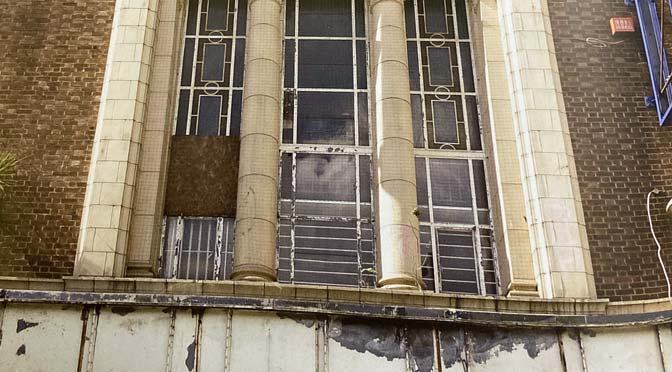
Thank you Netgalley and Amber Books for the opportunity to review this beautifully illustrated tome.
Written by one of London’s most innovative Blue Badge Guides, Katie Wignall’s Abandoned London takes you on a journey around forgotten, or unknown (at least to this cabbie) buildings and sights in the capital.
Each chapter covers a single theme, from transport to shops and retail.

Accompanying the images are descriptions by the author disclosing little known facts about the subject. Who knew that the decrepit Asylum Chapel in Peckham was, rather than a hospital for the mentally ill, a retirement home for pub landlords that is now a licensed wedding venue.
London is forever a city that reinvents itself and some of the buildings I discovered on the knowledge are, like the Hungarian Gay Hussar Restaurant in Soho, in business since 1953, are now featured here as derelict, awaiting reinvention.
As the Londonist website acknowledges, the title also holds a slight irony, given that the book was written during the lockdown, when much of central London was all-but-abandoned.
This lavishly illustrated book with over 200 photos of abandoned places capturing a moment in time is sure to appeal to anyone who has a passing interest in London.
Featured image from the book: Grade II Listed Savoy Cinema, Burnt Oak by Ewan Monro (CC BY-SA 2.0).


 On 15 August 1941 Josef Jakobs, a German spy, was the last person to be executed in the Tower of London by firing squad. Because he had a broken ankle he was shot sitting down
 The Boundary Street Estate London’s first council estate was built on the rubble of the Old Nichol, once a notorious criminal area
 In 2003 Temple Bar Trust bought the gate for £1 it was returned to London stone by stone and re-erected as an entrance to Paternoster Square
 William Blake (who wrote the lyrics to Jerusalem) married Catherine Boucher at St Mary’s, Battersea in 1782
 Nancy Astor, the first woman take a seat in Parliament after a by-election in December 1919 and was elected as a Conservative for the Plymouth, once lived at 4 St James’s Square, Westminster
 In 1891 Sherlock Holmes creator, Sir Arthur Conan-Doyle, penned his first 5 short stories at 2 Upper Wimpole Street then known as Devonshire Place
 A red, white or black flag was flown outside the Globe in Shakespeare’s time to denote a history, comedy or tragedy
 London’s oldest sports building still in use for its original purpose is the Real Tennis Court at Hampton Court Palace, one of its walls dates back to 1625. Today the court is listed Grade I
 The Central line introduced the first flat fare when it opened the tuppence fare lasted until the end of June 1907 when a threepenny fare was introduced for longer journeys
 Elephant and Castle is named from a pub whose sign was the symbol of the Cutlers who made cutlery with ivory handles
 It costs £4 million a year to advertise your firm on Piccadilly Circus’s neon sign which measures 21.1 metres by 4.8 metres
 CabbieBlog