
Monthly Archives: January 2021
Protected: Blind Fred
London in Quotations: Ralph Waldo Emerson

The best bribe which London offers to-day to the imagination, is, that, in such a vast variety of people and conditions, one can believe there is room for persons of romantic character to exist, and that the poet, the mystic, and the hero may hope to confront their counterparts.

Ralph Waldo Emerson (1803-1882)
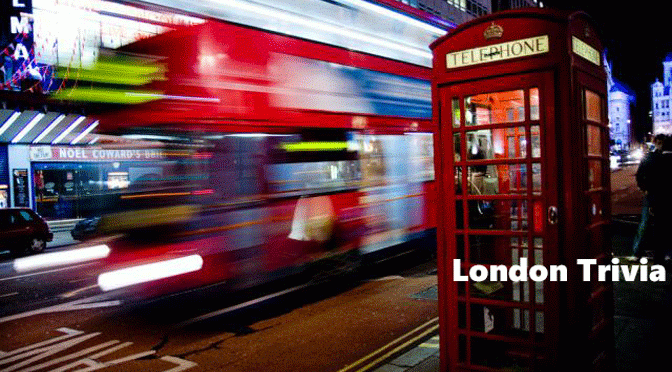
London Trivia: Power to the people
On 17 January 1934, The Times reported that Battersea Power Station was fully operational, known as Battersea A. The building as we know it would not be completed until 1955. During the 4 years of constructing Battersea A, there were six fatal and 121 non-fatal accidents. This history of this iconic building which went into decline on 17 March 1975 when A station was closed is now the subject of a book by Peter Watts Up in Smoke.
 On 17 January 1712 Robert Walpole, England’s first ‘Prime Minister’ was imprisoned in the Tower of London following charges of corruption
 Byng Street, Wapping named after a seafaring family, one of whom Admiral Byng was executed for cowardice on the deck of HMS Monarque in 1757
 Adelaide House completed in 1925 was the first building in the City to employ the steel frame technique at 141ft the tallest block in London
 The gravestone of the famous Elizabethan actor Richard Burbage in the graveyard of St Leonard’s, Shoreditch, reads simply ‘Exit Burbage’
 Margaret Thatcher went to the same Mayfair hairdresser, Evansky as Barbara Castle, while Thatcher sat in main area Castle had a private room
 The George Inn, Borough High St. dates back to 1676, is the last galleried coaching inn in London and is mentioned in Dickens’ Little Dorrit
 In the early 1800s Thomas Britton ran a music club above his coal shop in Jerusalem Passage, Handel often attended
 The footbridge outside Wembley Stadium is named White Horse Bridge after the police horse who controlled the 1923 FA Cup Final
 There’s only one Tube station that doesn’t have any of the letters from the word mackerel in it: St John’s Wood
 In 14th century London employed Rakers to rake the excrement out of toilets, notably one Richard the Raker died by drowning in his own toilet
 Between 17-25 January 1963 the temperature at Kew failed to rise above freezing that winter is regarded equal to the infamous winter of 1740
 Trivial Matter: London in 140 characters is taken from the daily Twitter feed @cabbieblog.
A guide to the symbols used here and source material can be found on the Trivial Matter page.

Parting company with TfL
When arriving in London, whether you’re a tourist or on business, you expect seeing well-known icons: Red buses ✔; Big Ben ✔; Tower of London ✔; but there’s now a rarity and is one seemingly in terminal decline – Licensed Black Cabs.
Sadly, the taxis and their thousands of drivers are going the way of Victorian lamplighters, and are on the brink of extinction.
In recent years wave upon wave of punitive green schemes unleashed by Transport for London have made it almost impossible to earn a living driving around the capital’s streets, whether you’re a cabbie or private hire. It was already a perilous situation, but the pandemic has seen work dry up completely because, frankly, no one is going anywhere.
City offices are empty because most people are working from home. The world’s greatest centre of culture has over 100 theatres that have remained closed for the best part of a year. With no crowds of tourists or foreign business travellers ensure that thousands of hotels are running at well below occupancy. No pub-goers, hen- and stag-parties or nightclubbers trying to get home.
Railway stations are empty, if it wasn’t for builders travelling to one of London’s numerous building sites, including the soon to become obsolete Crossrail and HS2, they would be running ghost trains. Heathrow and City Airports barely see any flights and consequently no passengers.
You would have thought that with this dramatic drop of journeys in London any travel would be an unrestricted joy. Not so. Since Sadiq Khan became London Mayor more and more major thoroughfares and cut-throughs learnt on the Knowledge have been banned to cabs. Now the sudden closure of hundreds of traffic lanes has brought chaos and gridlock to central London. The overnight transformation of our streets – without consultation – means that taxi journeys take much longer and cost punters more money. These new cycle lanes, with bollards separating bikes from vehicles, have slowed traffic to a crawl and some areas are at a standstill for most of the day, all rushed out under emergency powers granted by the Government at the start of the pandemic.
Infuriatingly, some of these new bike lanes have popped up right next to existing cycle routes. Among the worst examples of this is on Park Lane, where just 100 yards away there is already a bike route cutting through bucolic Hyde Park, or take the new bike lane in Euston/Marylebone Road where a bespoke bike lane running parallel just yards to the south was constructed over a decade ago denying motor vehicles the use of these roads.
I agree that there should be segregated cycle lanes, but some consideration as to their consequences need to be thought through. After riding around London on a moped (and getting knocked off three times) while on the Knowledge I know how vulnerable cyclists feel in rush-hour traffic, but these new lanes are just punishing anyone in a vehicle, and these are the ones who pay road tax, not the cyclists, who are few and far between in these lanes anyway.
Next time my license comes up for renewal and it will be with a heavy heart, I have decided to surrender my Bill, as we cabbies refer to the document.
I know I’m not alone. According to ex-cabbie Andrew Carter, writing recently in the Mail on Sunday, the official figures reveal that about 160 cabbies have been quitting each week during the pandemic, and the number of licensed taxis available to be driven in the capital fell by over a quarter from 20,136 last year to 15,000 this month. Whilst anecdotal evidence from the Licensed Taxi Drivers’ Association has found that of those retaining their license, only 20 per cent of cabbies are still driving their vehicles.
Not far from where I live in Essex, there is a field full of black cabs. The firm that hires them out to drivers has left them parked there until demand picks up again, but I’m sorry to say that many cabbies don’t think that they will ever get back behind the wheel.
This comes amid the relentless expansion of faceless taxi-hailing apps which Sadiq Khan’s Transport for London has sanctioned, that push our earnings well below a decent wage.
To gain my Bill the Knowledge took me nearly 5 years studying for at least 30 hours a week while holding down a full-time job. While these are the hoops that the licensing authority makes you jump through to become a black cab driver, that same licensing authority is now closing off roads to taxis, practically forcing cabbies like me out of a job.
You have to love the job, and I really did. The best part of the job was meeting and talking to interesting people from all walks of life and all corners of the world. But I know I’ll never go back to driving a cab. Why would I want to take that risk, given that Boris Johnson and Sadiq Khan seem intent on erasing cars from Central London? And those who do venture out in a vehicle that uses a combustion engine the journey will be long, expensive and arduous. Without change, I am afraid that this will make hailing a black cab an unattractive option for ordinary people.
Before Transport for London allows more money spent on cycle lanes and road closures or reduces the standards for anyone wishing to carry passengers, I’d like to see the authorities actually speaking to all interested parties and road users and before implementing their ideas.
Because without a drastic rethink, I fear that London’s black cabs will go the same way as the gondolas in Venice. They will be hailed by tourists outside Madame Tussauds and the Tower of London for a bit of fun, but they will become too expensive for everyday use.
But for me after 25 years I’ll be saying goodbye to a service once started in the austere times of 1654 by one ‘Lord Protector’ Oliver Cromwell, which now seems to have come full circle with Sadiq Khan in today’s mightily straitened-times in London.
 CabbieBlog