
Tag Archives: London’s streets
Rockin’ Roads
As someone who has made a good living studying maps, I’ve come to accept that many roads are named after local worthies, some of these are commemorating politicians, and some commendably feature the name of a local hero or it could be a sports person, in fact, Tessa Sanderson has two to her name.
But one group seems to have been forgotten – musicians. So much so I’ve only managed to locate four in London.
Bob Marley Way, Brixton
Bob Marley arrived in London on 3 January 1977, fleeing Kingston after an attempt to kill him (he would go to his grave years later with a bullet still lodged in his arm), he moved into 42 Oakley Street, just off the King’s Road, giving him easy access to the recording company Island Studios in Basing Street, Notting Hill. Marley would leave London after 16 months returning to Jamaica in April 1978. His eponymous street is off Mayall Road which runs parallel to Railton Road, but so small it doesn’t appear on the map.
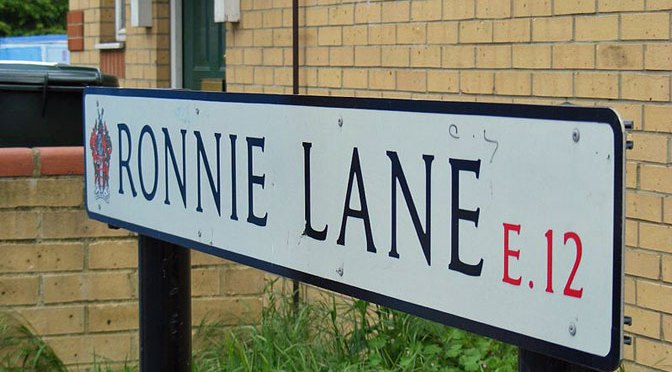
Ronnie Lane, Manor Park
With a name that lends itself perfectly to a street, Ronnie Lane was an obvious choice when naming a new development. Close to the North Circular, Ronnie Lane has three entirely separate stunted dead ends leading off two different main roads. A founder member of the 1960s rock band Small Faces, the Plaistow-born musician, who subsequently played bass guitar with Faces, acquired the nickname ‘Three-Piece’, much like the three cul-de-sacs which now take his name. He died in 1997, after suffering from multiple sclerosis for more than two decades.
Vera Lynn Close, Forest Gate
The singer, from East Ham, became known as the ‘Forces’ Sweetheart’ for her performances and recordings during the Second World War. She became the first centenarian to have an album in the charts last year when a collection of songs to mark her 100th birthday made it into the top three. Again this close off Dames Road is too small to feature on a map.
Freddie Mercury Close, Feltham
Farrokh Bulsara worked at nearby Heathrow washing dishes in a kitchen, growing up at 22 Gladstone Avenue (another road named after a worthy), which is marked with a blue plaque. Farrokh is better known as Queen’s frontman Freddie Mercury, but I’m surprised they haven’t put the giant figure which stood outside the Dominion, Tottenham Court Road at the entrance to this unprepossessing cul-de-sac off Hanworth Road.
Featured image: Ronnie Lane, Manor Park, London Borough of Newham. Street named after British musician Ronnie Lane by Sludgegulper (CC-BY-SA-2.0).
Just where was London’s first door number?
Many of us know of Number 1, London – Apsley House, built in 1778 on the north side of Piccadilly. At the time, it was next to the main turnpike or toll into central London, so became known as ‘Number 1, London’, because it was the first house you came to once you entered London.
The property’s official address today is 149 Piccadilly, Hyde Park Corner, London, W1J 7NT, but rumours still abound today that if you posted a letter to ‘Number 1, London’ it would reach this address. We haven’t tried this one, but if you do, let me know how you get on.
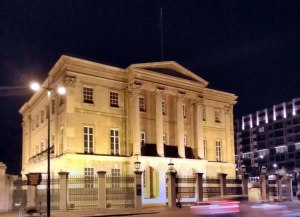 Apsley House by Paul Farmer (CC BY-SA 2.0)
Just before a lease for the land was negotiated from the Crown Estate and builders stood around shaking their heads while telling his Lordship they had discovered problems in the build, The Postage Act of 1765 was given Royal Assent, apparently to start numbering houses for the postie.
The full text of the 1765 Postage Act does not contain any direct reference to house numbering, either introducing or for standardising. The Act enabled plans to measure distances along roads, encouraging house numbering, but the Act didn’t directly require numbering.
So when did the first number appear?
Most likely at the start of the eighteenth century, for this is what The British Postal Museum & Archive says:

The first recorded instance of a street being numbered is Prescot Street in Goodmans Fields in 1708. By the end of the century, the numbering of houses had become well established and seems to have been done on the consecutive rather than the odd and even principle which we have now become familiar.
None of this was regulated and numbering systems varied even in the same street. For example about 1780, Craven Street in the Strand had three sets of numbers. There were irregularities everywhere, and the naming of streets and parts of streets was left to the idiosyncrasy or whim of the owner.
Regulation did not take place until 1855 with the passing of the Metropolitan Management Act. For the first time, the power to control and regulate the naming and numbering of streets and houses were provided for and given to the new Board of Works.

That version can be traced back to the 1708 publication, Hatton’s New View of London, which, using slightly different spelling, recorded that:
In Prescott Street, Goodman’s Fields, instead of signs the houses are distinguished by numbers, as the staircases in the Inns of Court and Chancery.
There are hints that house numbering spread throughout the 18th century, all without that 1765 Postage Act. So his Lordship might not have lived in Number 1, London after all.
 CabbieBlog