Tag Archives: London pubs

The Nonce

Many of London’s pub names have a royal connotation: The Royal Oak, The King’s Head or The Crown, it dates back to the time when many were illiterate, and the depiction of a well-known image enabled patrons to identify each hostelry.

The Duke of York pub in Fitzrovia continues this tradition, but with an unusual twist.

It displays the only known sign with the image of Prince Andrew (the current Duke of York) on its sign.

Operated by the 200-year-old Suffolk brewers Greene King this pub was first licensed in 1767 and then rebuilt in 1897, and is tucked away at the top end of Rathbone Street.

In 2014, Prince Andrew, the present Duke of York, permitted his likeness to be used on the pub sign. Russian-born American artist Igor Babailov, known for his commissioned portraits of world leaders and celebrities, duly painted the pub’s sign. The painting is now thought to be the only pub in the world featuring a likeness of a living member of the Royal Family.

Fitzrovia, the place of my birth, was also where the literary and artistic crowd hung out, Donovan, Ian Dury, Rod Stewart, Paul Jones, Johnnie Ray, and John Lee Hooker were also regulars, as was David ‘Del Boy’Jason.

In the 1940s and 50s the Duke of York’s clientele had regular encounters with so-called razor gangs and novelist Anthony Burgess is thought to have used his wife’s 1943 experience of razor gangs forcing her to drink copious amounts of beer in his later novel, A Clockwork Orange.

Milking the area’s reputation for knife crime, landlord Major Alf Klein initiated male customers by snipping off their ties, the collection grew to over 1,500. His great dane, named Colonel, starred in the title role in the film Hound of the Baskervilles, apparently, it was partial to drinking customers’ beer.

Despite being stripped of all of his titles in 2021 due to his association with financier and trafficker Jeffrey Epstein, Prince Andrew’s image remains and after commissioning the painting the publican has no intention of replacing it any time soon.

According to Adrian Brune on her Substack blog, in Soho, locals now colloquially refer to the pub as “the Nonce”.

Nonce (n.) Prison slang a rapist or child molester; a sexual offender.

Featured image: The exterior of the Duke of York pub in Fitzrovia, bearing the image of Prince Andrew, the present Duke of York by Ethan Doyle White (CC BY-SA 4.0)
Why are pubs on street corners?

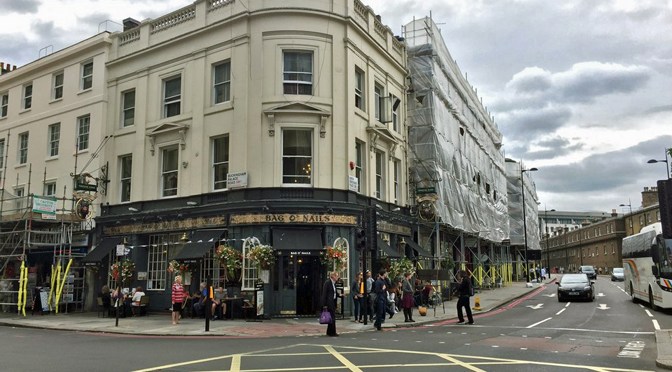
Why are London pubs so often situated on street corners, and why didn’t developers hardly ever construct pubs in the middle or halfway down a terrace?

The whole building of the pub is always divided into several sections: saloon or lounge, parlour, public bar, snug, counter, and beer engine. Most of the time, one side is allocated for a saloon or lounge, while the public bar is exactly that. The parlour or saloon is mostly reserved for business persons, and they used to sit here with a modicum of privacy and discuss business matters, away from the riff-raff in the public section. In addition, many public houses also provided limited accommodation and a beer garden.

Landowners controlled large pieces of land and worked with developers through the leasehold system. The landowners let plots out to the developers, who paid for the construction of long terraces, and the developers borrowed to pay construction costs.

The pubs, therefore, were built first to house, feed and water the builders. In the worst case, the pub and its licence could be flogged off to pay for finishing the terrace.

The developer could lend building money to plumbers, glaziers and construction workers who’d do the work on each other’s homes for free – so everybody won. And the pub remained on the corner after they’d all finished, ready to provide them with a social focus. Thus the pub was there first and last, throughout the lives of those who lived in the terraces.

Odd fact: Griffin Park, where Brentford FC play, is the only football ground with pubs at all four corners.

The Bag o’ Nails on the corner of Lower Grosvenor Place by Alan Hughes (CC BY-SA 2.0)

The widow’s son

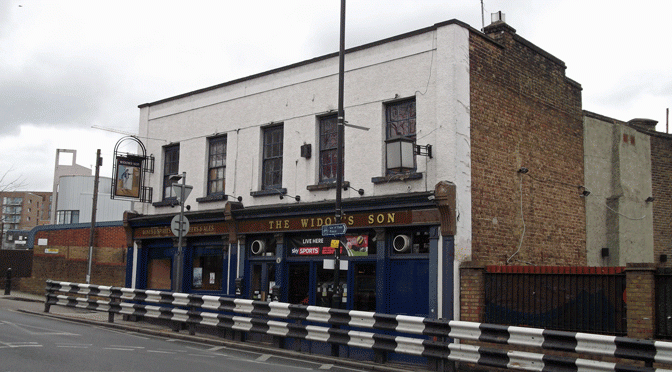
Just up the road from Beaumont Square is the Widow’s Son in Devons Road which is a Grade II* listed public house built in the 19th century with an interesting history, featuring a Christian festival behind its name.

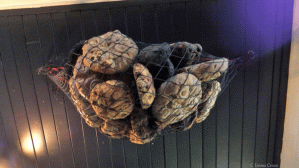
The story is that a widow’s house previously stood on the site. Expecting her sailor son home from the sea during the Napoleonic wars one Easter, she naturally baked him a hot cross bun, but unfortunately, he did not return. The widow lived in hope and next year made another bun, and so on.

It was commonly believed at that time, that bread or buns baked on Good Friday would never grow mouldy and had a marked medicinal value, it was also not unknown for such items to be hung up.

After her death years, stale buns were found hanging from a beam in her cottage, inevitably the house became famous for its collection of buns, and when in 1848 a pub was built on the same site it was naturally called the Widow’s Son and the custom continued; each year a sailor bringing another bun to be hung from the pub’s ceiling. The tradition almost ended when ironically the lease on the Widow’s Son ran out a week before Easter, with developers wanting to turn the site into yet another a block of flats.

Thankfully the tradition is back at the Widow’s Son after the enthusiasm of the new landlord and the participation of sailors from the training ship HMS President which is permanently moored alongside the Victoria Embankment.

You can see the current, currant buns (sorry!) in the net.

Featured image: The Widow’s Son, Public House, Bow, a grade II listed public house on Devon’s Road, opposite Campbell Road, by David Anstiss (CC BY-SA 2.0)