Previously Posted: Waste not, want not

For those new to CabbieBlog or readers who are slightly forgetful, on Saturdays I’m republishing posts, many going back over a decade. Some will still be very relevant while others have become dated over time. Just think of this post as your weekend paper supplement.

Waste not, want not (08.03.11)

I’ve always thought that Prêt à Manger is a rather pretentious name for what is, frankly, just a sandwich shop. The company would seem to now agree with me, for recently they have been referring to themselves simply as Prêt, whatever that might mean. But I can forgive them all the marketing hype when I see their little vans promoting the company’s philanthropy.

Throughout the year they support hundreds of charities by giving unsold sandwiches to the homeless at the end of each day; they deliver over 12,000 fresh meals to numerous shelters in London every week. In total, Prêt à Manger donates over 1.7 million products to charities for the homeless across the UK every year. Their philosophy is that it’s much better that unsold food goes to people who really need it at the end of each day than putting it in the bin.

Being born just after World War II my mother intoned her mantra that nothing should be left on the plate at the end of a meal, for there were many children starving in the world who could do with a square meal. She had good reason for promoting the virtues of preventing food waste, for incredibly until I was seven years old in 1954, Londoner’s were still subject to food rationing.

In the succeeding decades scientists and farmers have been very successful at increasing crop yields but at a cost. Increased use of fertilizers and pesticides has given rise to adverse health problems for many people. While the increase in water consumption used to grow food for the West, has for many countries, promoted friction, indeed many analysts predict the next major war will be caused, not by land ownership, but water rights.

British households throw away a third of the food they buy, while supermarket waste adds a further 25 per cent to that. From a time during the last war when nothing was wasted (even eggs were dehydrated to increase their shelf life), we have come to a point that recently in 2009 the United Nation’s Environmental Programme estimated that more than half of the world’s food is lost, wasted or discarded along the chain from farm to shop, that before consumers’ buy it. They concluded that the world could easily feed itself for a long time into the future, even with the Third World’s burgeoning wealth resulting in increased consumption. All we have to do is radically change our attitude to waste.

The major supermarkets chains claim to send waste food to power the national grid, but this is part of the distorted consumerism that has developed since 1950. What sense is there in sending carefully bred meat and delicately nurtured tomatoes to an anaerobic digester to produce methane gas? This it seems to me, a gross waste.

At least Prêt with their cute little charity vans are putting surplus food into someone’s deserving mouth. It’s just every time I see their evening deliveries I have the notion of two homeless people saying “Oh No! Not wild crayfish and rocket salad with mayo and lemon juice dressing again, what I’d give for a cheese and pickle sandwich.

Taking a long sabbatical

This post has had a gestation period of 5 years, in fact since December 2018 when WordPress released the much-hyped Gutenberg Block Editor update.

At that time I’d been blogging on WordPress for nearly 10 years and felt comfortable with using the platform.

This was in the halcyon days of blogging when hundreds would come here every day to read about London. These days the hit rates rarely reach three figures, in fact, I’m now averaging less than 50.

But first a little bit about me. Having been a typesetter since the early 60s, in 1982 we dropped using ‘hot metal’ and started assembling pages of type matter using machine coding. So you would think with over 40 years of experience with this code assembly malarkey, using the ‘upgraded’ WordPress system would be a doddle. Unfortunately, it wasn’t to be.

CabbieBlog’s theme is Twenty Fourteen released as WordPress’s theme of the year. The theme’s sidebar headings were displayed in a distinctive typeface in black with a rule running above them. Now if I want to insert a new item they cannot incorporate this heading, even though they at WordPress developed the theme. The only way is to copy a previous heading.

The sidebar ‘What I would read on the rank’ is written in CSS, unfortunately, the first few characters on each line disappear beneath the sidebar’s edge, so it’s guesswork to write up a new book’s description.

The block editor is fraught with traps. Each post section has to have a new block, and trying to code in HTML is nigh impossible. Mistakes are easily made unless you keep a strict eye, if you update the post it reverts to a draft and doesn’t then publish at the scheduled time, and things jump and move around all the time.

Also, every time you click on anything, you have to wait for everything to stop moving or you risk clicking on the wrong thing.

Refreshing the page is something that takes an age and getting to look at your work, as readers would read it, often just doesn’t work.

Can someone tell me what specific concrete problem was raised with the old editor that Gutenberg is supposed to solve?

Oh! Did I say? The times are given in a 12-hour clock, presumably, the Gutenberg children don’t understand 24-hour timings.

Much of this was overcome by using the ‘classic’ version, in other words as we have always written posts. This was still possible as a secret pull-down tab enabling you to post in the old way (thank you BeetleyPete followers for the tip).

Not content with making life difficult for hobby bloggers, WordPress has promised the ‘out-of-date’ dashboard will be upgraded, and, no doubt, the secret button removed, this, of course, will force you to write in block editor.

You might think this is a post about an old man not wanting change until you look at Gutenberg’s popularity rating, (at 25.03.24) in which out of 4,006 ratings 2,414 gave it just one star.

I’ve tried using it for a while and it is terrible and it’s just gotten worse, how many mouse clicks does it take to do the simplest thing? It may be great for people who know how they want everything to look, from the very beginning down to whether your links are no-follow, and which text will be in italics. But if you work on the fly, or God forbid, make a mistake and want to change things, it’s awful!

By way of an apology and an excuse for this rather rambling post, goes to explain the cession of the daily post from CabbieBlog. Life is too short to keep fighting Gutenberg’s idiosyncrasies.

So with a heavy heart soon only Saturday’s Previously Posted, Sunday’s Trivia and Monday’s London Quote will appear, up until 29th February 2032 at 13.50. The Tuesday to Friday postings will cease, with just the occasional missive to hold your attention.

Adverts may start to appear as I’m not now prepared to pay WordPress for their ‘Personal Package’ which, ironically, when launched was aimed at the hobbyist blogger, the very people WordPress is doing their damnedest to exclude.

There is good news, should you have an overwhelming urge to follow my witterings, Substack has a platform that makes it possible for writers to communicate via email, with the addition of an app should you wish to read work from other writers. Once in a while an occasional London subject pops up in my brain, often these are not worthy of a long-form post, or short enough for a tweet. As an experiment, I thought I’d try drafting these snippets for anyone who would like to receive them and send them via email. It’s free, of course, titled Unblogged London. Most posts will be short reads only taking a couple of minutes to peruse with the addition of the odd photo. At uncertain intervals, you won’t be getting these that often, they’ll pop into your inbox. Signing up is free (a paid version is offered for some other Substack writers), contributions from me will always cost nothing. If you’d like to sign up please do so and consider sharing. CabbieBlog can be now be found on Substack under the title: Unblogged London, sign up for free and download the app.

If you have been following CabbieBlog since the Dawn of Time a huge thank you, it has been quite a journey these past 15 years.

I can’t sign off before a special mention must be made to thank those who’ve taken the trouble to comment on my ramblings. Regular commentators know who are, again, thank you for putting your virtual pen to my comments box.


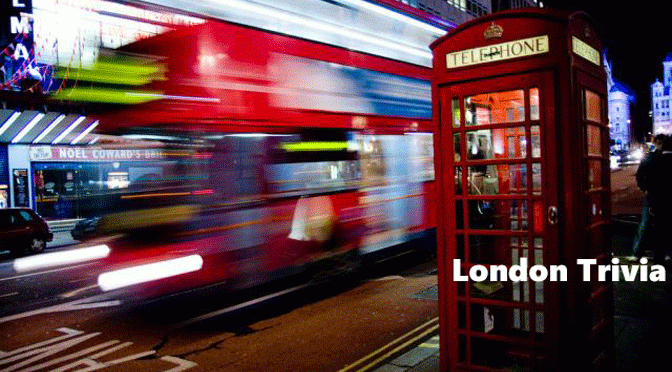
London Trivia: Goodby GLC

On 31 March 1986 the Greater London Council was abolished, with thousands of people taking part in festivities to mark the historic final hours of 97 years of local rule in London. A throng of 250,000 people gathered on the South Bank in London, home to the Greater London Council, which ceased to exist at midnight, festivities ended with the largest display of fireworks ever seen in the city after a week of events costing £250,000.

On 31 March 1986 Lady Gale died in her apartment at Hampton Court Palace, the result of a fire that caused millions of pounds damage

In 1961 Elsie Batten was killed in Cecil Court by Edwin Bush the first UK man to be caught by the use of an identikit picture

The Oxo Tower’s windows were designed in ‘O-X-O’ shapes to get round rules banning neon advertising. Lit up at night they did the same job

The Imperial War Museum was once Bethlem Asylum known as Bedlam where Victorian artist Richard Dadd was incarcerated

The clock above Horseguards Parade has a black mark by the figure II marking the time when Charles I was executed nearby

Artist Rosetti kept several animals in his Chelsea home including a wombat who ate the hat of a woman he was painting

Waterstone’s Islington Green was built as Collins Music Hall where Charlie Chaplin and Gracie Fields were among the performers

Jonathan Trott has never hit a Test six. The only man ever to hit a six over the Lord’s pavilion was Albert . . . Trott. Related (distantly)

Actor Timothy Bentinck who plays David Archer in the long-running Radio 4 soap drama was the voice of “Mind the Gap” on the London Tube

In 1696 Edward Lloyd published London’s first daily newspaper containing shipping information he picked up from customers in his coffee shop

After purchasing a London cab, the immensely rich Nubar Gulbenkian said that a London taxi can turn on a sixpence – “whatever that is”

CabbieBlog-cab.gifTrivial Matter: London in 140 characters is taken from the daily Twitter feed @cabbieblog.
A guide to the symbols used here and source material can be found on the Trivial Matter page.

Previously Posted: Regency retail park

For those new to CabbieBlog or readers who are slightly forgetful, on Saturdays I’m republishing posts, many going back over a decade. Some will still be very relevant while others have become dated over time. Just think of this post as your weekend paper supplement.

Regency Retail Park (04.03.11)

If you should jump into a London cab and direct the driver to Locks he should drive you to number 6 St. James’s Street. That is according to the website of London’s most famous hatters, James Lock of St. James’s. Just don’t ask for a bowler while you’re there, at Locks it’s called a Coke hat, after William Coke a farmer from Holkham, Norfolk, for whom Locks made the first such headgear in 1850.

But this cabbie was surprised to find after reading David Long’s Tunnels, Towers & Temples that Locks have a rear entrance giving onto Crown Passage. For years I’ve driven down Pall Mall (now being transformed with London’s most pointless road works) little realising that alongside Quebec House, with its blue and while flag, lies the entrance to Crown Passage as perfect example of a Georgian shopping centre as you’ll find in London.

Many of the little shop fronts in this side street are Georgian, Lock’s small wooden bay window on its serpentine brackets is a reminder of the period when shopkeepers were starting to be a bit more assertive in their architectural display, pushing their windows out towards the street to attract passers-by. But they were only allowed to invade the pavement-space by so much – there were strict regulations about how far they could protrude. In a narrow street like this – it’s little more than an alley, really – your windows were only meant to stick out 5 inches or less.

Next door the Red Lion pub which calls itself London’s last village pub, this little alleyway has a village feel about it with shops for all your daily requirements: hat, shoes, groceries, papers, dry cleaners and a sandwich shop, there is even a chimney sweep.

The Red Lion also plays a part in a curious custom on 30th January each year when The Royal Stuart Society laments the death of the beloved monarch, Charles I executed in Whitehall on that day in 1649.

Wearing full Cavalier attire they first lay wreaths at the base of the King’s statute at Charing Cross, itself the point where all distances are measured from in London. The statute by Hubert Le Sueur in 1633 has a curious tale. In 1649 John Rivett, a brazier, was ordered to destroy it by Cromwell, but he buried the statute in his garden and made a fortune by selling souvenirs allegedly from the metal. He then gave it back to Charles II upon the Restoration of the Monarchy.

Having done their duty for King and country like many societies The Royal Stuart Society repair to the pub after a job well done, The Red Lion in Crown Passage.

March’s monthly musings

🚓 What Cab News

As I wrote last week, a FoI request discovered the number of black cab drivers entering the the trade sat at just 185 new licensees in 2023. Shows a marked decrease in the number of new taxi drivers licensed over the past nine years in the capital.

🎧 What I’m Listening

Nick Ferrari officially took on the role of his LBC breakfast programme in 2004, running from 7 am to 10 am, with a format of news, political debate and discussion. For a phone-in show, after 20 years he still doesn’t mention the phone number to call the programme.

📖 What I’m Reading

Hedgelands by Christopher Hart appeals to the geek in me, this book is about the humble countryside hedge, and how it’s woven into our language, landscape and culture.

📺 What I’m watching

Spring must have arrived, the bluetits have been busy building their nest in our garden.

❓ What else

Check out Google Arts & Culture: TfL’s Cultural Archive, over 2,000 images and documents: historic documents, images and maps charting the history of public transport in London. Whether you want information about maps, posters, gardens, lost property, the famous moquette, and Johnson typeface.

📆 What date?

The 1st of April is just around the corner, a message will appear on CabbieBlog which isn’t a joke, far from it.


Taxi Talk Without Tipping