

September 2025
🎤 Talking to the Oldies
I’m now booked in to give my cabbie talk in the middle of September. Hopefully it will result in a few donations to Tom Hutley’s fund raising money for the Cabbie Green Huts.
🩺 In praise of the NHS
Everyone said it would catch up with me. My life now seems to revolve around doctor’s phone calls, blood tests, health check ups and consultations. And there was me thinking when I stopped pushing a cab around London I could relax.
✍️ Gloriously bonkers
I’m enjoying Chaz Hutton’s comic graphic take on life. He’s created a light switch, clicking his tongue for audio and drawn, well, a working switch; paradoxical islands; vikings; or explaining a skerry:
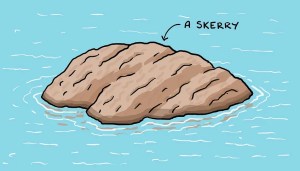
I’ll leave you to seek out Chaz’s description of just what’s a skerry.
🏡 Losing Trust
As lover of the British countryside and a history geek, for the last 50 odd years I’ve been a member of the charity The National Trust, happy to make an annual contribution to maintaining our glorious land, coast and historic buildings. But now The Trust, which looks after about 500 historic properties and thousands of square miles of our most cherished landscapes, is making 550 of its 9,500 employees redundant, apparently to control soaring costs after losing 89,000 members last year. The problem is that the charity needs to go back to basics and concentrate on conserving its buildings and landscapes thus giving its visitors a great day out. Too often in recent years its bosses have seemed perversely determined to infuriate their traditional supporters — the people whose membership fees keep The Trust going — by endorsing trendy social justice and eco-warrior causes. The first signs we noticed of a profound change in The Trust, was whilst holidaying in Jersey, a couple told us they ‘were asked’ to leave after 10 years volunteering after refusing to wear badges promoting a liberal political view of which they disagreed. Since then The Trust has accelerated this egregious wokery, lecturing us on the evils of the colonialism which, after all, enabled The Trust’s properties to be built in the first place, whilst trying to make the charity more ‘inclusive’, when anyone with an interest can join anyway. They have changed the voting procedures enabling members to back The Trust’s governing council by simply agreeing with one keystroke to its recommendation on issues and recommended candidates, who no doubt belong to London clubs which are clearly not inclusive. Former Supreme Court judge, Lord Sumption described the quick vote system as ‘North Korean’ in nature. They’re turning half of its restaurants vegan, I’m expecting the remainder to become halal any time soon. And instead of sourcing locally produced ingredients cooked in their kitchens, they now will offer factory generic culinary delights full of e-numbers. When visiting we don’t expect to be branded white privileged middle class, nor to be lectured on our colonial history. A home baked scone, choice of tea and an afternoon spent in one of the glorious corners of our Island Nation is sufficient. I’m sorry to say my family ticket at £168.60 is unlikely to be renewed.
Last month’s posts and pages:
Most read – Green cab shelters
Least read – 100 years down the drain
Statistics:
1,220 views
694 visitors
37 likes
50 comments



 On 31 August 1888 Mary Ann Nichols’ body was found in Buck’s Row, she was Jack in Ripper’s first victim
 Buckingham House built 1702 which would later become Buckingham Palace was built on the site of a notorious brothel
 A ‘tot’ was an artificial Celtic beacon hill arranged along solstice lines London’s most famous tot hill was Westminster hence Fields and Street
 Richard the Lionheart’s heart is believed to be buried in the churchyard of All Hallows by the Tower, beneath a demolished chapel
 Pear Tree Court on Lunham Road has an 18-room nuclear bunker in the basement, now closed as Lambeth declared the borough nuclear free
 165 Broadhurst Gardens was home to Decca Records until the early 1980s, on 1 January 1962, Brian Epstein paid for an hour audition for The Beatles, but they were turned down by Decca
 Bleeding Heart Yard is almost certainly derived from an ancient religious symbol later adopted by a tavern which once stood on the site
 The footbridge outside Wembley Stadium is named White Horse Bridge after the police horse who controlled the 1923 FA Cup Final
 Building the tunnels for the first section of the District Line (South Kensington to Westminster, 1868) used 140 million bricks
 Until Edward VIII changed the rules in 1936, Beefeaters at The Tower of London were required to sport a beard
 Dulwich College founded in 17th century by actor Edward Alleyn has famous alumni including PG Wodehouse and Ernest Shackleton

 CabbieBlog