

We challenge our contributors to reply to ten devilishly probing questions about their London and we don’t take “Sorry Gov” for an answer. Everyone sitting in the hot seat they will face the same questions ranging from their favourite way to spend a day out in the capital to their most hated building on London’s skyline to find out what Londoners think about their city. The questions are the same but the answers vary wildly.
Roundel Round We Go is a podcast created by two London Underground nerds. In each episode, we draw one of the 272 stations out of a bag, research it, and make a show. Though we love trains, the show goes beyond just the Tube and looks at architecture, local history and how London has been built around the underground network.
What’s your secret London tip?
Emily: In 2018 I rode on every bus in London (they’ve added a few since – I need to catch up), and some take you on remarkable journeys around the city. I love the 210 (Finsbury Park to Brent Cross), 319 (Sloane Square to Streatham Hill), 52 (Willesden to Victoria), 36 (Queen’s Park to New Cross Gate), 139 (Golders Green to Waterloo) and W3 (Finsbury Park to Northumberland Park – great views from Ally Pally). I think I’m showing my north Londoner bias here, but if I’m ever at a loose end in London I’ll always just hop on a bus.
Paul: Despite being a massive enthusiast for public transport, when I’ve got time I love to walk across central London. I’d always visualised London as effectively a series of islands around tube stations, but one day not long after getting a smartphone with maps on for the first time decided to try navigating town on foot. Suddenly I realised not only how close together so much of it is, but also just how quiet and beautiful the many side roads and squares can be only a few dozen metres from even the busiest roads. So my tip is, if you get the chance, don’t hop on the tube or a bus, try wandering through the backstreets of London.
What’s your secret London place?
Emily: Not a specific place per-se, but I absolutely love cycling at night in London, particularly on the quiet side streets. I used to be an usher at the National Theatre, and I’d cycle home at about 10:30 most nights up Hampstead Road and swing off at Mornington Crescent and then cycle up along the railway lines out of Euston. It was such a different world from the business of Camden just a couple of streets away, and it always felt a bit magical.
Paul: South East London Combined Heat and Power – also known as the giant municipal waste incinerator near the Millwall stadium. Not strictly secret given its chimney can be seen for miles, but what is less apparent is that it’s often possible to visit during London’s annual Open House weekend, and is one of the most impressive and exciting buildings to look around. You can see the sci-fi-like control room, open a hatch to stare through a window straight into the flames of the furnace, get almost deafened by the generators, and look over the vast bunker full of waste to watch rubbish lorries empty their loads onto the mounds far below. Best of all, they once even let me have a go operating the crane that moves the waste from the heap into the furnace – it’s like a giant version of the seaside arcade grabber crane games!
What’s your biggest gripe about London?
Emily: Probably a pretty standard one, but the cost of living. I’ve paid way too much of my income to live in mice-infested, falling-down flats in the past – and I’m one of the lucky ones! When I was a teacher, I saw so many families living in poverty, and the level of disparity between people all living in the same city really upsets me.
Paul: I can’t stand the politicisation of transport policy and funding in London. It’s particularly prominent at the moment, but goes back decades, whether that be mayoral vanity projects, imposition of privatisation, starvation of funding… All done for ideological reasons, or even worse political scheming, and totally detached from the genuine needs of the city.
What’s your favourite building?
Emily: The Houses of Parliament – I know that’s the most basic, touristy answer, but my reason is a little more interesting! I used to be a tour guide there for school groups and one of my favourite parts of that job was when we got to do morning inspections of the tour route before the building opened to the public to make sure there weren’t any unforeseen obstacles, and it was always quite magnificent to stand in the middle of Commons or Lords completely on my own and think about all the things that had happened in those rooms. I’d also usually have my headphones on, and so had a history of dancing through the voting lobbies to the great amusement of the security guards.
Paul: 55 Broadway. Until 2019 it was the headquarters of Transport for London, having originally been built as the headquarters for their privately owned predecessor the Underground Group back in 1929. I first visited as a volunteer giving tours of the building for the Transport Museum, and later many times while working for TfL. It is one of those buildings where every visit from my first to my last had a real sense of occasion; entering through teak doors into a marble-clad lobby; climbing the stairs decorated with old enamelled metal tube maps; attending lectures in what was once the chairman’s vast wood-panelled office and holding meetings around what had been the same chairman’s table. The view from the top was quite spectacular too.
At the end of 2019, it was sold to a hotel company, so I’m hoping to be able to visit again in a few years’ time.
What’s your most hated building?
Emily: I have nothing particularly personal against Arsenal fans, but I hate Emirates Stadium. Compared with the beautiful Highbury one (I love walking through the housing complex it is now) and various other recent stadia, I just think it’s not very attractive. Plus, when I lived in Finsbury Park, every time there was a game on, the whole area was massively overcrowded and I could barely get on the tube or a bus. Ironically, however, Arsenal Station is my favourite tube station – I love that it is in the middle of a bunch of terraced houses and it has beautiful platform tiling – so at least something nice came out of massive football overcrowding!
Paul: I absolutely detest St George Wharf in Vauxhall. It’s a giant block of multi-million-pound flats by the Thames which looks absolutely hideous. They form a solid wall of five near-identical buildings, providing no variety or visual interest along their length, blocking all views past them, towering over their surroundings, visible for miles, with a badly-proportioned, ungainly design that combines the excessive size of Soviet-style apartment blocks with the cladding and glazing of a nineties office park.
What’s the best view in London?
Emily: I have a friend who lives in Dawson Heights in East Dulwich – it’s the big, brutalist housing estate by Kate Macintosh you can see really clearly on the Horizon if you’re at the Horniman Gardens. He lives on the north side of the building, and the views from his flat are immaculate. I was once there entirely by coincidence on Bonfire Night, and I saw fireworks go off over all of London – you can see from Wembley to Stratford to and everywhere in between. And the flats are rent-controlled – it’s a very enviable situation! If you ever get a chance to go up there, even to the little park below the flats, I highly recommend it (just don’t be too loud or I’ll hear no end of complaints from said friend).
Paul: Standing on the south end of the platforms at London Bridge station, you can see for over two miles of almost dead straight railway, with up to eleven tracks running in parallel. By daylight, you can see five or more trains running beside each other to and from the station at busy times, like a fantastic synchronised dance that carries tens of thousands of people. At night you can just see the trains’ headlights and tail-lights and above them the rows of signals shining from gantries over the track, controlling this incredibly complex system.
What’s your personal London landmark?
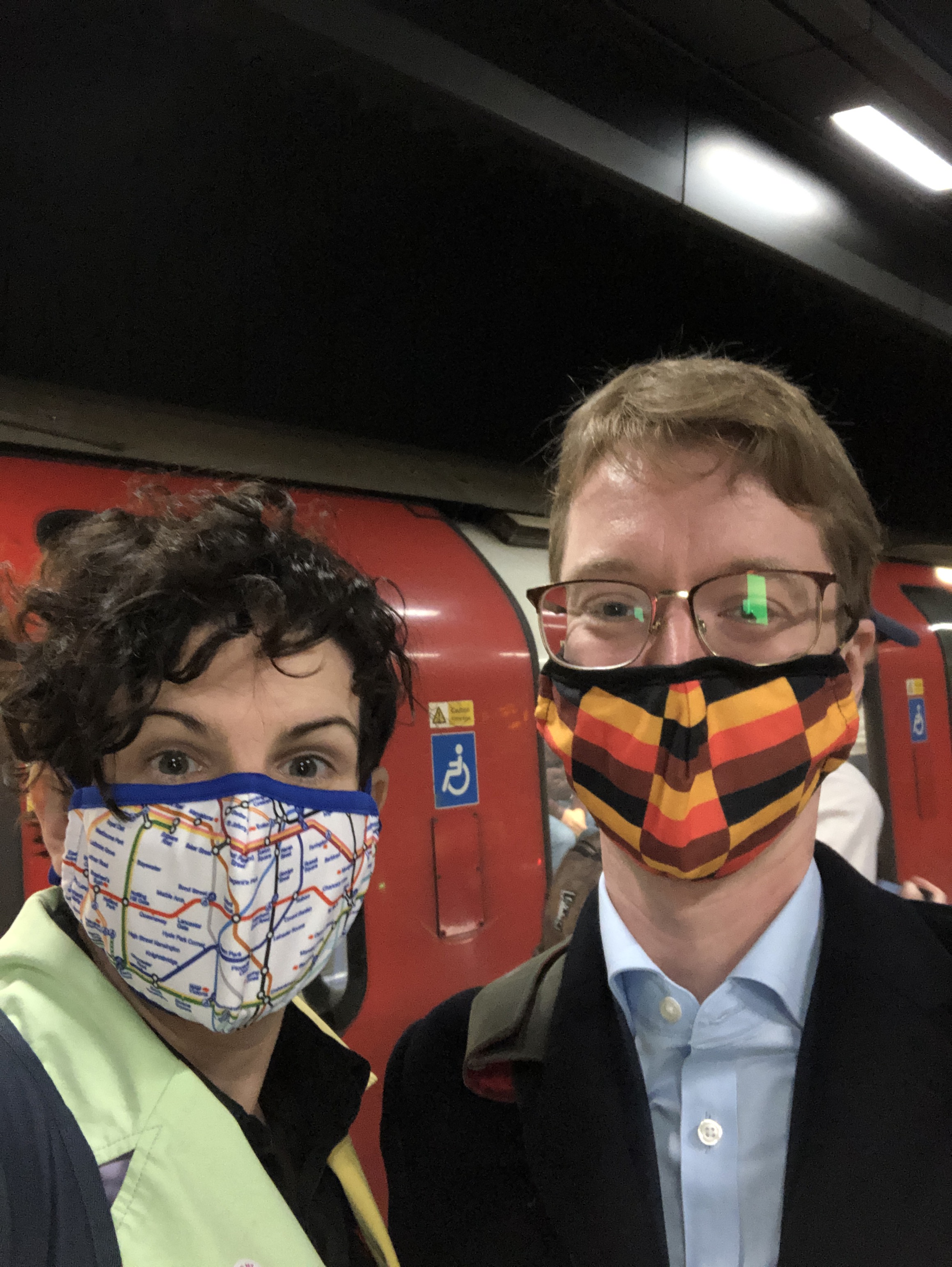
Emily and Paul: I guess for both of us it would be Moorgate Station? It’s where we met in 2020, just before lockdown at a work training event. It was Emily’s birthday and she had made a roundel-shaped cake. We basically haven’t stopped talking since that day.
What’s London’s best film, book or documentary?
Emily: White Teeth by Zadie Smith. I read it when I first moved to London and was living in NW very close to where it was set. Smith is a great storyteller, but I love the intimacy with London geography that her writing has. I haven’t lived in NW for years, but it’s still a place close to my heart.
Paul: Neverwhere by Neil Gaiman – originally a 1996 BBC TV series, then a novel and also a radio drama, telling the story of a man accidentally pulled into a magical underworld version of London. I love how familiar landmarks are reimagined, like the bizarre Earl’s Court complete with jester, and the terrifying Knight’s Bridge which one must risk death to cross.
What’s your favourite restaurant?
Emily: Saki in Crouch End. Vegetarian Sushi is usually pretty lacklustre, but they do this thing called the Rock ‘n’ Roll with sweet potato tempura and avocado that is to die for! I moved out of their delivery range over a year ago and I’ve still not over it – but I still go up there in person when I can and it’s a good excuse to walk up part of the abandoned railway line that is now the Parkland Walk.
Paul: Piccolo Mayfair sandwich bar on Shepherd Street. When I’m doing tours of disused stations for the Transport Museum I like to treat myself to lunch somewhere nice each time, and Piccolo is where I always go when I’m at Down Street. It’s one of those classic deli-greasy spoon-sandwich shop type places, used by a huge variety of the people who live and work in the area. I particularly love their extensive range of delicious toasted paninis.
How would you spend your ideal day off in London?
Emily: Riding buses, and then walking. I’ve walked the Capital Ring, and am about ¾ through the London LOOP, and I love just exploring all the natural spaces that exist within London, particularly whilst listening to podcasts or non-fiction audiobooks. After a long walk, I’d go to the theatre, as I’m a huge theatre fan – ideally to see an exciting new work at somewhere like the Young Vic, Royal Court, or Donmar – but I’m happy in any theatre!
Paul: Working for both TfL and the Transport Museum, I’ve got to see some amazing parts of our transport infrastructure that are usually hidden from the public, either long-closed or not yet opened. But my ideal day off would be to explore all the tunnels I’ll probably never get to see, like the secret government tunnels around Whitehall and quite possibly well beyond. There are rumours of them extending all over central London, maybe out to the suburbs, and I’d love to see how much of that is true.


 On 27 February 1557 the first Russian Embassy opened in London, within a year a trade mission brought sable skins opening up trade routes between England and Russia
 The Neckinger River and the street get their name from ‘devil’s neckinger’ London slang for a handkerchief or the hangman’s noose
 Marble Arch was built as the entrance to Buckingham Palace until it was realised that the arch was too narrow for Queen Victoria’s carriage
 At Holy Sepulchre Church lies buried Captain John Smith who was rescued by Pocahontas when he was Governor Virginia, Pocahontas is buried at Gravesend
 On 27 February 1975 PC Stephen Tibble, a policeman for only 6 months, was shot in Baron’s Court, hours later London’s first bomb factory was found
 The gargoyles on the façade of The Natural History Museum depict the extent of palaeontological knowledge at the time of its construct
 Chelsea buns originate from the Bun House which stood on the junction Lower Sloane Street/Pimlico Road and patronised by royalty until 1839
 Millwall (Rovers) were formed in the summer of 1885 by workers at Morton’s Jam Factory on the Isle of Dogs
 The Austin FX-4 taxi was introduced in 1958 and remained in production until 1996, only the Mini surpasses this record for a British vehicle
 The term ‘Black Friday’ was first used in 1866 when the private banking house of Overend, Gurney and Co collapsed causing panic in the City
 No throughfare is called a road in the City. Road is a corruption of the word ride and the streets of the City were too narrow for carriages


 CabbieBlog