For those new to CabbieBlog or readers who are slightly forgetful, on Saturdays I’m republishing posts, many going back over a decade. Some will still be very relevant while others have become dated over time. Just think of this post as your weekend paper supplement.
Harry Gordon Selfridge (12.02.13)
Over the years Harry Gordon Selfridge has had many imitators: Swan & Edgar, Dickens & Jones, Bourne & Hollingsworth, Marshall & Snellgrove but none have matched him for innovation and flair. If you, like me, are watching ITV’s drama Mr Selfridge and don’t want to read any plot spoilers, look away now.
Harry Selfridge was an American self-made millionaire and he did that by understanding how women shopped, he invented the phrase ‘the customer is always right’ and gave his iconic department store sex appeal when his competitors were still left in the Victorian era.
What the ITV drama, Mr Selfridge hasn’t dwelt upon, although it is loosely based on Lindy Woodhead’s biography: Shopping, Seduction & Mr Selfridge is his early life.
Harry was born in Wisconsin in 1856, but within months he moved to Jackson, Michigan where his father had acquired the town’s general store. At the outbreak of the Civil War, his father joined the Union Army rising to the rank of Major. When discharged from the army his father deserted his family when Harry was just five. Within a short time, his two older brothers died, leaving Harry and his mother to cope alone.
At 10 years old he was delivering newspapers and by 12 he was working in a local store at the same time he created a monthly boy’s magazine.
After becoming redundant at 20 as a bookkeeper at a local furniture factory his ex-employer, Leonard Field, agreed to write Selfridge a letter of introduction to Marshall Field in Chicago where he started as a stock boy. Over the next 25 years, he rose to become a partner in the company and married into a prominent Chicago family.
He invented the phrase ‘Only – Shopping Days until Christmas’ and ‘The customer is always right’. Dubbed ‘Mile-a-minute Harry’ because of his tremendous energy and fountain of ideas, he was the first person to suggest lighting shop windows at night and the first to open an in-store restaurant. He then founded his own, rival store, which he sold for a huge profit.
At the age of 50, flushed with success he determined to travel to London which, with its fusty and unwelcoming stores, was ripe for a retail revolution. On one visit to London, he had gone into a store and a snooty assistant asked what he wished to purchase. When Selfridge replied that he was ‘just looking’ the assistant dropped his posh accent and told him to ‘’op it, mate.’
Selfridge decided to invest £400,000 in building his own five-storey department store in what was then the unfashionable western end of Oxford Street. The new store opened on 15th March 1909, setting new standards for the retailing business.
Assistants were encouraged to help customers rather than patronise them, and goods were displayed so they could be handled. There were elegant restaurants with modest prices, a library, reading and writing rooms, special reception rooms for French, German, American and “Colonial” customers, a First Aid Room, and a Silence Room, with soft lights, deep chairs, and double-glazing, all intended to keep customers in the store as long as possible. Before Selfridge, cosmetics and toiletries had been hidden discreetly away at the back of the shop, considered too racy and taboo to be on display. Moving scents to the front entrance of Selfridge’s so that people entering were assailed by a cloud of sweet scents was revolutionary, and it worked like magic.
Selfridge also managed to obtain from the GPO the privilege of having the number ‘1’ as its own phone number, so anybody had to just dial 1 to be connected to Selfridge’s operators. He proposed a subway from Bond Street Station to his store that was squashed as was his idea of building a massive clock tower on the roof just like Wickhams department store on Mile End Road. His architect told him with its weight it would fall through the roof.
Selfridge was an innovator: the store sold telephones, and refrigerators and in 1925 held the first public demonstration of the television. His attention to detail was legendary: he was known as The Chief and would patrol the floors every day.
Unfortunately, his womanising would be his downfall. After installing his family at Highcliffe Castle near Christchurch in Dorset (the council and English Heritage have recently restored this magnificent building) he could pursue beautiful women. After his wife died in the influenza pandemic in 1918 along with millions of others that year his spending on women took on a whole new dimension.
He also began and maintained a busy social life with lavish entertainment at his home in Lansdowne House located at 9 Fitzmaurice Place, in Berkeley Square. Today there is a blue plaque noting that Gordon Selfridge lived there from 1921 to 1929. By 1939, exasperated with his profligacy, Selfridge’s board ousted him from the business he had created 30 years earlier. He owed £150,000 to the store and £250,000 to the Inland Revenue — around £8 million and £13 million in today’s money.
The Selfridges board removed the apostrophe when he left and cut his pension by two-thirds. He ended up in a rented flat in Putney and would often take the bus to Oxford Street to gaze at his creation. By then, his clothes were so shabby that he was once arrested as a vagrant.
In 1947, he died in straitened circumstances, at Putney, in south-west London. Selfridge was buried in St. Mark’s Churchyard at Highcliffe, next to his wife and his mother.

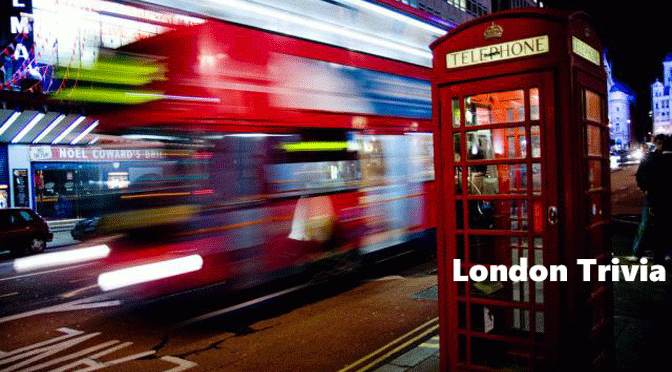
 On 29 March 1981 at 09:00hrs in Greenwich Park 6,700 runners set out to run the first ever London Marathon
 Legally children should obtain written permission from the Chief Constable before seeking to ask “A penny for the Guy, Mister?”
 On 29 March 1871 the Prince of Wales opened the Albert Hall on behalf of his mother HM Queen Victoria, who was present but too overcome with emotion to speak
 On 29 March 1772 mystic Emanuel Swedenborg died in Wapping. He had predicted there would be a special part in heaven reserved for the English
 The owner of Tony Blair’s old house in Barnsbury has painted the front door Labour red. Blair’s house in Connaught Square, as with No 10 is black
 The famous music hall song On Mother Kelly’s Doorstep is based upon a real location that can be found at Paradise Row, Bethnal Green
 London’s first gastro pub the Guinea Grill, Bruton Street opened in 1952, a tavern is believed to have existed on the site since 15th century
 London’s oldest golf club is The Royal Blackheath formed by Scottish courtiers visiting Greenwich Palace in 1608 in whose ground they played
 In 1952 a 78 bus was on Tower Bridge when it started to rise – the driver put his foot down and jumped the widening gap, he got £10 for his bravery
 Waterloo Bridge is known as the Ladies’ Bridge, because it was completed by female labourers during the Second World War
 On the corner of Trafalgar Square is the official standard (in brass) for inch/foot/yard/etc it is accurate at 62 deg Fahrenheit
 Trivial Matter: London in 140 characters is taken from the daily Twitter feed @cabbieblog.



 CabbieBlog