
Category Archives: Puppydog tails
Protected: . . . And then three came along at once
London in Quotations: Jane Austen

The truth is, that in London it is always a sickly season. Nobody is healthy in London, nobody can be.

Jane Austen (1775-1817), Emma
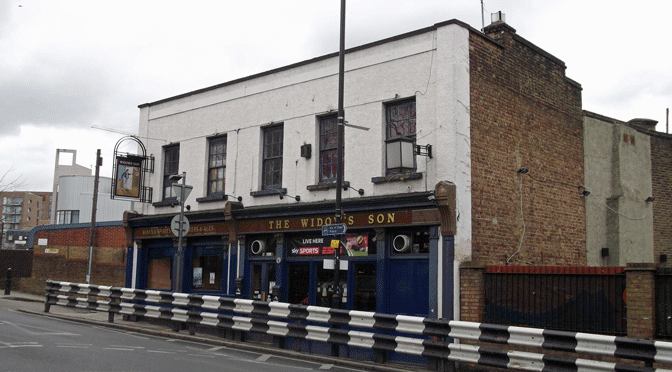
The widow’s son
Just up the road from Beaumont Square is the Widow’s Son in Devons Road which is a Grade II* listed public house built in the 19th century with an interesting history, featuring a Christian festival behind its name.
The story is that a widow’s house previously stood on the site. Expecting her sailor son home from the sea during the Napoleonic wars one Easter, she naturally baked him a hot cross bun, but unfortunately, he did not return. The widow lived in hope and next year made another bun, and so on.
It was commonly believed at that time, that bread or buns baked on Good Friday would never grow mouldy and had a marked medicinal value, it was also not unknown for such items to be hung up.
After her death years, stale buns were found hanging from a beam in her cottage, inevitably the house became famous for its collection of buns, and when in 1848 a pub was built on the same site it was naturally called the Widow’s Son and the custom continued; each year a sailor bringing another bun to be hung from the pub’s ceiling. The tradition almost ended when ironically the lease on the Widow’s Son ran out a week before Easter, with developers wanting to turn the site into yet another a block of flats.
Thankfully the tradition is back at the Widow’s Son after the enthusiasm of the new landlord and the participation of sailors from the training ship HMS President which is permanently moored alongside the Victoria Embankment.
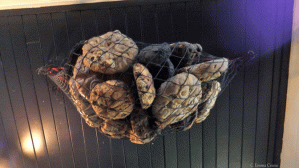
You can see the current, currant buns (sorry!) in the net.
Featured image: The Widow’s Son, Public House, Bow, a grade II listed public house on Devon’s Road, opposite Campbell Road, by David Anstiss (CC BY-SA 2.0)
A Journey by a 1950’s London Bus
I came across this production by the Colonial Film Unit which tells those who find themselves in a foreign land, just how to identify a bus, the reasons we have a conductor, how to buy a ticket, and importantly how to queue. It’s just the sort of essential information our cousins from Africa would have needed in 1950 to assimilate themselves into British society. It also reinforces the perception that everyone speaks in either a plummy received pronunciation BBC accent or is a cockney urchin.
Opening scenes show Piccadilly Circus teeming with buses and cabs, some looking to be pre-1914 models. No cars or lorries are to be seen.
In case you haven’t realised, we are told that these “splendid” buses will transport you out of “the largest city in the world”, and yes, they will actually retrace their route back to the Metropolis, but we are told that one must ensure the bus is travelling in the correct direction for one’s needs.
The narrator describes how two “African students studying in London”, who’ve been walking across fields in the badlands of Potters Bar, now need to get back to their studies and prepare to catch the bus. They remarkably manage to join a queue at the bus stop, presumably having been told by the upper-class documentary makers at just what end of the queue to stand.
The Cockney conductor, after ensuring everybody is safely seated, collects the fares. The film is at pains to show even our African students are capable of purchasing a ticket, but our guinea pigs don’t have the correct change, which the narrator tells us that it’s just not the British way.
Later in the journey, as if to reassure the public, the bus manages to stop for schoolchildren at an early pedestrian crossing.
At the end, the students alight from the bus to a cheery wave from the conductor, before unhurriedly crossing the road, presumably the subject of another documentary to teach bright African students how to traverse England’s highways.
Wonderfully politically incorrect, and evocative of post-war Britain, when only those with the correct accent had the brains to use buses and a much-needed teaching aid for Johnny Foreigner.
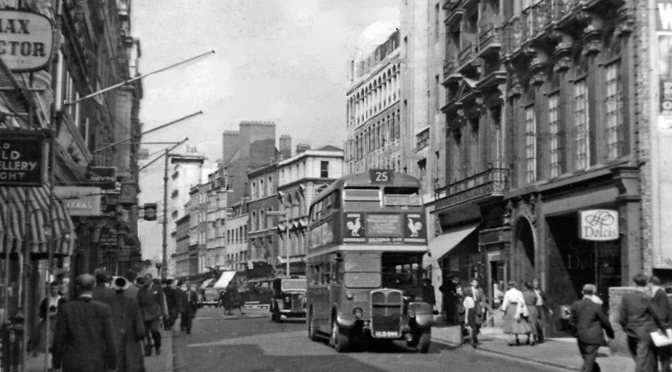
Featured image: Northward up Old Bond Street from Piccadilly, the 25 bus, the only route on Bond Street, is bound for Victoria from Becontree Heath by Ben Brooksbank (CC BY-SA 2.0)
 CabbieBlog