
I’ve been walking about London for the last thirty years, and I find something fresh in it every day.

Walter Besant (1836-1901), on his deathbed, 9th June 1901

I’ve been walking about London for the last thirty years, and I find something fresh in it every day.
Walter Besant (1836-1901), on his deathbed, 9th June 1901
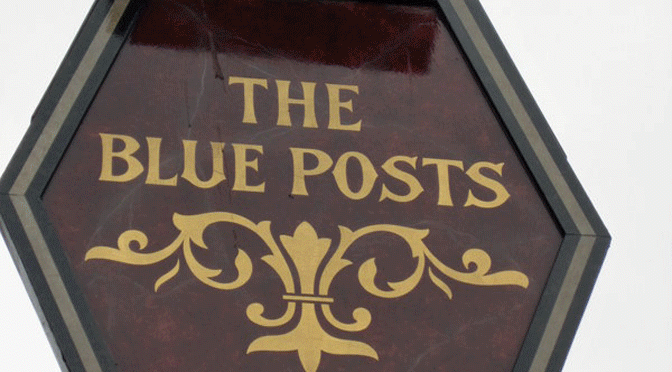
Have you noticed the preponderance of pubs named the Blue Posts? A simple tally shows at least five plus, as is inevitable in London nowadays, there are others which have closed to allow yet more ’executive apartments’ to be built.
For many years it was thought that while barber/surgeons sported a red and white striped pole outside their premises, a pair of blue posts denoted that this was a sedan rank.
So how many blue posts pubs are, or were, in London?
Cowcross Street (now called Jacomo’s); Berwick Street; Rupert Street; Kingly Street (now a gastropub); Hanway Street (closed); Old Bond Street (called Two Blue Posts, now closed); Cork Street (called Old Blue Posts, a famous dining room, closed in 1911); Newman Street and Shoe Lane. The Blue Posts in Bennet Street has the following sign hanging above this St James hostelry featuring a sedan chair and two brilliant-blue bollards:
Although the existing ’Blue Posts‘ replaces the one which was destroyed during World War II, a pub of this name, on this site, was mentioned by the Restoration dramatist George Etheredge as early as 1667. The poet Lord Byron lived next door in 1813. The ‘Blue Posts’ (two azure painted poles) once stood in the tavern’s forecourt and served as an advertisement for a fleet of sedan chairs which used to ply for hire in Bennet Street.
In 1634 the first rank for horse-drawn cabs was the brainchild of Captain John Baily, situated on the Strand near Somerset House. Unlike the old sedan ranks with their tiny blue posts this nascent rank was next to a 100ft maypole, no wonder they usurped the sedan chairs.
Horse-drawn vehicles for private hire had been around in one form or another since medieval times. But no one had attempted to operate from a designated waiting place, or rank, until the 17th century, pioneer Captain John Baily, was a veteran of one of Sir Walter Raleigh’s expeditions.
He managed a rank of four horse-drawn carriages, Baily’s cabmen wore a distinctive livery and charged customers a fixed tariff depending on the distance. The rank was positioned close to the Strand maypole, a prominent medieval landmark. This towered 100ft high, making it one of the tallest structures in London at the time. It must have made the cab rank very easy to find.
Baily’s cab rank scheme appears to have worked well, and others soon appeared. The cab profession was given official approval in 1654 when one of the first Acts of Parliament under Oliver Cromwell set up the Fellowship of Master Hackney Carriages, under the control of a court of aldermen in the City of London, and initially restricted to 200 cabbies.
Featured image: The Blue Posts on Eastcastle Street by Ian S (CC BY-SA 2.0)(CC BY-SA 2.0)
The City of London, whose resident population hardly equals that of Dover, but whose precincts over a million persons enter daily, Sunday excepted, on business bent.
A. H. Beavan, Imperial London
Much as I hate to agree with that tedious old git Samuel Johnson . . . I can’t dispute it. After seven years of living in the country in a sort of place where a dead cow draws a crowd, London can seem a bit dazzling.
Bill Bryson (b. 1951)
 CabbieBlog