
Category Archives: An urban view
Protected: Four-Three-Two-One, Happy New…
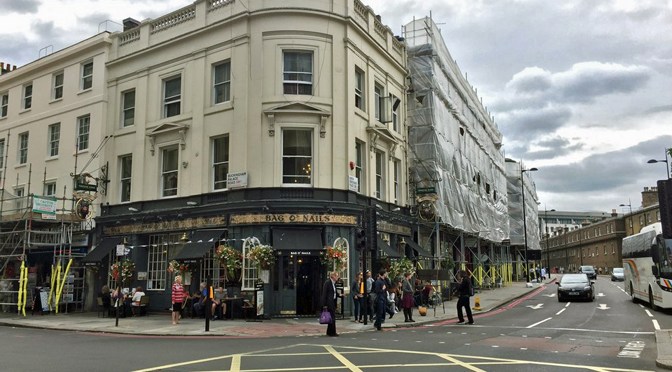
Why are pubs on street corners?
Why are London pubs so often situated on street corners, and why didn’t developers hardly ever construct pubs in the middle or halfway down a terrace?
The whole building of the pub is always divided into several sections: saloon or lounge, parlour, public bar, snug, counter, and beer engine. Most of the time, one side is allocated for a saloon or lounge, while the public bar is exactly that. The parlour or saloon is mostly reserved for business persons, and they used to sit here with a modicum of privacy and discuss business matters, away from the riff-raff in the public section. In addition, many public houses also provided limited accommodation and a beer garden.
Landowners controlled large pieces of land and worked with developers through the leasehold system. The landowners let plots out to the developers, who paid for the construction of long terraces, and the developers borrowed to pay construction costs.
The pubs, therefore, were built first to house, feed and water the builders. In the worst case, the pub and its licence could be flogged off to pay for finishing the terrace.
The developer could lend building money to plumbers, glaziers and construction workers who’d do the work on each other’s homes for free – so everybody won. And the pub remained on the corner after they’d all finished, ready to provide them with a social focus. Thus the pub was there first and last, throughout the lives of those who lived in the terraces.
Odd fact: Griffin Park, where Brentford FC play, is the only football ground with pubs at all four corners.
The Bag o’ Nails on the corner of Lower Grosvenor Place by Alan Hughes (CC BY-SA 2.0)
Protected: Hidden London: Bermondsey Market
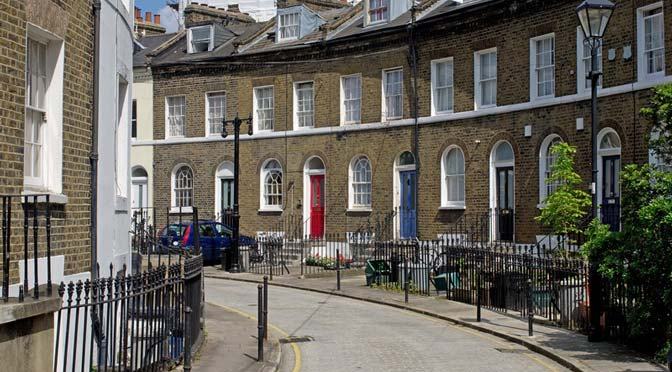
Europe’s smallest crescent
Keystone Crescent, just a few minutes walk from King’s Cross, reputedly has the smallest radius of any crescent in Europe, and is unique in having a matching inner and outer circle.
This tiny street consisting of only 24 houses is to be found at the southernmost end of Caledonian Road. Robert James Stuckey, whose father was a bricklayer, built the crescent in 1846 and imaginatively called it Caledonian Crescent, its shape was probably chosen to make the most of an unusually shaped site.
The houses would have initially been those of lower/middle class, working families. According to London Living History, in 1851 there were 240 people, of 76 families, living in 22 houses, with many properties rented out by the Stuckey family, with 2A acting as the estate office.
Up until recently, the area has had a reputation for deprivation and prostitution, and in the early 1900’s Algerton Stuckey, Robert’s grandson wanted to redevelop his investment. The plans fell through, however, he did change the name to Keystone Crescent, presumably to make it sound more appealing. Ninety years later, when the Channel Tunnel was being proposed, a new station was planned next to King’s Cross, this would have involved half of Keystone Crescent being demolished to dig the hole required to build the station.
Researching the history of Keystone Crescent, Jack Chesher from Living London History came across a dramatic story about the Stuckey family:

A stash of letters and personal items belonging to Robert Stuckey was discovered by his descendants under the bed at number 2A. They are generally about everyday occurrences, however also reveal a shocking secret: he had a second family!
Robert first married Hannah Bennewith, with whom he had 7 children. He then married Sarah Culver in 1864, with whom he also had 7 children, this time using the surname ‘James’ (his middle name). Hannah died in 1857 but the letters reveal that the two relationships ran alongside each other. Indeed, Robert’s first child with Sarah (the 2nd wife) had arrived in 1841. Whether Hannah knew she was sharing his affections with another woman is unclear but this was all certainly news to Robert’s descendants.

Bob Stuckey has had the letters transcribed and you can buy them here.
Keystone Crescent, King’s Cross, mid 19th century terraced houses in a crescent just off the Caledonian Road. Grade II listed by Jim Osley (CC BY-SA 2.0)
 CabbieBlog