

For those new to CabbieBlog or readers who are slightly forgetful, on Saturdays I’m republishing posts, many going back over a decade. Some will still be very relevant while others have become dated over time. Just think of this post as your weekend paper supplement.
Cabbie entente cordiale (04.01.13)
Tourists it seems, still think of the traditional London cab as an iconic symbol of London. It was rather reassuring to me when I was contacted by Amandine late last year who was working for a French publisher of tourist guides wanting to include a London cabbie in this year’s French London guide.
My return to London after the New Year break was not to sit on a rank, at this the quietest time of the year, in the forlorn hope of getting a fare. No today I was to be interviewed and spend time being photographed beside my cab.
Amandine, I was relieved to discover spoke perfect English, just as well for I can just about order a coffee in French.
After meeting outside Leadenhall Market we drove to Westminster Abbey and parked in the forecourt outside the south entrance. The Abbey is too large a building to be photographed at such close quarters, but in winter with the trees stripped of their leaves, the Sanctuary, to give it its correct title, is perfectly positioned to photograph Big Ben in the distance.
It was not long before the photographer; Regis and his assistant Caroline were asked for a photography permit. We were informed that this land was owned by the Abbey.
For a place of worship needing £150,000 a day just to maintain the fabric of the building, one would think publicity would be embraced.
After a short period of discussion it transpired that while the Abbey is trying to forge stronger bonds with Rome, entente cordiale seems not one of their priorities.
With the cost of travel falling year-on-year, the tourism industry has found it much tougher to attract to London the much-needed Euro and Dollar, and yet no one seems prepared to support the very unique aspects of our Capital.
The old Routemaster bus was replaced by a German bendy bus seen in many towns in Europe. After much public debate, a token route is now maintained.
Drive around central London and every tourist wants to be photographed opening a red telephone box. With their demise with the advent of the mobile phone, we are left with a stock of dirty boxes advertising ‘adult services’. How much would it cost to clean them up?
Now we can see on the horizon the demise of the traditional London cab. Its predecessors the Fairway and FX Series are being withdrawn from service. Now deemed to pollute London’s atmosphere. While the manufacturer of the current model has been placed into administration as a buyer is sought, many in the trade feel that it is the end for the black cab.
The only current alternative is a converted van from a German manufacturer, the like of which could be seen around the world. The Queen’s Diamond Jubilee and the highly successful 2012 Olympics have shown London in the best light for a generation, now is not the time to sit back and wait for the world to come to us.
We need red buses, red telephone boxes and yes, at this time we should have a colour prejudice – black cabs.


 On 8 February 1983 champion thoroughbred Shergar was kidnapped in Ireland, never found Lloyds of London paid $10.6 million insurance
 Little Ease dungeon at the Tower is too small to stand, lie or walk forcing its occupant to squat painfully in the dark for days on end
 The Millennium Dome (O2) the largest structure of its kind in the world big enough to house the Great Pyramid of Giza or Statue of Liberty
 On 8 February 1960 Sir Giles Gilbert Scott, architect of Waterloo Bridge, Battersea & Bankside Power Stations and the red telephone box died
 The ashes of former Prime Minister James Callaghan are scattered next to the Peter Pan statue at Great Ormond Street hospital
 On 8 February 1819 writer and art critic John Ruskin was born at 54 Hunter Street, Brunswick Square, Holborn
 Stone blocks outside the Athenaeum Club, Pall Mall were installed to assist the rather short Duke of Wellington mount his horse
 Greater London is 607 square miles, if grassed over it would total 220,000 football pitches – but without room for spectators
 When the first escalators were installed at Earls Court Station a one-legged man was employed to demonstrate their safety and ease of use
 According to Guinness World Records Whitechapel Bell Foundry in London’s East End established in 1570 is Britain’s oldest manufacturing firm
 On the London Eye, despite there only being 32 capsules, for superstitious reasons they are numbered 1-33, for good luck number 13 is left out

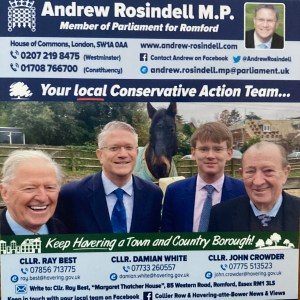
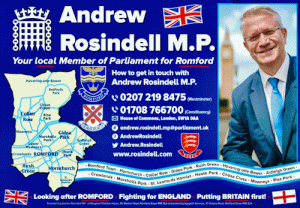 Andrew is convinced that Romford shouldn’t be in Europe, be a part of London, or within the embrace of the political party he’s been a member of since he was 14. He has proposed that “Havering Belongs in Essex – Not Greater London”. Andrew loves to use the coat of arms of the long-defunct Municipal Borough of Romford, so it appears on his flyer. I suspect soon we’ll have Romford passports.
 CabbieBlog