For those new to CabbieBlog or readers who are slightly forgetful, on Saturdays I’m republishing posts, many going back over a decade. Some will still be very relevant while others have become dated over time. Just think of this post as your weekend paper supplement.
Rage against the machine (13.04.12)
This year’s mayoral race is following the predictable campaign that you would expect from the front runners, all the time honoured issues are being aired and as per usual it looks like a two-horse race. Fortunately for Londoners, some with more eccentric views have made their voices heard over the years on the Capital’s streets which have both amused, entertained and informed us in equal measure.
STANLEY GREEN An entrepreneurial spirit has at times been commendable with some individuals, for example, Stanley Green who upon retirement from the civil service decided against taking up golf, but chose to spend the next 30 years warning us of the dangers of protein. “Protein makes passion” his printed leaflets exclaimed, so reduce your consumption of fish, bird, meat, cheese, egg, peas, beans, nuts and well err . . . sitting, and the world will be a happier place. From 1968 until his death in 1993 Stanley sold his own pamphlet called “Eight Passion Proteins with Care”, which sold over 87,000 copies. With an eccentric approach to punctuation, the document was 14 pages long and rendered in a smorgasbord of font faces and weights, it also existed in a 392-page book form, which the Oxford University Press rejected in 1971.
WILLIAM BOAKES Riding a bicycle festooned with slogans and driven by a solidly-built, elderly gent Bill Boakes fought his first Parliamentary contest in 1951 when he stood for election at Walthamstow East polling 174 out of 40,041 votes cast; in 1956 he tried his luck again but this time in Walthamstow West, where he had an even worst result at 89. After a 30-year career in the Navy (he was a gunnery officer at the sinking of the Bismark) he stood under the banner: ‘Public Safety Democratic Monarchist White Resident.’ Road safety was central to his manifesto, that and a little racism thrown in for good measure. He would push a pram loaded down with bricks onto pedestrian crossings to make the point that motorists should slow down. He is pictured here in his ‘campaign bus’. It was actually a 140lb armoured bicycle hung with road safety and other posters that cleverly concealed an iron bedstead. Sadly for one who dedicated his life to road safety, he was injured whilst stepping off a bus and died from complications to a head injury.
GEORGE CECIL IVES Was a poet, writer, penal reformer and early gay rights campaigner. Born in Germany the illegitimate son of an English army officer and a Spanish baroness, he was educated at Magdalene College where he started to amass 45 volumes of scrapbooks of press clippings of murders, punishments, freaks, theories of crime and punishment, transvestism, psychology of gender, homosexuality, cricket scores, and letters he wrote to newspapers. In 1897 Ives created and founded the Order of Chaeronea, a secret society for homosexuals which was named after the location of the battle where the Sacred Band of Thebes was finally annihilated in 338 BC. Working to end the oppression of homosexuals, what he called the ‘Cause’ he hoped that Oscar Wilde would join the ‘Cause’, but was disappointed. He met Wilde at the Authors’ Club in 1892, Wilde was taken by his boyish looks and persuaded him to shave off his moustache, whereupon he kissed him passionately the next time they met in the Travellers’ Club. In later life he developed a passion for melons, filling this house with them. When the Second World War ended he refused to believe it and carried a gas mask with him everywhere in a case until his death.
DAVID SUTCH Screaming Lord Sutch founded the Official Monster Raving Loony Party in 1983 and fought the Bermondsey by-election. In his career he contested over 40 elections, rarely threatening the major candidates, but often getting a respectable number of votes and was easily recognisable at election counts by his flamboyant clothes. It was after he polled several hundred votes in Margaret Thatcher’s Finchley constituency in 1983 that the deposit paid by candidates was raised from £150 to £500. His most significant contribution to politics came at the Bootle by-election in 1990 securing more votes than the candidate of the Continuing Social Democratic Party (SDP), led by former Foreign Secretary David Owen, within days the SDP dissolved itself. In 1993, when the British National Party gained its first local councillor, Derek Beackon, Sutch pointed out that the Official Monster Raving Loony Party already had six. He committed suicide by hanging on 16th June 1999.

 On 13 April 1999 a nail bomb exploded in Brixton, injuring at least 45 people, it was thought that the target was the largely black clientele of Brixton Market
 In Oliver Twist Charles Dickens sited Fagin’s Lair in the notorious area that existed around the current Saffron Hill
 In the 11th century, Brixton was known as ‘Brixistane’ meaning ‘the stone of Brihtsige’. Locals used the stones as a meeting place
 Behind the stalls of Islington’s Sadlers Wells Theatre is the well containing medicinal water which Thomas Sadler found in 1684
 The House of Commons’ press gallery bar is named Moncrieff’s in honour of respected political journalist, Chris Moncrieff – a teetotaller
 George Orwell used Senate House in Bloomsbury as the inspiration for The Ministry of Truth in his book 1984
 Birdcage Walk was the site of the 17th century Royal Aviary. Diarist John Evelyn spotted “many curious kinds of poultry” here
 In 1922 in the rafters of Westminster Hall was found a tennis ball dating from before 1520 made of leather and stuffed with dog’s hair
 In between Golders Green and Hampstead the tube slows down for the ghost station “Bull and Bush”, a station which was never built
 In the early 80’s comic Jo Brand worked as a psychiatric nurse at the Maudsley Hospital, Denmark Hill, a fact of her life she will often talk about
 Chains from Brunel’s Hungerford Bridge, demolished in 1864, were re-used as part of the Clifton Suspension Bridge in Bristol
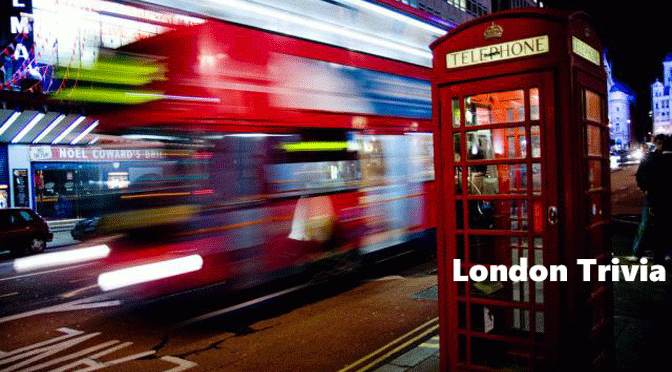
 Trivial Matter: London in 140 characters is taken from the daily Twitter feed @cabbieblog.


 CabbieBlog