

For those new to CabbieBlog or readers who are slightly forgetful, on Saturdays I’m republishing posts, many going back over a decade. Some will still be very relevant while others have become dated over time. Just think of this post as your weekend paper supplement.
The King’s Cross Lighthouse (16.10.12)
It has been degenerating since Edison Lighthouse appeared in the charts during the 70s and has lay empty for years, but recently scaffolding has appeared surrounding the building. Could this be the start of the regeneration that this forlorn building has needed for the best part of a quarter of a century?
Sandwiched between two converging roads – Pentonville Road and Gray’s Inn Road – opposite King’s Cross railway station perched on top of a narrow building, sometimes referred to as the flatiron building (it shares a similar footprint to the iconic Manhattan block), stands an architectural folly some people think of as a windmill or lighthouse.
It has looked much as it does today since 1884 but its date of building and original purpose are unknown.
Now apparently owned by the splendidly named – The Peninsular and Oriental Steam Navigation Company (or just P&O) it has been left to rot in this area of huge regeneration.
There are many explanations for this strange Grade II listed building, which was erected in 1875, but no one seems to be absolutely sure. It has been semi-derelict for many years and always seems to be on the point of being regenerated, or falling down, but never quite getting there.
Used as the location for Harry Palmer’s office in the 1967 film Billion Dollar Brain, some say it was a clock tower, Victorian helter-skelter, or even a camera obscura.
Another explanation, although it has to be said that no other examples have been found, is that when oysters were the cheap and popular fast food of the day, Netten’s Oyster House was marked with a lighthouse – a kind of the Mcdonald’s golden arches’ of their day.
An architectural practice called Richard Griffiths has been charged with redeveloping the area, so it’s already spawned a suitably gentrification-friendly, nom-de-plume, ‘The Regent’s Quarter.’
Let us hope this eccentric and loved building gets the refurbishment that it deserves.




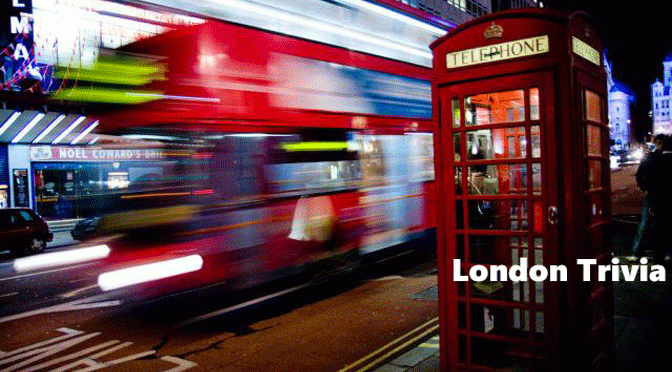
 On 2 November 1953 the Samaritans, based in the crypt of St Stephen’s Walbrook, received its first call. It was founded by the Revd Chad Varah, vicar of St Stephen’s, with the stated aim ‘to befriend the suicidal and despairing’
 On 2 November 1824 Henry Fauntleroy, a partner of Marsh, Sibbald 81 Co., bankers of Berners Street, was sentenced to death for forgery. He was executed at Newgate before an estimated 100,000 people
 In Star Yard Holborn stands a late Victorian gents’ ‘pissoir’. Another one in is to be found in Twickenham, a similar example is in Regency Street
 In 19th century London, middle class men lived to 45, workmen and labourers life spanned half that time and children were lucky to survive until five
 It was at the Merchant Taylor’s Hall, in 1607 in honour of King James I, that the National Anthem was first sung
 The West End’s oldest theatre, Theatre Royal Drury Lane, is also reported to be haunted by the Victorian music hall star and panto dame Dan Leno, whose spirit is said to exude the scent of lavender oil
 You are allowed to use a camera in a London Royal Park, but not a tripod, nothing is mentioned about the use of a monopod
 Richmond Golf Club’s 1940 rules: Known unexploded bombs are marked by red flags at a not guaranteed safe distance, a player whose stroke is affected by a explosion may play another ball from the same place
 There are thirty-three bridges of all types across the tidal Thames up to Teddington Lock, a distance of just under 99 miles
 Filming on location in the Underground costs £500 per hour (plus VAT) unless you have a crew of less than five
 At 440 feet the village of North End on the edge of Hampstead Heath is the highest inhabited point in London
 CabbieBlog