

I am always looking out for cabmen’s shelters and recently the Crich Tramway Village contacted me about the completed restoration of a 19th-century Bradford Cabmen’s Shelter.
 At the beginning of 2020, the Museum started a project to restore and interpret a rare and early example of a cabmen’s shelter. The shelter dates from 1877, only two years after London opened its first in St. John’s Wood, and this shelter was the first for Bradford.
The shelter started its life outside Christ Church in Darley Street, Bradford, the church was demolished in 1879 and the shelter was moved to the entrance of Exchange Railway Station, itself demolished in 1973.
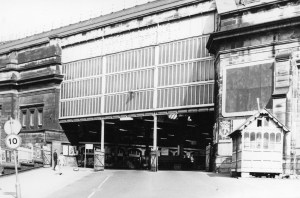 Outside Exchange Station – photographer J. H. Meredith, The National Tramway Museum Collection
In 1973 the shelter was donated to the Museum by the Bradford Taxi Association, to save it from being broken up. Designed gratis by local architects T.H. & F. Healey and built by Messrs. Johnson and Smith, it cost £194 which was paid for by funds raised by the ‘Ladies’ Committee’.
The Building News of 1878 reported that “The structure is of pitch-pine, stained and varnished, the roof laid with felt upon the boarding and then covered with sheet zinc. The very compact stove contains an oven, hot plate, and boiler for supplying warm water for the horses – an arrangement much appreciated by the cabmen.”
The architects’ drawings show the interior of the shelter fitted with lockers under the bench seating, a table with a coal locker beneath, and a lavatory, clarified by The Bradford Observer of 26th November 1877 as a ‘wash basin’.
 Although structurally unsound the museum aimed to take the shelter back to its original form, whilst retaining as much as possible of the original structure that remained in a sound and conservable condition.
Most of the exterior of the shelter was still original, apart from the roof which had already lost its zinc covering before it arrived at the Museum and had been covered with tiles at some point, also there was no visible evidence of the clerestory roof, as evidenced in the original drawings. A very similar surviving shelter at Embsay and Bolton Abbey Steam Railway was used as a point of reference for both the corrugated zinc roof and the clerestory.
 Painted various shades of blue during its time outside Exchange Station Bradford, possibly in line with the occupying railway companies (L&YR/GNR Joint, L&NER, British Railways, North Eastern Region). No records of the shelter’s original colour could be found except the reference in The Building News of 1878 which reported that it was ‘stained and varnished’.
The conservators found beneath the numerous layers of dark and pale blue, a base layer of tan paint, finding only evidence of white paint on the upper half. The shelter’s original colour was likely to have been created from a mixture of white lead paint and iron oxide which could not be accurately replicated using modern non-toxic surface finishes. The colour which was eventually chosen, which was considered to be the most accurate representation of the base layer of tan paint, was GWR Light Stone.
 Most of the upper half of the shelter was in good enough condition to be conserved and re-used in its original location, but large parts of the lower half were decaying from moisture ingress and needed to be replaced. The original structure was constructed from pitch pine, but as this is no longer commercially available, Douglas Fir was chosen as the closest alternative for outdoor use.
The shelter was originally set on two iron axles and four cast steel wheels. One of the axles and wheelsets, plus one wheel bearing, were still in situ and in suitable condition to be refurbished for re-use. The remaining three bearings had to be re-manufactured along with the other axle and wheelset.
Dorothea Restorations designed and built a new clerestory as close as possible to the architects’ drawings and the shelter at Embsay Station. This allows ventilation through fixed louvres on either side of the clerestory, with two hatches on the roof beneath which can be opened and closed independently using a pulley system.
The interior was fitted with bench seating, as close to the original, as the backs of the seats could be retained as these are thought to be original. A table with a coal locker beneath, a stove and a wash basin had to be constructed.
If you want to know what it is like inside the shelter, V21 Artspace has produced a 3D scan of the fully restored shelter which gives you an enhanced virtual tour. Details and more pictures of the wonderfully restored shelter can be found on the Crich Railway Village website.


 On 18 June 1583 Richard Martin, an Alderman arranged an insurance policy for William Gibbons, a salter. At 8 per cent over 8 months it was the world’s first known insurance policy
 The Old Bailey’s Blind Justice roof statue is unusual in not having a blindfold. Her impartiality is said to be shown by her ‘maidenly form’
 In Gough Square off Fleet Street is a statue of Hodge, the pet cat of Dr Samuel Johnson, writer and lexicographer who lived nearby
 A macabre statistic is that the most popular suicide time on London’s Underground is around eleven in the morning
 Greek Street is named after mass of Greek Christians who arrived in London around 1670 after being persecuted under Ottoman rule
 The nude cover shot for John Lennon and Yoko Ono’s 1968 album ‘Two Virgins’ was taken at their flat at 38 Montagu Square
 The Prospect of Whitby pub dates from 1520 and is named after ‘The Prospect’ a Whitby registered coal boat moored there in the 18th century
 Tim Berners-Lee appeared in the 2012 Olympics opening ceremony – a US TV commentator had no idea who he was so suggested viewers Google him
 The station with the most platforms is Baker Street with 10 (Moorgate also has 10 platforms but only six are used by Tube trains – others are used by overground trains)
 Harry Beck produced the well known Tube map diagram while working as an engineering draughtsman at the London Underground Signals Office. He was reportedly paid 10 guineas (£10.50) for his efforts
 Colehearne Court in Brompton Road was Princess Diana’s home in the early 1980’s when she charged two flatmates £18 a week rent

 CabbieBlog