
Monthly Archives: November 2017
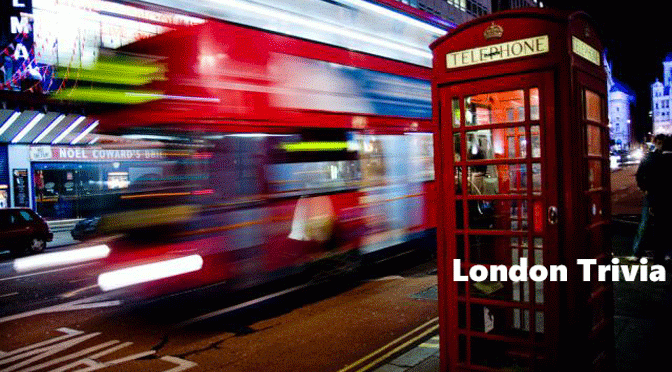
London Trivia: Gold standard
On 26 November 1983 Britain’s most successful robbery took place at Heathrow. £26 million sterling in gold, diamonds and cash was stolen from the Brink’s Matt security warehouse. The investigation lasted nearly 10 years and a large percentage of the gold bars were never recovered and few convicted. Several murders have been linked to the case, plus links established to the Hatton Garden safe deposit burglary over 30 years later in April 2015.
 On 26 November 1964 The Stones described in court as not a long-haired idiots but highly intelligent university men Mick was still fined £10
 In 1736 gravedigger Thomas Jenkins received 100 lashes for selling dead bodies from St Dunstan and All Saints, Stepney High Street
 Underneath the MI6 building is the overflow pipe for the River Effra, it’s just big enough to launch a mini-submarine from the orifice
 Nell Gywnn, orange seller and mistress to Charles II was born in the Coal Yard, now Stukeley Street off Drury Lane in 1650
 After his victory over England Hitler had a plan to dismantle Nelson’s Column in Trafalgar Square and display it in Berlin
 Only one house where Charles Dickens lived still stands 48 Doughty Street from 1837 to 1839 here he wrote Oliver Twist and The Pickwick Papers
 The upper span of Tower Bridge was originally a walkway but it was closed in 1910 as it had become a haunt of prostitutes
 One of the Scotland fans who invaded the pitch at Wembley in 1977 was Rod Stewart. In the commotion someone nicked his Cartier watch
 In 1910 the London and North Western Railway offered its business passengers the on-board services of Miss Tarrant. (Typist)
 In 2013 one ton of dust was removed from the attics at Kensington Palace, the first time since 1719 they had been cleaned
 In the 1950s three members of the Attkins family were Highgate’s fishmonger, butcher and dentist – known as Fishkins, Porkins and Toothkins
 Trivial Matter: London in 140 characters is taken from the daily Twitter feed @cabbieblog.
A guide to the symbols used here and source material can be found on the Trivial Matter page.
Protected: Down Your Alley: Adam and Eve Court
Protected: Pointless
London Trivia: Hitting the jackpot
On 19 November 1994 defying the odds of 1-in-14-million seven lucky lottery winners won Britain’s first national lottery aired live from a London studio. 35 million tickets were purchased and the winning numbers as drawn were 30, 3, 5, 44, 14 and 22. The bonus ball was 10. A lottery took place in 1566 for a jackpot of £5,000 according to a letter from Queen Elizabeth I, giving instructions for collecting money, commanding that persons of ‘good trust’ be entrusted with the prizes.
At the Royal Albert Hall on 19 November 1987 a rare 1931 Bugatti Royal was sold for £5.5 million at the time a semi-detached house cost £50,000
For some crimes the guilty were locked in the pillory then had their ears nailed to the frame, upon release were forced to leave them behind
King Street, St James’s is named after Charles II, King Street, Covent Garden is named after Charles I and Kingsway after Edward VII
The American talk show host Jerry Springer was born at Highgate during the Second World War: his mother had taken shelter in the station from an air raid
Trafalgar Square was to have been called ‘King William the Fourth’s Square’; however, George Ledwell Taylor suggested Trafalgar Square
It was at 9A Denmark Street (Tin Pan Alley), then La Gioconda, where David Jones (Bowie) and his first backing band – Lower Third – met
The Sanderson Hotel, Berners Street was a showroom for Sandersons wallpaper, the listed sign meant the hotel could have no other name
The oldest (and possibly most bizarre) medal winner was John Copley who won Silver in the London 1948 Olympics for an etching he was 73 at the time, drawing was in the Olympics until 1948
Charles Pearson, MP and Solicitor to the City of London, is credited with successfully campaigning for the introduction of the Underground. He died in 1862 shortly before the first train ran
During the war, some stations (now mostly disused) were converted into government offices: a station called Down Street was used for meetings of the Railway Executive Committee
Brydges Place named after Catherine Brydges daughter of 3rd Baron Chandos at 15 inches at its narrowest point is London’s tightest alley
Trivial Matter: London in 140 characters is taken from the daily Twitter feed @cabbieblog.
A guide to the symbols used here and source material can be found on the Trivial Matter page.
 CabbieBlog