

The gondolas of London.

Benjamin Disraeli (1804-1881), Describing the horse-drawn hansom cab

The gondolas of London.
Benjamin Disraeli (1804-1881), Describing the horse-drawn hansom cab
On 22 September 1735 Sir Robert Walpole moved into 10 Downing Street. Before taking up residence as Prime Minister, he commissioned William Kent to join the adjacent house at the rear to form a property more suited for a Minister of the Crown. Walpole persuaded Mr Chicken, to move to another house in Downing Street, this small house and the mansion at the back were then incorporated into Number Ten.
 On 22 September 1848 John Harold, London’s first case of cholera died at 8 New Lane, Gainsford Street, Horsleydown, Southwark
 The smallest prison in London is a single room in the base of the St Stephens Tower in the Houses of Parliament, although never used these days, it is still classed as a state prison
 The Ritz was one of the first steel-frame buildings to be erected in Europe. The restaurant has so many chandeliers that its ceiling has had to be specially reinforced
 Playwright Richard Brinsley Sheridan died at 14 Savile Row. Whilst laid out in his coffin an overzealous bailiff arrested him for his debts
 Christ Church, Lambeth, has a spire decorated with stars and stripes, half the cost of the church was borne by Americans, and the tower commemorates President Lincoln’s abolition of slavery
 In the film The Da Vinci Code – The ‘Parisian’ lecture hall, where Tom Hanks gives a lecture is actually Fairfield Halls, Croydon
 The Roundhouse in Camden was originally built as a turntable engine shed for the London & Birmingham Railway in 1846, within 10 years the engines were too big for the building to continue to serve its purpose
 The 1908 Olympics were heading for Rome until Mount Vesuvius erupted on 5 April 1906 and the Italians suddenly had other priorities, with just two years’ notice, London came to the rescue
 Cabbies face a daily £1 fine should he take two consecutive days off ‘without just cause’ according to section 33 of The London Hackney Carriages Act 1843
 The Worshipful Company of Clockmakers, one of the Livery Companies of the City of London, was formed by a Royal Charter in 1631 and remains the world’s oldest horological institution
 There are now 25 Sherlock Holmes Societies around the world, in countries as diverse as Japan, Israel, India, Australia and Venezuela
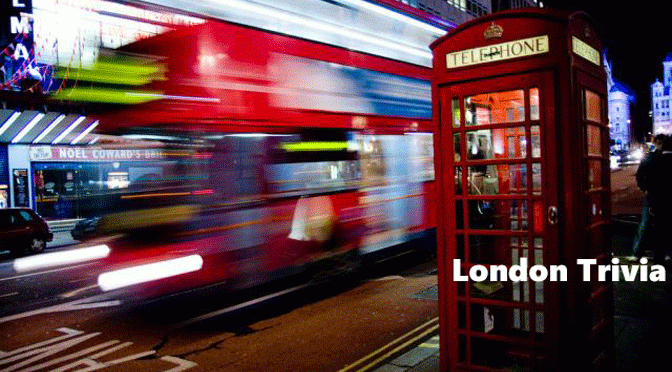
 Trivial Matter: London in 140 characters is taken from the daily Twitter feed @cabbieblog.
A guide to the symbols used here and source material can be found on the Trivial Matter page.
For those new to CabbieBlog or readers who are slightly forgetful, on Saturdays I’m republishing posts, many going back over a decade. Some will still be very relevant while others have become dated over time. Just think of this post as your weekend paper supplement.
The term “lovable rogue” has been applied to many crooks over the years, most are just unpopular villains, but one from the 18th century remains known to us even today, in fact so great was his popularity over one-quarter of London’s population came to his execution.
John Shepherd known to all as Jack was a fairly diminutive chap at 5’4” and was by all accounts very strong for his size. Born in 1702 in Spitalfields he was Christened with some haste due to his frail condition at St. Dunstan’s. At six years old he was apprenticed to a cane chair maker, which didn’t last, but later following in the footsteps of his father he took up an apprenticeship as a carpenter; he was probably only accepted as his mother’s current lover had taught him to read and write.
Leaving his employer after five years he took up with a bad lot at a pub in Drury Lane called the Black Lion and would frequent an area, now developed as the London School of Economics, called Clare Market frequented at that time by prostitutes and later would become the centre for pornography.
He made friends with a criminal called Joseph “Blueskin” Blake and Jonathan Wilde known as the Thieftaker General. Wilde led a double life and was high up in what purported to be the police force at that time, he also led a group of thieves who would steal property and then he would return the stolen goods to the rightful owners for a fee. He also met a prostitute Elizabeth Lyon known to all as Edgeworth Bess who was, not to be ungallant, a woman with a fuller figure.
In 1723 Jack – who by that time had given up his apprenticeship and was partial to a drink – stole two silver spoons from the Rummel Tavern at Charing Cross. He was caught and put into St. Giles Roundhouse a prison that was situated near modern-day Seven Dials.
So far nothing unusual, hundreds of small-time crooks in London must have taken the same road to the hangman’s noose at that time.
Jack was somewhat different and would have put Houdini to shame. He overcame his first incarceration by breaking through the cell’s timber ceiling and fashioned a rope from sheets with which he shimmed down while still wearing his leg irons.
He was rearrested two years later for picking pockets in Leicester Fields (known today as Leicester Square). This time he was sent to New Prison in Clerkenwell. When later Edgeworth Bess came to visit him he broke out of prison ending up on the roof, from there jumping down into an adjacent building only to find himself in Bridewell Prison next door, this time he climbed a 22ft wall while still manacled and helped Buxom Bess along the way.
Later after being plied with a copious amount of alcohol Bess disclosed to the authorities Jack’s whereabouts, he was duly arrested and this time sentenced to death and put into Newgate. This time he loosened the bars of his window and escaped dressed as a woman. He then went into exile on Finchley Common, but Jack really was Jack The Lad and liked having money, drink and a woman on each arm.
He came back into London and was rearrested, and put back into Newgate. This time he found himself in “The Castle” which was a prison within a prison and was thought by the authorities to be impregnable. He was clapped in leg irons and chained to two metal staples attached to the stone floor. He escaped again climbing up a chimney and scaling a 60ft wall making his escape via six barred doors. Back outside a crowd formed upon hearing of yet another escape and while still in leg irons he diverted their attention by claiming to see somebody on the roof.
Thinking himself untouchable he was at large for two weeks before he broke into Rawlings a pawnbroker in Drury Lane. There he stole a number of items including a fashionable black silk suit which he proceeded to put on and went out on the lash. So conspicuous was he that inevitably he was arrested and put in the “Middle Stone Room” of Newgate and this time loaded with 300lbs of iron weights.
Loved for his escapology people pleaded for commuting his death sentence to deportation but to no avail. Taken by cart from Newgate, a journey that could take two hours, he was plied with drink along the way. At one hostelry, the City of Oxford on modern Oxford Street they gave him a pint of sherry.
When London’s population was estimated at 700,000 an audience of over 200,000 turned up for his execution. He did not die immediately as his diminutive frame was too light to allow the rope to break his neck. After 15 minutes the crowd surged forward wanting a memento of Jack which prevented his friends from cutting him down, and trying to resuscitate him.
Buried at the recently rebuilt St. Martin’s in the Fields he was known in his time as Jack The Lad and Gentleman Jack and has had over the years a huge following in popular culture. Painted while in Newgate by Sir James Thornhill the Serjeant Painter to the Crown [see illustration]; the Beggar’s Opera is loosely based on his life; he has been the subject of two silent films; and Christopher Hibbert wrote The Road to Tyburn based on his life. More recently the 1969 film starring Tommy Steele Where’s Jack was also an adaptation based on Jack’s colourful life.
London is a city of clubs and private houses. You have to be a member.
Alec Waugh (1898-19810, The Sugar Islands
On 15 September 1964 the Sun newspaper, printed on Fleet Street, was published for the first time, replacing the Daily Herald promising to follow a ‘radical’ and ‘independent’ agenda – unlike its predecessor the Daily Herald which had strong ties to the Labour party. The TUC sold its 49 per cent stake in the paper in 1960. It hit the streets on the day an announcement of a general election by Prime Minister Sir Alec Douglas-Home.
On 15 September 1928 Scottish bacteriologist Alexander Fleming discovered penicillin while studying influenza at St Mary’s Hospital Medical School, the University of London
Garnet Street was the scene of four victims from the famous Radcliff Murders of 1811, Johnny Speight used the name for his character Alf Garnet
London’s oldest statue King Alfred in Trinity Church Square with an estimated date of 1395 originally stood in the old Palace of Westminster
Europe’s largest crypt is under St. Paul’s Cathedral and the first person to be interred was its architect Sir Christopher Wren
During the First World War Alexandra Palace was used to detain German civilians living in Britain in what was called a concentration camp
The lions of Trafalgar Square were sculpted from life. The artist Landseer used dead lions supplied by London Zoo until neighbours complained of the smell
Gordons Wine Bar is London’s oldest wine bar founded at its present location in 1890 by Arthur Gordon. Current owners are unrelated Gordons
On 15 September 1930, the first international bridge match was held in London United States team defeated England
With 207,000 items handed into Transport for London’s Lost Property Office in Baker Street last year made it the highest total in its 77-year history
N, S, E, and West Tenter Street surrounded a ground where tenters- wooden frames used to stretch woven cloth- were; hence “on tender hooks”
On 15 September 1784 Vincenzo Lunardi commenced England’s 1st hydrogen balloon flight from the Honourable Artillery Company area, Moorfields
Trivial Matter: London in 140 characters is taken from the daily Twitter feed @cabbieblog.
A guide to the symbols used here and source material can be found on the Trivial Matter page.

 CabbieBlog