Previously Posted: An icon’s swansong

For those new to CabbieBlog or readers who are slightly forgetful, on Saturdays I’m republishing posts, many going back over a decade. Some will still be very relevant while others have become dated over time. Just think of this post as your weekend paper supplement.

An icon’s swansong (19.06.12)

The other day my cab broke down – gearbox in case you were wondering – and I found myself driving, as a replacement, an old Fairway of the type American tourists love. It’s hardly surprising, if your vision of London is of a rather quaint city that is still stuck firmly in the 50s, then the classic Fairway fits the bill for our colonial visitors.

Little changed since its launch in July 1958, few vehicles have matched its longevity. Although the indicators were moved from their original position on the roof (giving them the sobriquet ‘bunny ears’) the vehicle still has the little round indicators last seen on a car being driven by Jack Regan in The Sweeny.

Manual sliding rear windows locked by means of an ineffectual metal lever, no intercom, brakes fit for a go-kart with 2 tonnes of momentum to slow down, top-heavy necessitating roundabouts need to be negotiated at half the speed of a modern car and its acceleration beyond 30 mph is almost impossible especially when travelling up a hill. Clunking doors which open the wrong way – the driver can reach out and open the offside passenger door without leaving his driving seat. Oh yes! and plastic seats.

It was a trip down Memory Lane. The hardwood 3-spoke steering wheel, imitation walnut trim to the doors and a top speed of 60mph. Many passengers could not fathom out how to open the doors and with the stiff buttons on the outside handles, ladies needed strong thumbs to open the door. The chrome door handles have a plastic guard, presumably an early health and safety requirement.

For all its faults driving this London icon has been a privilege, evocating days when London changed little and we worked at a gentler pace. I’m not the only one who loves this cab. Tourists love its quaintness, choosing it over the more brash upstarts. I’ve even had a guy chase me down the road offering to buy the vehicle. Apparently, they are very much in demand abroad and a rather enterprising cabbie buys them for export to of all places Saudi Arabia.

So it looks like the old girl might have a second life after being taken off the road by the Burgers at the Public Carriage Office who following the dictats of Europe have decreed that cabs over 15 years old must die.

Or she might stay in England many owners like them some even write blogs about them.

London in Quotations: Stephen Sondheim

There’s a hole in the world / Like a great black pit / And the vermin of the world / Inhabit it . . . / And it goes by the name of London.

Stephen Sondheim (b.1930), Sweeney Todd

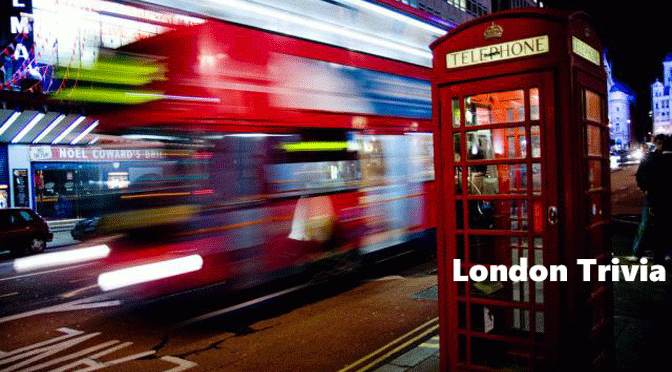
London Trivia: 10 Rillington Place

On 22 June 1953, Reginald Christie was tried for the murder of his wife at 10 Rillington Place, he had previously admitted to 7 murders, corpses were found in the house, garden and shed.

On 22 June 1814, the first cricket match was played at the new Lord’s cricket ground in St. John’s Wood between Marylebone and Hertfordshire

On 22 June 1535 John Fisher was martyred at the Tower refusing to submit to the Act of Succession his head was displayed on London Bridge

Waterstone’s elegant premises in Piccadilly was the world’s first steel-framed shop built at the time for Simpsons the previous owner

50 Berkeley Square is reported to be the most haunted house in London, the attic room is haunted by a young woman who died there, and a whole range of deaths followed throughout the 19th Century

The Thames is the second oldest geographical name in the country only Kent pre-dates it. Julius Caesar called it Tamesis, no one knows why

Lilian Baylis, the manager of the Old Vic, cooked her meals backstage during the show and the aroma filled the theatre

The Great Eastern Hotel once boasted two Masonic temples, its own railway siding and weekly sea water deliveries for its natural brine baths

Old English skittles, once popular in pubs across the southeast, but now confined to a single alley at the Freemasons’ Arms in Downshire Hill, Hampstead

A taxi rate of a shilling (5p) a mile was established in an Act of 1662 by King Charles II it was not increased until 1950 nearly 300 later

St. Margaret Pattens Church in Rood Lane has a memorial to James Donaldson, a ‘City Garbler’, and a person who specialised in selecting spices

The Japanese term for a business suit is a sebiro, a simple transliteration of Savile Row a street famous for London’s finest tailors

CabbieBlog-cab.gifTrivial Matter: London in 140 characters is taken from the daily Twitter feed @cabbieblog.
A guide to the symbols used here and source material can be found on the Trivial Matter page.

Previously Posted: Liquid History

For those new to CabbieBlog or readers who are slightly forgetful, on Saturdays I’m republishing posts, many going back over a decade. Some will still be very relevant while others have become dated over time. Just think of this post as your weekend paper supplement.

Liquid History (05.06.12)

The River Thames is etched into England’s psyche, over the years it has played a central role in the life of the nation, historically used for coronations, processions, funerals and as we saw this weekend pageants.

In 1929 the MP John Burns famously described the river as “The St Lawrence is water, the Mississippi is muddy water, but the Thames is liquid history”.

King Henry VIII loved his palaces at Greenwich and Richmond, but once he had sight of Cardinal Wolsley’s palace at Hampton Court he did not rest until he “persuaded” Wolsley to “give” it to him.

Queen Elizabeth I also loved Greenwich and Richmond, and it was at Richmond Palace in 1603 that she died. Her body was brought downstream to Westminster for her funeral on a magnificent black barge; the poet William Campden described the scene as follows:

“The Queen was brought by water to Whitehall. At every stroke of oars did tears fall”.

Less romantic was Henry VIII’s final trip from London to Windsor – he was due to be buried in St George’s Chapel there. During the overnight stop between London and Windsor his barge moored at Syon House in Isleworth. His coffin suddenly split open, and dogs were found licking his remains.

The banks of the Thames became the favoured location for buildings of all kinds, from monastic abbeys to gorgeous palaces. The huge number of famous buildings along the course of the Thames gave rise to the description of the river as a “string” linking a series of “pearls”.

In the 17th and 18th centuries during the hard winter freezes, Frost Fairs were held on the River Thames, complete with ox-roasting, groups of musicians playing, stalls selling a variety of popular novelties and food, fairground amusements and performing animals.

The last fair to be held on the Thames was in February 1814. In 1831 the old London Bridge was replaced, and – with the removal of the “starlings” or piers upon which the old bridge rested – the river no longer slowed down sufficiently for it to freeze over sufficiently to support public events.

The River Thames also provided some of the greatest “shows” seen on the water. In 1422 the Lord Mayor’s Show took to the water. The participating barges of the City Livery companies became ever more ornate. Barges were covered in gold leaf and some rowed with oars of silver.

In the 17th century, the Lord Mayor’s procession included dramas and pageants. However, these came to an end in 1856 as the river had become clogged up with working vessels.

It was an actor who established one of the most enduring traditions of the River Thames. In 1715 Thomas Doggett was so grateful to a local waterman for his efforts to ferry him home on a bad night, pulling against the tide that he set up a rowing race for professional watermen.

The winner receives prize money and also the coveted scarlet coat and badge, made of silver – hence the name of the race “Doggett’s Coat and Badge”. The race is still held on 1st August each year when professional watermen row from London Bridge to Chelsea and is recognised as the world’s oldest rowing race.

London in Quotations: William Butler Yeats

This melancholy London – I sometimes imagine that the souls of the lost are compelled to walk through its streets perpetually. One feels them passing like a whiff of air.

William Butler Yeats (1865-1939), letter to Katharine Tynan, 25th August, 1888

Taxi Talk Without Tipping