Category Archives: An urban view

Bridges of Sighs

If as a cabbie, a group of tourists ask to be taken to ‘Old London Town’, you could do a lot worst than by crossing London’s ancient bridges.

To start take them to Richmond Bridge opened months after America gained its independence (1777); then show them how those industrious Victorians constructed most of London’s bridges: Westminster (1862), Blackfriars (1869), Albert (1873), Hammersmith (1887), Battersea (1890), Tower (1894).

Post-Victoria far fewer bridges have been constructed, with only one road bridge since World War II: Kew (1903), Vauxhall (1906), Southwark (1921), Lambeth (1932), Chiswick (1933), Twickenham (1933), Chelsea (1937), Wandsworth (1940), Waterloo (1945), London (1973).

The bridges’ condition is so poor, the London Assembly’s Transport Committee produced a report which was launched with the rather punchy headline: London’s ageing river crossings – an international embarrassment.

We still have Hammersmith Bridge’s debacle, which saw the bridge closed to motorists in April 2019 after cracks were found in the cast iron pedestals, the bridge was then completely closed. Now reopened for pedestrians and cyclists while ‘stabilisation work’ going on.

One of the big problems with maintaining all these ageing structures is that no one is responsible for them. London Bridge is owned and maintained by Bridge House Estates, Transport for London is the one responsible for the road, then one end is in the City, while the other end is in Southwark.

One of the recommendations of the report is to set up a central ‘kitty’ into which ‘all the relevant asset owners would contribute’.

This is needed because the report warns that ‘Twickenham, Kew, Battersea and Lambeth may need extensive interventions within 10 years’ and the estimated cost of the maintenance work that‘s needed to deal with just the existing issues is coming in at around £241 million.

As Mayor Khan is planning to remove thousands of vehicles from London’s roads, closing bridges for repair should not present a problem.

Featured image by Philip Halling (CC BY-SA 2.0) London Bridge: The present London Bridge opened in March 1973 and was designed by Mott, Hay and Anderson. In medieval times the then London Bridge stood slightly upstream from the site of the present bridge, this old bridge had buildings on it and was also the place where the heads of those executed would be placed on a spike.

It hasn’t fallen down

London Bridge is falling down,
Falling down, falling down.
London Bridge is falling down,
My fair lady.

London’s most famous bridge has never fallen down, but it has been replaced several times over the centuries, and the latest incarnation was opened by the Queen 50 years ago this week on 16th March 1973.

Whether by accident or a deliberate nod to the late Queen’s age, Operation London Bridge was the code name for the funeral plan for Queen Elizabeth II, which of course swung into action a few months ago.

London Bridge’s predecessor, famously shipped off to the Arizona desert, had been there since 1831 when it replaced ‘Old’ London Bridge, the medieval one with the houses down it.

Where London Bridge is today is 50 yards upstream from its predecessor.

Have you ever wondered why the Monument feels off-centre and Gracechurch Street terminates with an awkward curve? This piece of poor urban planning is because this was the original alignment of the former bridge, and the introduced curve aligned the road to the modern bridge.

In particular, the northern roadway used to pass the west door of St Magnus the Martyr, a church which for six centuries was the spiritual guardian of this crucial bridgehead. It was one of the first churches to be destroyed in the Great Fire of London so what now occupies the site is Wren’s magnificent replacement. Its clock once projected out above the roadway, and when traffic increased a pedestrian walkway had to be cut through the bottom of the tower.

St Magnus’s importance vanished when the bridge shifted, and its churchyard is now a flagstoned dead end, barely trodden, with a small flowerbed at one end. It’s still worth a visit, though, to see two chunky stones from the Old London Bridge which were relocated here in 1921.

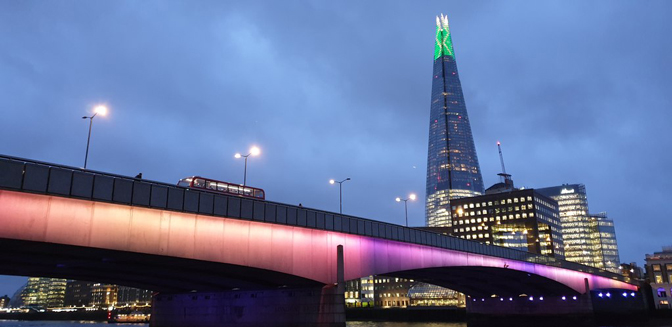
London Bridge and the Shard by Christine Matthews. The top of the Shard is being decorated with different coloured lights designed by local children. (CC BY-SA 2.0)

The Christopher Wren Ramble

Tomorrow marks the 300th anniversary of the death of London’s greatest architect. Ironically, it was on a trip to London to see how St Paul’s was progressing that the architect ‘caught a chill’, which eventually led to his death, hardly surprising, despite his advancing age, he would be hoisted up the cathedral in a bucket to view the works.

Rather than celebrating this event by going on about his churches, monuments and hospitals, we’re taking a tour of his plaques.

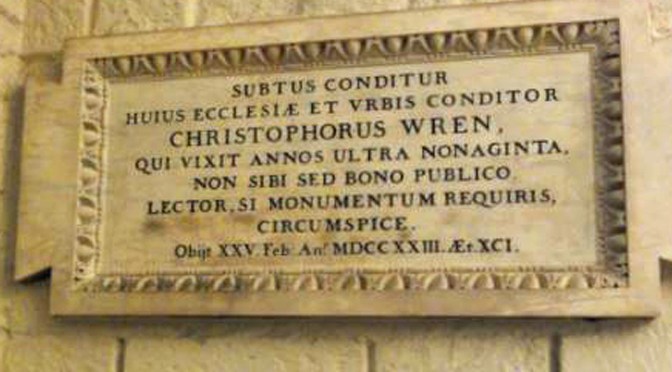
Famously the inscription on his tombstone in St. Paul’s Cathedral reads: ‘Lector, si monumentum requiris circumspice’ – Reader, if you seek his monument – look around.

So today we’re going on a ‘circumspice’ of Wren’s London plaques. A total of eleven plaques, some genuine locations, others whose claim to Wren’s fame is tenuous.

From St. Paul’s, crossing New Change into Watling Street we find at 69:

The Guild Church of St Mary Aldermary Rebuilt 1679-82 by Wren’s office after the Great Fire of London The interior is enriched with splendid plaster fan vaulted ceilings The plan of the church follows its medieval outline.

At the end of Watling Street left into Queen Street and forward to King Street is Guildhall Yard:
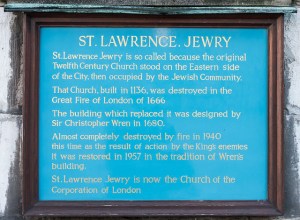
St Lawrence Jewry is so called because the original Twelfth Century Church stood on the Eastern side of the City, then occupied by the Jewish Community. That Church, built in 1136, was destroyed in the Great Fire of London of 1666 The building which replaced it was designed by Sir Christopher Wren in 1680. Almost completely destroyed by fire in 1940 this time as the result of action by the King’s enemies it was restored in 1957 in the tradition of Wren’s building. St. Lawrence Jewry is now the Church of the Corporation of London

Leave by Gresham Street it is a short walk down Princes Street to Bank Junction:
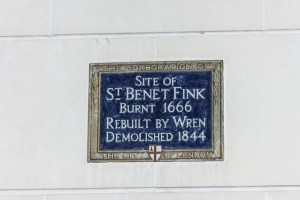
At 1 Threadneedle Street, there’s a plaque on the site of St. Benet Fink burnt 1666 rebuilt by Wren demolished 1844:
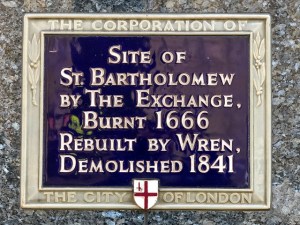
Further along Threadneedle Street a plaque marks the site of St. Bartholomew by The Exchange, burnt 1666 Rebuilt by Wren, Demolished 1841

Turning right into Gracechurch Street leads you to Wren’s most famous:
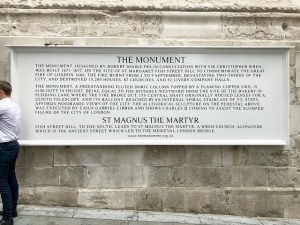
The Monument, was designed by Robert Hooke FRS in consultation with Sir Christopher Wren, was built 1671-1677, on the site of St Margaret Fish Street Hill. To commemorate the Great Fire of London 1666. the fire burnt from 2 to 5 September, devastating two-thirds of the city, and destroying 13,200 houses, 87 churches, and 52 Livery Company Halls. The Monument, a freestanding fluted Doric column topped by a flaming copper urn, is 61m/202ft in height, being equal to the distance westward from the site of the bakery in Puddin Lane where the fire first broke out. It’s central shaft originally housed lenses for a zenith telescope, and its balcony, reached by an internal spiral staircase of 311 steps, affords panoramic views of the city. The allegorical sculpture on the pedestal above was executed by Caius Gabriel Cibber and shows Charles II coming to assist the slumped figure of the City of London. St Magnus the Martyr Fish Hill Street, to the south, leads to St Magnus the Martyr, a Wren church, alongside which is the ancient street which led to the medieval London Bridge

Leaving by Pudding Lane, turning right into Eastcheap, St. Dunstan’s Hill takes you to:

The church of St. Dunstan in the East stood on this site from ancient times. Sir Christopher Wren rebuilt the church after the Great Fire of 1666 and the only part of his design which survives is the tower. The remainder of the church was rebuilt in 1817 and destroyed by enemy action in 1941. This garden was created by the Corporation of London and opened by the RT. Hon. The Lord Mayor Sir Peter Studd. on 21st June 1971

At the bottom of St. Dunstan’s Hill, walk west along Lower Thames Street, climb up to London Bridge forward to Borough High Street and left to St. Thomas Street in the shadow of The Shard find:

Church of St Thomas Apostle (formerly St Thomas Martyr) Southwark, SE1 Parish Church of St Thomas 1136-1862 which also served as the Chapel of St. Thomas’s Hospital 1215-1862 Rebuilt in 1703 by Thomas Cartwright & Son (Sometime Master Mason to Christopher Wren) The roof space was used as the hospital’s Herb Garret and from 1822 as its Operating Theatre Rediscovered by Raymond Russell in 1956, the Herb Garret and Operating Theatre is now a Museum.

Retracing your steps turn left into Borough High Street and bear right at the lights Stoney Street on the right gives onto Clink Street and follow the signs to Shakespeare’s Globe:
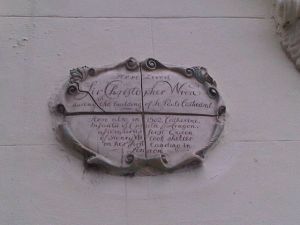
On Bankside a disputed plaque states: Here lived Sir Christopher Wren during the building of St Pauls Cathedral

Fortuitously a cab rank is nearby outside the theatre to take you to Clerkenwell:
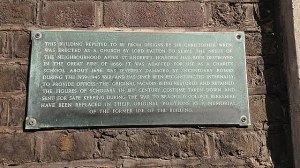
43 Hatton Garden has a complete history affixed to its wall:
‘This building, reputed to be from designs by Sir Christopher Wren, was erected as a church by Lord Hatton to serve the needs of the neighbourhood after St. Andrew’s Holborn had been destroyed in the Great Fire of 1666. It was adapted for use as a charity school about 1696, was severely damaged by incendiary bombs during the 1939-45 war and has since been reconstructed internally to provide offices – the original facades being restored and retained. The figures of scholars in 18th century costume taken down and sent for safe keeping during the war to Bradfield College, Berkshire have been replaced in their original positions as a memorial of the former use of the building.’

The last two mean a trek out to leafy south-west London:

Unusually on a wall of the Old Court House, Hampton Court Green, East Molesey, was unveiled by Virginia Bottomley, Minister for National Heritage:
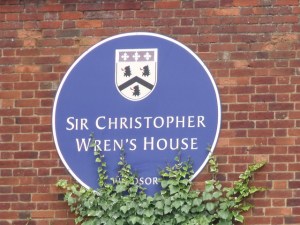
Thames Street, Windsor, this, strongly disputed claim, asserts the architect designed and lived in the property.

All images uploaded are registered with a Open Data Commons Public Domain Dedication and License (PDDL).

Be my Valentine

As far as I’ve been able to ascertain, London has seven streets romantically named Valentine. Valentine Avenue, Bexley; Valentine Road, Harrow; Valentines Way, Romford; Valentine Place and Valentine Row, Southwark; and then there is Valentine Road, Homerton.

But it’s Valentines Road, Ilford and its environs which can lay claim to having the most ‘Valentines’. Ilford has a Victorian estate near the High Road, and true to those proud Victorians, has streets named after Prime Ministers and outposts of empire: Balfour, Albert, Wellesley, Melbourne, Brisbane, and adjacent to all these empire-building monikers is Valentine Road and Valentine Park on its north-western side.

Even the local telephone number once had VALentine. Now it’s just another of London’s lost telephone exchanges, that once served the Ilford North area around Valentine’s Park from a building on its west side. Sadly it is now the more prosaic, and less romantic, anonymous 020 8554.

Valentines Park is huge at 130 acres, as you would expect with Victorian planning. It is what remains of a country house called Valentines, and its surrounding estate, which helps explain the ornamental lake and walled garden at the northern end, there is also a boating lake, a bandstand and two economically independent cafes.

Incredibly Valentines mansion still stands, and the restored 17th-century house reopened to the public predictably on Valentine’s Day in 2009. It has a small museum, artists are in residence at their studios and musical events are staged. Oh! The second series of the Great British Bake Off was filmed on its lawns.

Featured image: Valentines House Courtesy of Friends of Valentines Mansion (CC BY-NC-SA 2.0 UK)