Category Archives: An urban view

Not One Lamppost

Word on the Street is an occasional post about discoveries found on London’s streets, from street furniture, urban byways and trivial roadside facts.

I like to tell anyone who’ll listen that there are no ‘roads’ in The City of London, just streets, passages, alleys or other curious titles like Crutched Friars.

Goswell Street was renamed Goswell Road, in the past the northern section (that being furthest away from the City) was named Goswell Street Road. In 1994 boundary changes brought the eastern half under the jurisdiction of the City of London, while the western carriageway remains firmly in the Borough of Islington.

The boundary now runs down the middle of the road, pedants might argue that this still, technically, means that there isn’t a single road within the City of London, merely a half-road.

Curiously The Square Mile also doesn’t have street lamps, not on the pavements, anyway. Thanks to an old bylaw, all street lighting must be attached to buildings, or else run along a central reservation – you won’t find a single lamp jutting out from the pavement proper. What are dogs to do?

In all my journeys driving a cab in London, how could I have missed this major peculiarity?

The Kremlin Reopens

Only 13 London Cab Shelters remain out of the original 61 constructed, many of the survivors are Grade II Listed, and all incidentally are found North of the River.

The Chelsea Embankment Shelter opened in 1910 and is situated on the Thames’ north bank, overlooking the romantic Albert Bridge.

Due to the Chelsea Embankment being designated a Red Route and the local authority only providing parking for two cabs, the Shelter closed 20 years ago and slowly degenerated. David Fletcher has created this amazing 3-D model of the shelter in this dilapidated state.

After the Cabmen’s Shelter Fund was awarded a grant from the Heritage of London Trust. Despite the difficulty of delivering materials to the site, due to the parking restrictions, the shelter now has new timber around three sides, and a new clerestory roof, all finished with the all-important distinctive Dulux Buckingham Paradise 1 Green.

These works were completed in January 2022, and now Café Pier (a considerably better title than The Kremlin, its former nickname due to the Left-leaning cabbies who once frequented the Shelter) has taken over the lease and is opening tomorrow.

The Shelter enjoys a lovely little terrace overlooking the River enough for 12 diners. The team behind this revival promise to offer a much better bill of fare than the average greasy spoon, and if this wasn’t an excuse to give it a try, its an opportunity to check out one of these little Victorian gems which normally are for the exclusive use of London’s cabbies.

The Nonce

Many of London’s pub names have a royal connotation: The Royal Oak, The King’s Head or The Crown, it dates back to the time when many were illiterate, and the depiction of a well-known image enabled patrons to identify each hostelry.

The Duke of York pub in Fitzrovia continues this tradition, but with an unusual twist.

It displays the only known sign with the image of Prince Andrew (the current Duke of York) on its sign.

Operated by the 200-year-old Suffolk brewers Greene King this pub was first licensed in 1767 and then rebuilt in 1897, and is tucked away at the top end of Rathbone Street.

In 2014, Prince Andrew, the present Duke of York, permitted his likeness to be used on the pub sign. Russian-born American artist Igor Babailov, known for his commissioned portraits of world leaders and celebrities, duly painted the pub’s sign. The painting is now thought to be the only pub in the world featuring a likeness of a living member of the Royal Family.

Fitzrovia, the place of my birth, was also where the literary and artistic crowd hung out, Donovan, Ian Dury, Rod Stewart, Paul Jones, Johnnie Ray, and John Lee Hooker were also regulars, as was David ‘Del Boy’Jason.

In the 1940s and 50s the Duke of York’s clientele had regular encounters with so-called razor gangs and novelist Anthony Burgess is thought to have used his wife’s 1943 experience of razor gangs forcing her to drink copious amounts of beer in his later novel, A Clockwork Orange.

Milking the area’s reputation for knife crime, landlord Major Alf Klein initiated male customers by snipping off their ties, the collection grew to over 1,500. His great dane, named Colonel, starred in the title role in the film Hound of the Baskervilles, apparently, it was partial to drinking customers’ beer.

Despite being stripped of all of his titles in 2021 due to his association with financier and trafficker Jeffrey Epstein, Prince Andrew’s image remains and after commissioning the painting the publican has no intention of replacing it any time soon.

According to Adrian Brune on her Substack blog, in Soho, locals now colloquially refer to the pub as “the Nonce”.

Nonce (n.) Prison slang a rapist or child molester; a sexual offender.

Featured image: The exterior of the Duke of York pub in Fitzrovia, bearing the image of Prince Andrew, the present Duke of York by Ethan Doyle White (CC BY-SA 4.0)

Coronation Streets

It is nearly 70 years since we have had a coronation, so naturally, I started looking up roads named after that ceremony.

My 1936 copy of Phyllis Pearsall’s Geographers’ A-Z Street Atlas only shows two ‘coronations’:
Coronation Road E13
Coronation Road NW10

But hold on a minute, haven’t there been dozens of coronations since the start of roads being named in the 6th century and the 1936 coronation? But here in London, there are only two.

Next turning to a modern road atlas I find the originals plus five new ones:
Coronation Avenue N16
Coronation Close, Bexley DA5
Coronation Close, Ilford IG6
Coronation Road E13
Coronation Road NW10
Coronation Road, Hayes UB3
Coronation Walk, Twickenham TW2

But how many coronations have taken place in the intervening period which would promote the naming or re-naming of a London street?

Precisely two, the late Queen in 1953 and her father King George VI in 1937.

With the increase of Republican support, what national event has taken place in the last 86 years to inspire local authorities to give their thoroughfares a regal connotation?

In a word television.

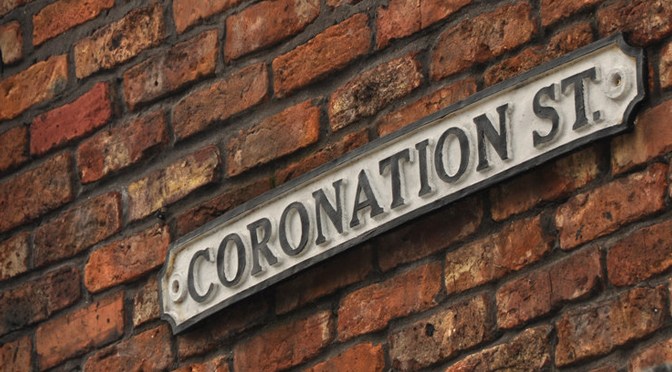
Since 1960 the world’s longest-running television soap, Coronation Street, has appeared on our television screens, but not one local authority has grasped the nettle and given the moniker Coronation Street, otherwise Bill Roach might turn up.

Featured image: Manchester: Coronation Street Sign. The sign on the corner of the road says we are on Coronation Street by Lewis Clarke (CC BY-SA 2.0).