London Trivia: Crystal Palace destroyed

On 30 November 1936 fire broke out in the lavatory of the central transept at Crystal Palace, despite there being 88 fire engines in attendance most of the Palace was destroyed. The only elements left unscathed were Paxton’s bust and some sphinxes.

On 30 November 1016King Edmund II was reputedly stabbed in the bowels whilst in the ‘outhouse’ (toilet) and died in London on the same day

In 1736 gravedigger Thomas Jenkins received 100 lashes for selling dead bodies from St Dunstan & All Saints, Stepney High Street

The Strand (technically just “Strand” – look at the signs) was originally the north shore of the much-wider Thames – “strand” means “bank”

Dame Cicely Saunders founded St. Christopher’s Hospice in Sydenham, the world’s first hospice, eventually she died there herself in 2005

Pains Fireworks, still making fireworks, founded in the 15thC in the East End, sold the light gunpowder used in the Gunpowder Plot of 1605

The ArcelorMittal Orbit is the UK’s tallest sculpture, at 684ft, the structure incorporates the world’s tallest and longest tunnel slide

The Grand United Lodge of England on Great Queen Street, founded in 1717 is the oldest Masonic Grand Lodge in the world

Henry VIII played tennis at Hampton Court in silk or velvet drawers (the first shorts) slashed with ‘cuttes’ and edges sewn with gold cord

Below the control box on a puffin crossing is a little ridged bobbin which swivels indicating to the visually impaired it’s safe to cross

A ‘Seven Dials Raker’ was a Victorian prostitute who lived in the vicinity of Seven Dials but plied her trade elsewhere in London

The oldest living thing in London is the 2,000-year-old Totteridge Yew in St. Andrew’s churchyard, which stands on the ‘Tott Ridge’

CabbieBlog-cab.gifTrivial Matter: London in 140 characters is taken from the daily Twitter feed @cabbieblog.
A guide to the symbols used here and source material can be found on the Trivial Matter page.

Previously Posted: Making History

For those new to CabbieBlog or readers who are slightly forgetful, on Saturdays I’m republishing posts, many going back over a decade. Some will still be very relevant while others have become dated over time. Just think of this post as your weekend paper supplement.

Making History (26.10.12)

This week three hundred and sixty-five years ago a series of debates took place in what was then the village Putney in the county of Surrey, Putney now has been subsumed into London.

After seizing the City of London from Presbyterian opponents in August 1647, the New Model Army had set up its headquarters at Putney. The year before in 1646 John Lilburne, John Wildman, Richard Overton and William Walwyn formed a new political party called the Levellers, which sought to give more power to the people. The debates to introduce those rights began at the Church of St. Mary the Virgin, by the river Thames at Putney Bridge.

From the 28th October to 9th November 1647, soldiers and officers of Oliver Cromwell’s New Model Army, including civilian representation, held discussions on the constitution and future of England.

Should they continue to negotiate a settlement with the defeated King Charles I?

Should there even be a King or Lords or an abolition of the monarchy and the House of Lords?

Should the people have the civil right to vote or should it be limited to property-holders? Some wanted a constitution based upon manhood suffrage (“one man, one vote”).

Should there be bi-annual Parliaments and a reorganisation of parliamentary constituencies?

Should complete religious freedom be allowed?

Could an end to the censorship of books and newspapers be implemented?

Should man have the right of trial by jury?Could they end taxation of people earning less than £30 a year and introduce a maximum interest rate of 6 per cent?

Would these democratic changes lead to anarchy?

This historic event saw ordinary soldiers take on their generals to argue for greater democracy and provided a platform for ‘common people’ to make their voices heard.

The Levellers started publishing their own newspaper, The Moderate. They also organised meetings where they persuaded people to sign a Petition supporting their policies. These debates, forced by the Levellers, paved the way for many of the civil liberties we value today.

The Guardian newspaper ran a reader’s competition to unearth which neglected event in Britain’s radical past most deserved a proper monument. St. Mary’s Church Putney, the site of the Putney Debates was the worthy winner.

London in Quotations: Richard Gordon

You know what London’s like on Sunday? About as lively as a wet night at Stonehenge.

Richard Gordon (1921-2017), Nuts in May

London Trivia: Alexander Litvinenko dies

On 23 November 2006 Russian dissident, Alexander Litvinenko, died at University College Hospital. His death was attributed to poisoning with radioactive polonium-210. The Russian government were suspected of his murder.

On 23 November 1896 Woolwich Arsenal’s Joe Powell broke his wrist in a league match, he died 6 days later from tetanus complications

It was at Francis Bacon’s studio at Narrow Street, Limehouse that he met lover George Dyer as Dyer attempted to burgle the place

The dome of the O₂ weighs less than the air contained underneath it; there’s only one curved piece of glass in the Gherkin – the one right at the top

In 1862, Dr Thomas Orton, one of London’s most senior physicians, established four sibling’s deaths in Limehouse were caused by vivid green wallpaper whose constituent was arsenic

Under Paddington Green is a disused Cold War command centre its entrance covered by a bush, nearby are the top-security jail cells for terrorist suspects inside London’s Paddington Green Police Station

A fight with a fashion designer at a party is said to have inspired Ray Davis to write The Kinks hit Dedicated Follower of Fashion

During World War II the south moat at the Tower of London was used by the Yeoman Warders as allotments to grow vegetables

The neon sign on Hornsey Road Baths is the sole survivor of 12 similar signs commissioned at various London baths in the 1930s

The eastern extension of the Jubilee line is the only Underground line to feature glass screens to deter ’jumpers’

Constructed in 1850 Crystal Palace had nearly 1 million square feet of glass, about a third of all the glass produced in England that year

The Clapham South wartime bomb shelter was later used to house the first ever Jamaican immigrants who arrived in 1948 on the Empire Windrush

CabbieBlog-cab.gifTrivial Matter: London in 140 characters is taken from the daily Twitter feed @cabbieblog.
A guide to the symbols used here and source material can be found on the Trivial Matter page.

Previously Posted: End of the road

For those new to CabbieBlog or readers who are slightly forgetful, on Saturdays I’m republishing posts, many going back over a decade. Some will still be very relevant while others have become dated over time. Just think of this post as your weekend paper supplement.

End of the road (23.10.12)

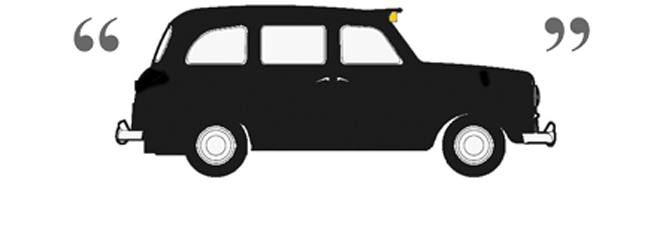
They were once described in Parliament by Prime Minister Benjamin Disraeli as “Hansom cab are the gondolas of London”, and in a recent poll by Hotels.com based on responses from 1,600 travellers found that passengers were more than twice as likely to ‘become amorous’ in a black cab, with 26 per cent of global travellers having kissed in the back seat.

The poll which put London cabbies ahead of all other cities’ cabs, passengers admitted to feeling so safe that 56 per cent had nodded off in the back seat. But this commodious form of transport more akin to gliding through London’s streets with the air of a liveried gentleman is threatened with its very survival.

The symbol of quiet dependability and polished tradition is under threat as Manganese Bronze, the company that has made the iconic cab since 1947 but has not made a profit since 2007 has now been put into administration.

The black cab’s demise will come as little surprise to its owners. The FX4 which first appeared on London’s streets some six decades ago was a beautifully engineered vehicle and a quantum leap in comfort and reliability from the other vehicles plying for hire on London’s streets. Its successor, the Fairway, which went some way to resolving the issue of the FX4’s brakes which seemed to have a mind of their own, is now to be withdrawn from London’s streets at the behest of Transport for London.

Beset with reliability issues, the recent incarnations by Manganese Bronze, the FX1, 2 and 4 have been prone to leaks (don’t ever leave anything not waterproof in the boot), spontaneous combustion and most recently steering problems. Seemingly cobbled together from parts made by other manufacturers, driving one seems to take one back to the early 1970s when British cars were synonymous with shoddy workmanship.

There has always been something pleasingly dignified about a bespoke vehicle for London rather than using vehicles which can be bought at a local car showroom. With ample headroom and legroom, it has none of the scrunch and squeeze of a regular automobile or looks like a converted van by a quality German manufacturer.

But it looks that unless something appears at the 11th hour the gondolas of London are doomed to be replaced with the ubiquitous black vans manufactured in Germany or Japan.