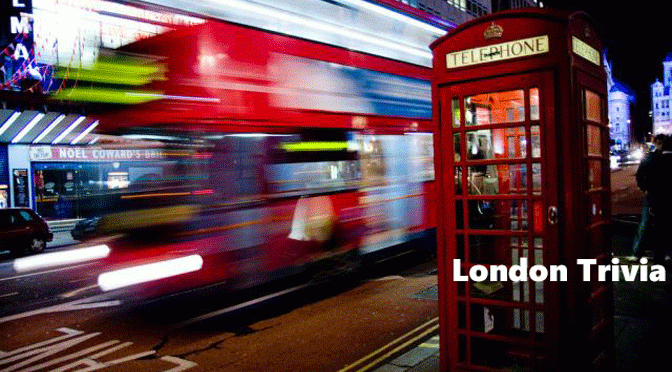
London Trivia: First professional footballers

On 20 July 1885 at the Anderson’s Hotel, Fleet Street, members of the Football Association accepted a report that stipulated that a footballer who received any remuneration or payment for expenses would have to be termed as a professional.

On 20 July 2014 Shepperton Swan Sanctuary rescued 4 pairs of Canada geese and their offspring from the carriageway at J11 of the M25

The Bishop of Rochester’s cook was boiled alive at Smithfield after poisoning fellow cooks. Boiling was struck off the Statute Book in 1548

The clock known by many as Big Ben completed in 1854 its original 2.5-ton hands had to be remade lighter as the mechanism couldn’t turn them

London’s 1845 International Exhibition saw the world’s first plastic using nitro-cellulose – the product failed as it tended to explode

Sadly for the UK’s richest city, London has the highest proportion of people living below the poverty line than anywhere else in the country

On New Year’s Eve 1853 a dinner was held inside the stomach of a iguanodon being constructed for Dinosaur Park at Crystal Palace

The Savoy was the first hotel with electric lifts known at the time as ascending rooms – it boasted en-suite rooms with hot and cold water

In 2014 the London Playing Fields Foundation reported that 20 per cent of London’s football pitches had been lost over 20 years

During rush hour motor vehicles average speed is 7mph while cyclists maintain 13mph – 15 per cent of Londoners spend over 2 hours commuting each day

Eurostar’s departure lounge has columns that are 3 beer barrels apart as the building was once where beer in transit was stored

Barnet Hill, the hill outside High Barnet Tube station is the one the Grand Old Duke of York marched his men up and down

CabbieBlog-cab.gifTrivial Matter: London in 140 characters is taken from the daily Twitter feed @cabbieblog.
A guide to the symbols used here and source material can be found on the Trivial Matter page.


Previously Posted: Hungry and homeless

For those new to CabbieBlog or readers who are slightly forgetful, on Saturdays I’m republishing posts, many going back over a decade. Some will still be very relevant while others have become dated over time. Just think of this post as your weekend paper supplement.

Hungry and homeless (11.07.12)

When I did The Knowledge some years ago much of the time learning was spent on my bike in the evening.

It wasn’t long before I realised that there were hundreds of homeless people sleeping rough in London.

At night all over London, there are dozens of charities providing at least one got a meal to those unfortunate enough to not have a roof over their heads. In fact, in Lincoln’s Inn Fields I have seen the queue for hot meals multiply by 10 times over the last 15 years.

So it is always reassuring to discover any new benefactors for our homeless.

But the Rector of a church in Mayfair has come up with an innovative solution which also benefits the cab trade.
St. George’s Church in Hanover Square has for many years given out small amounts of money to the homeless who sleep under the church’s portico at night.

As in many parts of London, the number of rough sleepers and other disadvantaged people has been increasing, and often this money is spent on alcohol or drugs, rather than on food and drink.

The green Cabman’s shelter close by has had difficulties of late obscured as it is by the hoarding for ongoing construction work for Crossrail.

The solution has been that the Vestry has now started to issue “refreshment coupons” valued at £2 each, (facsimile above), which may be exchanged for food and drink at the shelter.

The proprietor of the shelter is given funds in advance, and she accepts the coupons in lieu of payment for the excellent value meals she sells.

Anyone who wishes to purchase refreshment coupons to give out themselves to local homeless and disadvantaged people on the street, (rather than giving out money directly) may do so by contacting St. George’s Church.

I, for one, think this an excellent initiative by the church and if anyone is passing this beautiful Georgian church they should take a look around.

London in Quotations: Count William Combe

High Lords, deep Statesmen, / Duchesses, and Whores, / All ranks and stations, Publicans and Peers, / Grooms, Lawyers, / Fiddlers, Bawds, and Auctioneers; / Prudes and Coquettes, the Ugly and the Fair, / The Pert, the Prim, the Dull, the Debonair; / The Weak, the Strong, the Humble and the Proud, / All help’d to form the motley, mingled Crowd.

Count William Combe (1741-1823)

London Trivia: Suffragette found hiding

On 13 July 1911, schoolteacher and suffragette Emily Wilding Davidson was found hiding in the crypt at the Houses of Parliament, this enabled her to declare that her place of abode was the Palace of Westminister in this day’s census. She would later die from injuries sustained after being hit by the King’s horse during the 1913 Derby.

On 13 July 1955 at 9:01am at Holloway HMP Ruth Ellis was the last woman to hanged in Britain, the hanging delayed a minute after a hoax call

In Clink Street is the prison of the same name derived from the French “clenche” meaning catch outside of the door as opposed to the inside

The height of the Monument measures the same as the distance from its base to the place where The Great Fire of London was started

Statistically for some undefined reason would-be suicides prefer to meet their maker from underground stations than from one open to the sky

House near Globe Theatre claims Catherine, Henry VIII’s first Queen sheltered on her first landing in London and Christopher Wren lived there

Senate House on Malet Street in Bloomsbury was George Orwell’s model for the Ministry of Truth in his book 1984

The Guinea Grill in Bruton Street sells over 25,000 steak and kidney pies a year in 2000 it was officially declared Steak Pie of the Century

The home of cricket, Kennington Oval’s distinctive shape was dictated by the layout of the surrounding streets rather than the other way round

In 1928 Hyde Park Corner had more through traffic than any place in the world by 1998 Vauxhall Cross was declared Europe’s busiest junction

Beneath government buildings is a secret wartime complex between Great George Street and King Charles Street are 200 underground offices

Silver Vaults London’s oldest safe deposit assures confidentiality but when flooded one held a pair of knickers labelled “My Life’s Undoing”

CabbieBlog-cab.gifTrivial Matter: London in 140 characters is taken from the daily Twitter feed @cabbieblog.
A guide to the symbols used here and source material can be found on the Trivial Matter page.

Previously Posted: Old cabs never die…

For those new to CabbieBlog or readers who are slightly forgetful, on Saturdays I’m republishing posts, many going back over a decade. Some will still be very relevant while others have become dated over time. Just think of this post as your weekend paper supplement.

Old cabs never die . . . (03.07.12)

A few days ago I was contacted by a retired London cabbie to tell me to his obvious delight that his 54-year-old cab he had bought new was still alive and kicking.

The vehicle had somehow found its way across the Atlantic to a car dealer in Cape Cod rejoicing in the name ‘The Cape Crusader’ who had recently had the cab shipped halfway round the world to his customer in Australia. Old cabs never die; they just turn off their meters.

Then at the weekend one of London’s first cabs was auctioned for a staggering £22,000. The vehicle featured last week on the Radio Taxis website was a 1910 Panhard Levassor, one of only 674 cabs sent to England from France to become the nucleus for London’s early motorised taxi service, which slowly replaced the horse-drawn Hansom carriage.

The vehicle was believed to have worked as a London cab until 1921 when it was used for commercial transport, resurfacing again appearing in the 1955 movie ‘The Man who loved Redheads’ starring Moira Shearer.

It was later bought by a founding member of the Historic Commercial Vehicle Club who among its members included Lord Montague of Beaulieu.

The vehicle had been left in a barn for 15 years before the current owners contacted Wotton Auction Rooms in Gloucester at which time a regular contributor to the BBC Antiques Roadshow Philip Taubenheim became involved.
The winning bidder intends to restore this very rare example of an early cab which still has its meter and many original features to its former glory.