Coronation Streets

It is nearly 70 years since we have had a coronation, so naturally, I started looking up roads named after that ceremony.

My 1936 copy of Phyllis Pearsall’s Geographers’ A-Z Street Atlas only shows two ‘coronations’:
Coronation Road E13
Coronation Road NW10

But hold on a minute, haven’t there been dozens of coronations since the start of roads being named in the 6th century and the 1936 coronation? But here in London, there are only two.

Next turning to a modern road atlas I find the originals plus five new ones:
Coronation Avenue N16
Coronation Close, Bexley DA5
Coronation Close, Ilford IG6
Coronation Road E13
Coronation Road NW10
Coronation Road, Hayes UB3
Coronation Walk, Twickenham TW2

But how many coronations have taken place in the intervening period which would promote the naming or re-naming of a London street?

Precisely two, the late Queen in 1953 and her father King George VI in 1937.

With the increase of Republican support, what national event has taken place in the last 86 years to inspire local authorities to give their thoroughfares a regal connotation?

In a word television.

Since 1960 the world’s longest-running television soap, Coronation Street, has appeared on our television screens, but not one local authority has grasped the nettle and given the moniker Coronation Street, otherwise Bill Roach might turn up.

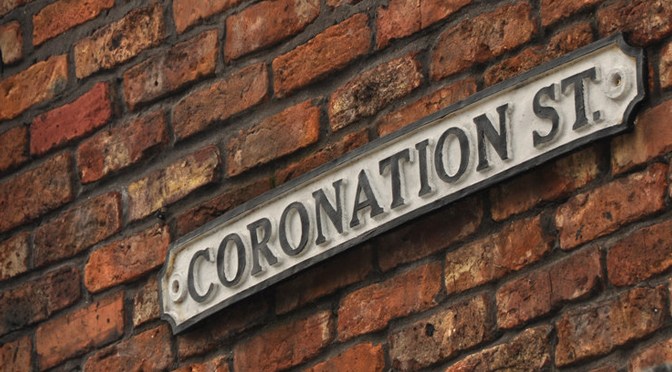
Featured image: Manchester: Coronation Street Sign. The sign on the corner of the road says we are on Coronation Street by Lewis Clarke (CC BY-SA 2.0).
London in Quotations: Horace Walpole

Would you know why I like London so Much? Why if the world must consist of so many fools as it does, I choose to take them in the gross, and not made into separate pills, as they are prepared in the country.

Horace Walpole (1717-1797)

London Trivia: For valour

On 23 April 1390 (St. George’s Day) a joust was held between Lord Welles, Ambassador to Scotland, and Sir David de Lindsay, a Scot, on London Bridge. This was a result of an argument as to the valour of the two nations. On the third run Lindsay unhorsed Welles so easily that the crowd began yelling that he had nailed himself to his saddle. To prove he had not, Lindsay jumped off his horse and then back on, while still wearing his full suit of armour.

On 23 April 1702 gout ridden Queen Anne became the first monarch to be carried to her coronation and wore a £12 wig to improve her demeanour

Reggie Kray and Frances Shea’s photographer at their wedding at St James the Great, Bethnal Green Road in April 1965 was David Bailey

Dr Samuel Johnson once owned 17 properties in London, only one of which survives – Dr Johnson’s Memorial House in Gough Square

18th century Hampstead was a spa resort where people came to take the waters which reputedly had health giving properties

In April 1905 Vladimir Lenin lived at 16 Percy Circus, since demolished and replaced with the rear of Kings Cross Royal Scot Travelodge hotel

Actor, dancer, comedian and clown Joseph Grimaldi lived at 56 Exmouth Market, Islington from 1818 to 1828, there is now a park off Pentonville Road named after him

Coram’s Fields park and playground in Bloomsbury is unique in that adults are only allowed to enter if accompanied by a child

The sport of golf, which originated in Scotland, was first played in England on Blackheath in 1608. The Royal Blackheath Golf Club was one of the first golf associations established (1766) outside Scotland

London’s heavily congested streets mean that a taxi’s average speed of 17mph is slower than that attained by Hansom cabs over 100 years ago

The ‘porter’ style of beer was officially invented at the Bell Brewhouse in Shoreditch by Ralph Hardwood in 1722

Marc Isambard Brunel came up with his idea on how to dig the Thames’ Tunnel whilst in debtors’ prison watching a shipworm bore through wood

CabbieBlog-cab.gifTrivial Matter: London in 140 characters is taken from the daily Twitter feed @cabbieblog.
A guide to the symbols used here and source material can be found on the Trivial Matter page.

Previously Posted: Just the ticket

For those new to CabbieBlog or readers who are slightly forgetful, on Saturdays I’m republishing posts, many going back over a decade. Some will still be very relevant while others have become dated over time. Just think of this post as your weekend paper supplement.

Just the ticket (12.03.2010)

Like any petty crook, London Councils traffic enforcement departments don’t miss a trick for turning over the law-abiding public. Their latest wheezes have a touch of inspired genius in their simplicity.

Not content with waiting by a vehicle whose allocated time is about to expire so a penalty notice can be imposed at the first opportunity, or penalising a disabled driver for displaying their badge with the wrong orientation, they have gone one further.

They have trawled through their by-laws to find a legal loophole to penalise motorists who have paid but simply forgot to remove a previous stub from their dashboard or window.
For if after your allotted time has expired and the driver leaves the spent ticket displayed they can be penalised, for if a busy mother should drive off with the offending ticket in full view either on her windscreen or on the dashboard the Traffic Taliban can charge for that offence.

Prior to that of course the ticket had to be displayed in an “appropriate” place as designated by the parking authority, failure to so do . . . well you know the score.

And don’t forget your vehicle must be positioned parallel to the kerb (God forbid that it is found to be at an acute angle of 10°), and must not be more than 19.6in from the kerb. Presumably those guardians of traffic enforcement, whose total revenue last year was £328million, carry the appropriate measuring equipment on their person to make a judgment.

Now two councils have joined to perpetrate an even more audacious crime, this loose association of the Notting Hill Cosa Nostra has split Ledbury Road down the middle, with each protecting their own “manor”, one side falls within Westminster’s authority while the other side is The Royal Borough of Kensington & Chelsea.

If you park your vehicle on the east side of the street but cross the road to buy a parking ticket on the opposite pavement, the ticket you buy will not be valid for parking on the opposite kerb, you will have contravened Westminster parking regulations, as Harvey Cass found when returning to his car to find penalty notice on his windscreen. So little time had elapsed between buying the ticket and having the penalty notice issued the traffic warden must have watched him cross the road and buy his ticket incorrectly from Kensington & Chelsea’s machine.

Westminster’s spokesman, a Mr Kevin Goad (a man whose name could not be more appropriate in the circumstances) said “We are working hard to improve motorists’ understanding of the rules and provide clearer signs and lines.”

So there you have it, its not old-fashioned greed to line the council’s coffers, quite the contrary, we motorists have to be educated in the “rules”.

Bridges of Sighs

If as a cabbie, a group of tourists ask to be taken to ‘Old London Town’, you could do a lot worst than by crossing London’s ancient bridges.

To start take them to Richmond Bridge opened months after America gained its independence (1777); then show them how those industrious Victorians constructed most of London’s bridges: Westminster (1862), Blackfriars (1869), Albert (1873), Hammersmith (1887), Battersea (1890), Tower (1894).

Post-Victoria far fewer bridges have been constructed, with only one road bridge since World War II: Kew (1903), Vauxhall (1906), Southwark (1921), Lambeth (1932), Chiswick (1933), Twickenham (1933), Chelsea (1937), Wandsworth (1940), Waterloo (1945), London (1973).

The bridges’ condition is so poor, the London Assembly’s Transport Committee produced a report which was launched with the rather punchy headline: London’s ageing river crossings – an international embarrassment.

We still have Hammersmith Bridge’s debacle, which saw the bridge closed to motorists in April 2019 after cracks were found in the cast iron pedestals, the bridge was then completely closed. Now reopened for pedestrians and cyclists while ‘stabilisation work’ going on.

One of the big problems with maintaining all these ageing structures is that no one is responsible for them. London Bridge is owned and maintained by Bridge House Estates, Transport for London is the one responsible for the road, then one end is in the City, while the other end is in Southwark.

One of the recommendations of the report is to set up a central ‘kitty’ into which ‘all the relevant asset owners would contribute’.

This is needed because the report warns that ‘Twickenham, Kew, Battersea and Lambeth may need extensive interventions within 10 years’ and the estimated cost of the maintenance work that‘s needed to deal with just the existing issues is coming in at around £241 million.

As Mayor Khan is planning to remove thousands of vehicles from London’s roads, closing bridges for repair should not present a problem.

Featured image by Philip Halling (CC BY-SA 2.0) London Bridge: The present London Bridge opened in March 1973 and was designed by Mott, Hay and Anderson. In medieval times the then London Bridge stood slightly upstream from the site of the present bridge, this old bridge had buildings on it and was also the place where the heads of those executed would be placed on a spike.